
Democracy in Tibetan Exile Community Turns 48
Tuesday, 2 September 2008, 5:26 p.m.
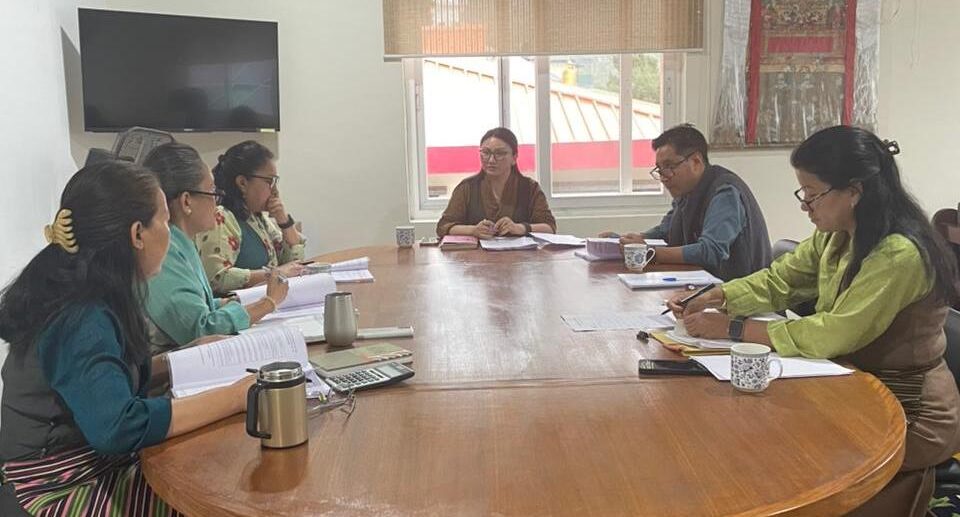
 observe the 48th Tibetan Democracy Day at a function organised at Tsuglagkhang, main temple, in Dharamshala, India, on 2 September 2008. |
Dharamshala: Marking the
occasion of 48th Tibetan Democracy Day, the Kashag of the Central
Tibetan Administration, underlined that the “Tibetan people living in
free world should work towards cultivating a culture of openness,
freedom and transparency and they should give more importance to their
democratic duties than rights.”
 officials of the Central Tibetan Administration, including chief justice commissioner, justice commissioners, speaker, deputy speaker and members of the Kashag at the 48th Tibetan Democracy Day celebration. |
On 2 September 1960, a 13-member Assembly of Tibetan People’s Deputies
(then the Commission of Tibetan People’s Deputies), with
representatives from the four Tibetan Buddhist traditions and three
provinces (and later from Bon), took office for the first time – the
day since marked as the Democracy Day.
“The Tibetans should give more importance to the national and
community’s benefits than individual’s and organisation’s and strive
towards combining their collective energies in order to challenge the
forces of division,” said acting Kalon Tripa Ven Tsering Phuntsok while
addressing a gathering of Tibetans at the Tsuglagkhang, main temple, on
Tuesday morning.
He said: “On this special occasion of the 48th anniversary of
His Holiness the Dalai Lama’s extraordinary efforts to transform the
Tibetan polity into a genuine democracy, the Kashag – as a way of
expressing its immense gratitude to His Holiness – makes obeisance to
him.”
 |
The acting kalon tripa said that “the Chinese autocratic
government’s ultra-leftist policies are responsible for the repression
of basic rights of the Tibetan people, including their political,
social, religious and cultural rights.”
“Therefore, until and unless the nature of the People’s
Republic of China’s polity does not become more open, free and
transparent, it is difficult for China to be able to resolve the
problem of Tibet,” he added.
Encouraging the women to partake in the in the Tibetan
administrative and political work in order to establish a robust
democratic society, he said: “The Kashag will soon come out with a
policy to strengthen women’s power in our society, and we request all
of you to co-operate with us in this regard.”
Paying homage to many heroic Tibetan men and women, who have
sacrificed their precious lives for the sake of Tibetan religion,
culture, national identity and freedom, the Kashag appealed to all
Tibetans to learn from their sacrifices and continue the rightful and
non-violent struggle of the Tibetan people until the issue of Tibet is
resolved once and for all.
 |
Describing the democracy for Tibetans as not a reward of labour,
but a gift bestowed by His Holiness the Dalai Lama, Speaker Karma
Chophel said: “active participation from the Tibetan populace in the
democratic processes, including elections, is the need of the hour.”
Underlining the need for every Tibetan to study and understand
the value of democracy, the speaker said, “One should strive to move
forward in strengthening the Tibetan democratic polity and to remain
vigilant not to indulge in acts on the pretext of democracy, which
would go against the democratic principles.”
Three students who scored top marks in the class XII exams this
year – Ms Ngawang Yangzom with 81 % (Tibetan Homes Foundation,
Mussoorie), Mr Thubten Rigzin with 86.8 % (Commerce/TCV Bylakuppe) and
Ms Sonam Dolkar with 86 % (Arts/TCV Gopalpur) – were also honoured
during the ceremony. In addition to others, the Education Department
also awards a cash prize of Rs. 5,000 to the toppers.