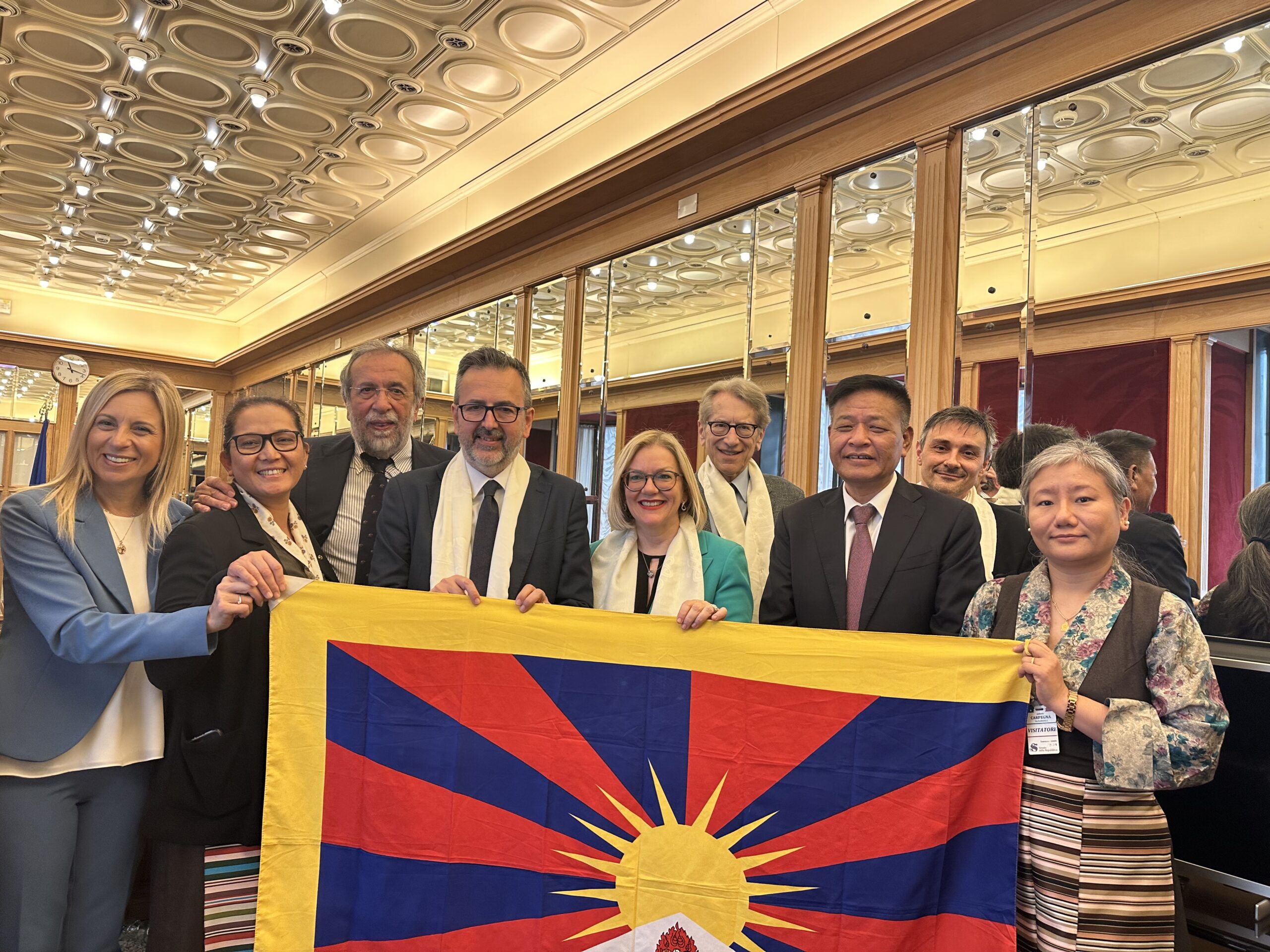
Geneva: Italian parliamentarians, including the chair and vice-chair of the Italy-Tibet Parliamentary Intergroup, have issued video statements condemning China’s new Law on the Promotion of Ethnic Unity, calling it a vehicle for forced cultural assimilation that threatens the survival of Tibetan language, identity, and heritage.
Senator Giulio Terzi, former Italian Foreign Minister, delivered one of the most pointed critiques, rejecting the premise of the law outright. “What kind of unity are we talking about?” Terzi asked. “It is the destructive, homogenising unity of cultural assimilation imposed by the Chinese Communist Party, which conforms everything and flattens everything.” He said the law, by imposing Mandarin as the sole official language at all levels — even for the Tibetan people themselves — points toward the erosion of Tibetan language and identity. Senator Terzi pointed to the boarding school system that has separated an estimated one million Tibetan children, aged four to eighteen, from their parents, as well as the closure of local and private schools in rural areas, leaving families with no alternative. He cited UN High Commissioner for Human Rights Volker Türk’s 15 June call for the law to be repealed and for the related practices “to finally cease,” and noted that the European Parliament, in a resolution last April, urged China to repeal the law and comply with its international obligations on non-discrimination and the protection of ethnic and religious minorities. Invoking the Dalai Lama’s 1959 exile to Dharamshala, Terzi warned against allowing Tibet’s millennia-old culture to now be silenced by law, and described the legislation as “a horrific, direct attack on fundamental human rights and on ethnic minorities” — one compounded, he said, by “the complicit, atrocious silence of international institutions.” He extended his support to the Tibetan people as well as the people of Uyghur regions and southern Mongolia, and to “all minorities and institutions abroad that truly represent the Tibetan people.”
Senator Andrea Di Priamo, Chair of the Italy-Tibet Parliamentary Intergroup, framed the law as part of a broader erosion of human rights, religious freedom, and minority identity. “I express deep concern regarding the so-called Ethnic Unity Law of the People’s Republic of China,” he said, warning that it risks further undermining “the cultural, linguistic, and religious identities of minorities,” particularly the Tibetan people. Senator Di Priamo noted that the European Parliament’s resolution of 30 April 2026, several national parliaments, and United Nations bodies — including the Office of the High Commissioner for Human Rights — have all called for the law’s repeal. He said the legislation, under the guise of ethnic unity, appears aimed at “erasing any remaining identity and autonomy” long sought by the Tibetan people, and reaffirmed his commitment, as Intergroup chair, to defending “human dignity, religious freedom, fundamental rights, and the cultural riches of every people’s identity.”
Parliamentarian Ilenia Malavasi, Vice President of the Italy-Tibet Parliamentary Intergroup, focused on the law’s looming implementation date and its human cost. “On July 1, a new law called the ‘Promotion of National Unity’ will go into effect in China,” she said, warning it would impose Mandarin as the sole official language and result in “the gradual elimination of the Tibetan language and, consequently, of Tibetan culture.” Referencing the roughly one million children sent to residential boarding schools, she said the law marks “yet another attack on Tibet, its history, its traditions, and its autonomy.” Parliamentarian Malavasi described the stakes as going beyond minority rights: “This is not a matter of worrying about a minority; it is a matter of worrying about an existential issue,” she said, calling Tibetan heritage — built on respect, solidarity, non-violence, peace, and inclusion — part of shared human cultural heritage.
Former Senator Roberto Rampi struck a more reflective tone, framing ethnic, linguistic, and cultural pluralism as a national strength rather than a threat. “I want to express my deep concern about the news we’re hearing regarding the new law on promoting ethnic unity that is set to take effect on July 1 in China,” Rampi said. He argued that a country in China’s position, with no need to “engage in power struggles,” should instead “promote linguistic autonomy, promote linguistic diversity, and pay particular attention to a great, millennia-old culture such as Tibetan culture.”
The four statements follow a pattern of mounting international parliamentary criticism of the Ethnic Unity Law, echoing concerns recently raised by Czech lawmakers and a resolution passed by the Czech Senate, as well as findings from UN human rights bodies and the European Parliament. With the law’s 1 July implementation date now imminent, pressure on Beijing from European legislators appears to be intensifying.
“It is deeply encouraging to see parliamentarians across Italy — across party lines and across both houses — speaking with one voice on this law. When Senator Terzi calls this ‘the systematic eradication of the Tibetan language,’ or when Vice President Malavasi calls it an existential threat to a shared human heritage, they are naming exactly what one million Tibetan children separated from their families, their language, and their faith have already lived through. The law takes effect on 1 July 2026. We urge the Italian government, and governments everywhere, to match these words with concrete pressure on Beijing before that date — because once Mandarin is imposed as Tibet’s only official language, the damage will not be easily undone,” Noted Representative Thinlay Chukki.
– Report filed by Office of Tibet, Geneva