
Tibetan delegation address the UN Human Rights Council Friday, 6 June 2008, 10:06 a.m.
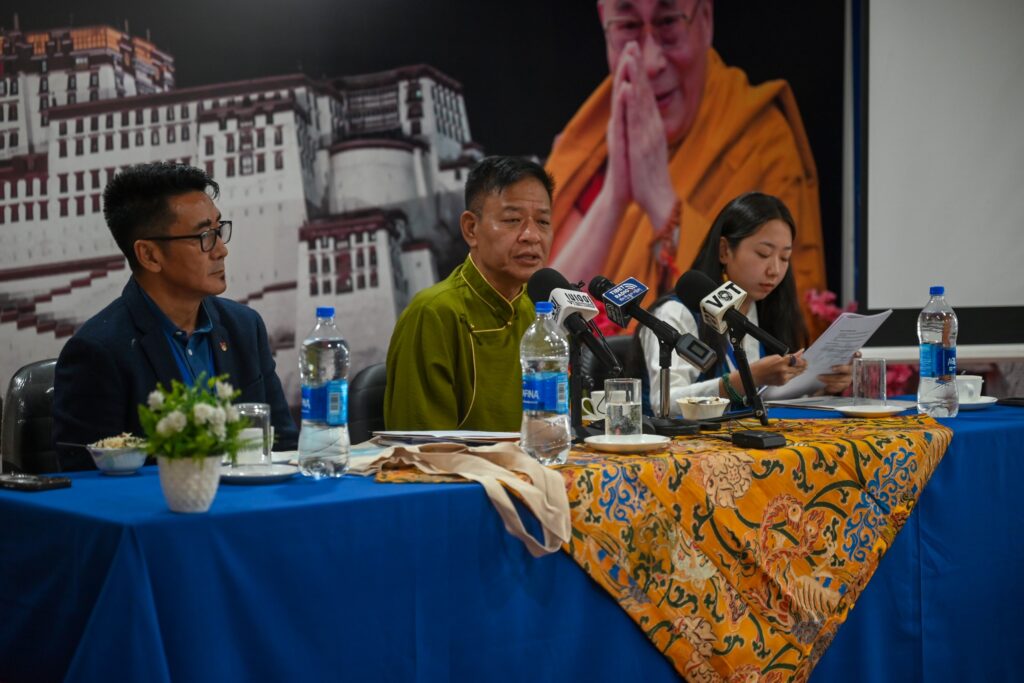
Geneva: A Tibetan delegation comprised of former political prisoners has sought more support from the United Nations’ Special Rapporteur for improving the deteriorating human rights situation in Tibet, since China’s clampdown on peaceful protestors on 10 March.
Below is the full text of oral statements made by Tibetan delegation in the ongoing 8th Session of the UN Human Rights Council in Geneva.
‘Report Of The Special Rapporteur On The Independence Of Judges And Lawyers’
Statement by Society for Threatened People, delivered by Tenzin Samphel Kayta
Mr President,
We totally agree with the special rapporteur on the independence of judges and lawyers that indigenous peoples and other vulnerable groups especially suffer institutionalised forms of criminalisation of their activities, discrimination and miscarriage of justice.
Mr President, in document A/HRC/8/4Add.1 under para 10, the special rapporteur on the situation in China (I quote) “reiterates his concern in relation to the lack of guarantees for lawyers to perform their professional duties without risking prosecution, including of a criminal nature.” (Unquote) We cite this in view of the interference and measures taken with a group of Chinese lawyers for having volunteered to defend Tibetans detained since the 10 March Tibetan uprising.
On 21 May, Ms Woser, a Tibetan writer living in Beijing reported this development on her blog: (I quote) “I met two Beijing lawyers, and they told me that though they are not among the 21 lawyers who sign their names to express that they were willing to provide legal assistance to the Tibetans… they also disclosed that some lawyers who have been implicated do not criticise the government who use their power to interfere legal issues, instead, they complain about these 21 lawyers.” (Unquote)
According to Human Rights Watch, in a second open letter published on 24 May, the 21 lawyers representing 10 law firms, explained the motives behind their offer to defend Tibetans and rejected the view that categorised such offer of legal services with a proof of support for Tibetan separatism ideas (which constitutes a state security crime under Chinese law). The statement said: (I quote) “To provide legal defense to criminal suspects and defendants is the function of a lawyer. It is an important component of the rule of law, and to defend them is not equivalent to agreeing to their position or actions … We could not imagine that issuing this appeal would result in such tremendous pressure and impact the yearly renewal of professional licenses.” (Unquote)
Mr President, Wen Haibo, a lawyer with the Yitong law firm in Beijing, was one of the Chinese lawyers who signed the statement. In an interview with Epoch Times on 4 April, Wen said: “We believe Tibetans may encounter greater cultural and legal difficulties. With these considerations in my mind, I feel, as a lawyer, I have the obligation to provide some free legal assistance to them.” The Beijing Judicial Bureau has to date refused to renew the professional licenses of Teng Biao and and Jiang Tianyong, two lawyers with distinguished records of defending civil and human rights cases. The deadline for renewal was 31 May.
The special rapporteur stated that he would welcome further information from the Government of China that “demonstrates that lawyers are able to freely conduct their work”. Today thousands of Tibetans detained since 10 March are languishing in overcrowded prisons all over the Tibetan plateau without any legal protection and representations. Therefore, we wish to know how the special rapporteur is monitoring this alarming situation?
I thank you.
2 June 2008
‘Report Of Special Rapporteur On Extrajudicial Or Summary Executions’
Oral Statement by France Libertes, delivered by Stewart Watters
 Stewart Watters, International Campaign for Tibet Europe’s Government Relations director delivers an Oral Statement at the plenary of the UN Human Rights Council in Geneva, June 2008/Photo:ICT Stewart Watters, International Campaign for Tibet Europe’s Government Relations director delivers an Oral Statement at the plenary of the UN Human Rights Council in Geneva, June 2008/Photo:ICT |
Mr President
While fully acknowledging Mr Alston’s report, we remain concerned by situations where, as a result of repressive government policies, there is a total absence of independent monitors, human rights defender and/or independent civil society organisations. We are concerned by the extent to which such conditions enable acts of impunity by authoritarian regimes and that the ability of Inquiry Commissions to bring the perpetrators to justice is highly unlikely to be realised.
With regard to the 30 September 2006 killing of at least one Tibetan minor, a nun aged 17, by Chinese security forces at the Nangpa Pass on the Nepal border, the special rapporteur requested the Chinese authorities “to make sure that there is full public accountability for the actions of the State and of its border military patrols by ensuring that the result of your official investigation be made public.” We, therefore, wish to know what specific response the special rapporteur received from the Chinese authorities.
Mr President, we raise this question due to further deterioration of the human rights situation on the Tibetan plateau with more than 200 Tibetans reported killed by Chinese security forces in the harsh military crackdown to suppress the predominantly peaceful protests over the past two months. According to one report, on 28 March more than 80 bodies were burnt together at an electrical crematorium in one country under Lhasa municipality. Other individuals report army trucks leaving Lhasa carrying scores of dead bodies.
The International Campaign for Tibet reports that Kirti Monastery in Sichaun Province has been surrounded by Chinese security forces since 16 March and the local community has not been allowed access after large public demonstrations were held there that resulted in mass detentions and the deaths of at least 10 Tibetans, including monks and three high school students. Images of those killed were broadcast by news media around the world. On 3 April, government troops fired upon protestors from Tongkor(Chinese: Donggu) monastery 60 kilometers from Kardze (Chinese: Ganzi) town, killing at least ten to 15 people, 3 of whom were monks, 6 were women and one was a child. We have reports of people being arrested, severely beaten and tortured, then being hastily released to their family to die at home from their injuries, out of police custody. On 28 May in Kardze (Chinese: Ganzi) county of Sichuan Province, the Tibetan Center for Human Rights and Democracy reports that security forces opened fire on a female Tibetan student staging a peaceful and solitary protest – she was later seen wounded and being dragged by security forces – we do not know her condition at this time.
These shocking reports have emerged at great individual risk from a Tibet under complete lockdown, with foreign NGOs under tight restrictions. Foreign diplomats, NGOs, media and tourists are still not allowed to travel freely to Tibet. In the absence of such independent monitors, what interventions has the special rapporteur undertaken with China, to seek clarifications on these reports of Tibetan deaths?
I thank you, Mr President
2 June 2008
‘Promotion And Protection Of All Human Rights, Including Right To Development’
Statement by France Libertes – Fondation Danielle Mitterland, delivered by Ms Phuntsog Nyidron Sanaschiga
 Phuntsog Nyidron, a Tibetan Buddhist nun, spent more than 12 years in prison for staging peaceful demonstration in Lhasa on 14 October 1989 Phuntsog Nyidron, a Tibetan Buddhist nun, spent more than 12 years in prison for staging peaceful demonstration in Lhasa on 14 October 1989 |
Mr President,
I am reading this statement for Ms Sanaschiga the Council was not able to accept the delivery of her statement in Tibetan language despite the past practice of the Commission.
I am speaking today before the Council as a former Tibetan political prisoner and my name is Phuntsog Nyidron. As I testified before the Sub-Commission of Human Rights in August 2006, I was imprisoned for 15 years.
Mr President, while learning about the Council’s work, I welcome that it attaches great importance on the subject of violence against women and human rights of women. But I am also told the UN human rights mechanisms are sometimes ignoring the issue when violence is motivated by a state policy. If this is true, it is a very sad focus of your debates. I say this because when a State targets a woman through violence, especially a political prisoner, it should be recognised as a crime to eliminate the human dignity of the person!
I have a responsibility to raise this notion from the experience of own physical trauma due to routine torture inflicted upon me and my colleagues were in the squalid prisons. You will understand that this trauma will remain within me for the rest of my life. For instance, with impunity security agents beat us like punching bags, tortured our naked bodies with electric cattle-prods and killed our colleagues through such inhuman methods. In some cases, trained dogs were set free to attack our naked bodies!
Mr President, Tibetan women, especially nuns have taken a prominent role in the Tibetan Uprising today again face State-violence. Therefore, I believe the realities of such engineered violence against women should be noted if the Council wishes to take a holistic approach to the subject.
I thank you, Mr President
‘Promotion And Protection Of All Human Rights’
Oral statement by Takna Jigme Sangpo on behalf of Society for Threatened Peoples
 Takna Jigme Sangpo, Tibet’s longest serving political prisoner addressed the 8th session of the Human Rights Council on Wednesday, 4 June 2008 Takna Jigme Sangpo, Tibet’s longest serving political prisoner addressed the 8th session of the Human Rights Council on Wednesday, 4 June 2008 |
Mr President,
I am reading this statement for the gentleman next to me as the Council was able to accept the delivery of his statement in Tibetan language despite the past practice of the commission.
Mr President, my name is Takna Jigme Sangpo, aged 80. I am a Tibetan who was denied of dignity and justice for more than three decades in prison out of a total sentence of 41 years.
Mr President, at this session an important recommendation came from the special rapporteur on executions that the Council “should give urgent consideration to the appointment of a Special Rapporteur on the rights of detainees.” We fully support this recommendation. Such a new mandate will help reveal of the depth of the problem faced by detainees around the world. From my personal experience, let me give you some examples of what detainees, especially political prisoners go through.
–interrogation sessions that make an uninhibited use of beating and torture –women prisoners, especially nuns will be abused with electric cattle-prods –summary executions and custodial deaths –solitary confinements –deprivation of medicine, sleep and food –indoctrination sessions on political ideology –military style drills to physically exhaust you –lectures defaming your spiritual leaders –denial of religious practices –denial of family contacts –denial of legal representations –humiliation to break your will as human being –hard labour quotas to accomplished –faked confessions of guilt resulting in harsh prison sentences
Mr President and distinguished members of the council, this old man from the land of snows urges to live up to your responsilities by ensuring an independent assessment of the human rights crisis confronted by the Tibetan people today.
I conclude by praying for the end of the suffering of all the detainees in this world.
I thank you.