
Chinese views on Tibet: Tibet – Her Pain, My Shame
————————-
by Tang Donhang
————————-
Monday, 2 June 2008, 12:05 p.m.
For more than a decade, I have
frequently entered Tibet and often stayed there for a long time,
traveling or working. I have met all kinds of Tibetans, from youngsters
on the streets, folk artists, herders on the grasslands, mystic doctors
in mountain villages, to ordinary cadres in state agencies, street
vendors in Lhasa, monks and cleaners in monasteries, artists and
writers…Among those Tibetans I have met, some frankly told me that
Tibet was a small country several decades ago, with its own government,
religious leader, currency and military; some stay silent, with a sense
of helplessness, and avoid talking with me, a Han Chinese, afraid this
is an awkward subject. Some think that no matter what happened, it is
an historical fact that Chinese and Tibetans had a long history of
exchanges with each other, and the relationship must be carefully
maintained by both sides. Some were angered by the railway project, and
by those roads named “Beijing Road,” “Jiangsu Road,” “Sichuan-Tibet
road,” but others accept them happily. Some say that you (Han Chinese)
invest millions in Tibet but you also got what you wanted and even
more; some say you invest in the development but you also destroy, and
what you destroy is exactly what we treasure…What I want to say here
is that no matter how different these people are, they have one thing
in common: They have their own view of history, and a profound
religious belief.
For anyone who has been to Tibet, he/she should sense such a
religious belief among Tibetans. As the matter of fact, many are
shocked by it. Such attitude has carried on throughout their history,
and is expressed in their daily lives. This is a very different value,
especially compared with those Han Chinese who have no beliefs, and now
worship the cult of money. This religious belief is what Tibetans care
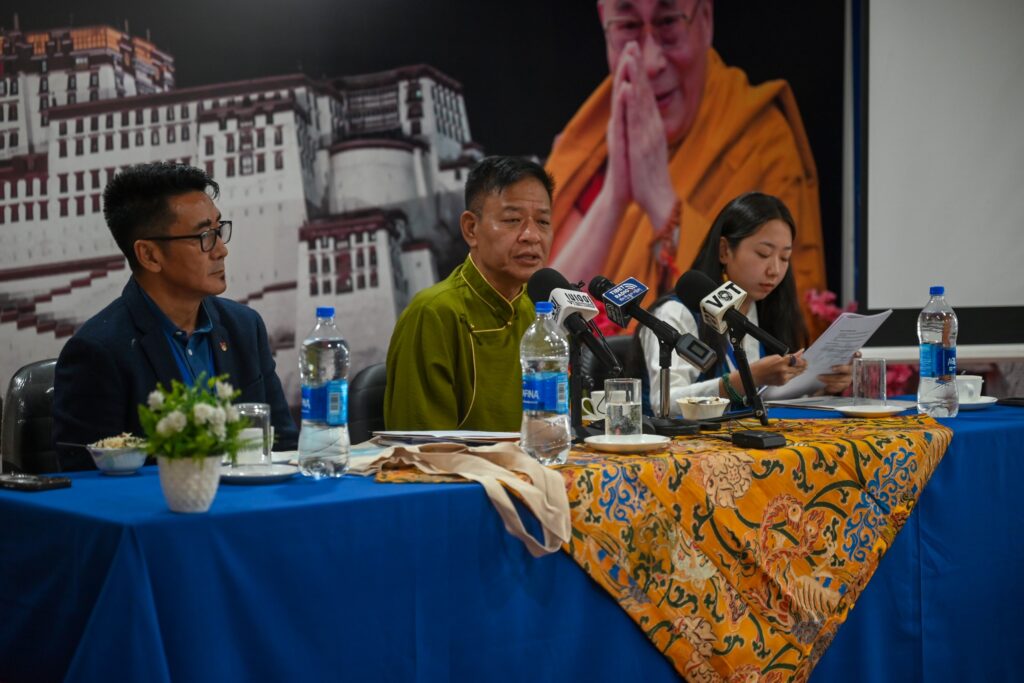
about the most. They project this belief onto the Dalai Lama as a
religious persona.
For anyone who has been to Tibet, it should not be strange to
see the “common Tibetan scene”: Is there any Tibetan who does not
worship him (the Dalai Lama)? Is there any Tibetan unwilling to hang up
his photo in his own shrine? (These photos are smuggled back in from
abroad, secretly copied and enlarged, not like those Mao portraits
printed by the government that we Han Chinese once had to hang up.) Is
there any Tibetan who wants to verbally disrespect the Dalai Lama? Is
there a Tibetan who does not want to see him? Is there any Tibetan who
does not want to present Khatak [white welcoming scarf] to him?
Other than those voices that the rulers want to hear, have we
ever heard the Tibetans’ full, real voices? Those Han Chinese who have
been in Tibet, now matter if one is a high official, government cadre,
tourist or businessman, have we all heard their real voices, which are
silenced, but are still echoing everywhere?
Is this the real reason that all monasteries in Tibet are
forbidden from hanging up the Dalai Lama’s picture? Is this the reason
that all work units have officials to check in every household and to
punish those who hang up his picture? Is this the reason that the
government has people to stop those believers on the pilgrimage path on
every religious celebration day? Is this the reason for the policy
barring government employees from having their children study in
Dharamsala; otherwise, they will be fired and their house will be taken
away? Is this the reason that at all sensitive times, government
officials will hold meetings in monasteries, to force monks to promise
to “support the Party’s leadership” and “Have no relations with the
Dalai splitist cliques”? Is this the reason we refuse to negotiate, and
constantly use dehumanizing language to humiliate him? After all, isn’t
this the very reason to reinforce the “common Tibetan scene,” making
this symbol of nationality more holy?…
Why can’t we sit down with the Dalai Lama who has abandoned
calls for “independence” and now advocates a “middle way,” and
negotiate with him with sincerity, to achieve “stability” and “unity”
through him?
Because the power difference of the two sides is too big. We are too
many people, too powerful: Other than guns and money, and cultural
destruction and spiritual rape, we do not know other ways to achieve
“harmony.”
This group of people who believe in Buddhism because they
believe in cause and effect and transmigration of souls, oppose anger
and hatred, developed a philosophy that Han nationalists will never be
able to understand. Several Tibetan monk friends, just the
“troublemaker monk” type that are in the monasteries explained to me
their view on “independence”: “actually, we may well have been ethnic
Han in a previous incarnation, and in our next incarnation we might
well become ethnic Han. And some ethnic Han in a previous life may well
have been Tibetan or may become Tibetan in their next life. Foreigners
or Chinese, men or women, lovers aand enemies, the souls of the world
transmigrate without end. As the wheel turns, states arise and die, so
what need is there for independence?” This kind of religion, this kind
of believer, can one ever think that they would be easy to control? Yet
there is a paradox here: if one wants them to give up the desire for
independence, then one must respect and protect their religion.
Not long ago, I read some posts by some radical Tibetans on an
online forum about Tibet. These posts were roughly saying: “We do not
believe in Buddhism, we do not believe in karma. But we have not
forgotten that we are Tibetan. We have not forgotten our homeland. Now
we believe the philosophy of you Han Chinese: Power comes out of the
barrel of a gun! Why did you Han Chinese come to Tibet? Tibet belongs
to Tibetans. Get out of Tibet!”
Of course behind those posts, there are an overwhelming number
of posts from Han ” patriots.” Almost without exception, those replies
are full of words such as “Kill them!” “Wipe them out!” “Wash them with
blood!” “Dalai is a liar!” – those “passions” of the worshippers of
violence that we are all so familiar with.
When I read these posts, I feel so sad. So this is karma.
In the last week, after I put down the phone which cannot reach
anyone on the the other end, when I face the information black hole
caused by internet blockage, even I believe what Xinhua has said –
strangely I do believe this part: There were Tibetans who set fire to
shops and killed those poor innocent Han Chinese who were just there to
make a living. And I still feel extremely sad. Since when were such
seeds planted? During the gunshots of 1959? During the massive
destruction during the Cultural Revolution? During the crackdown in
1989? During the time we put their Panchen Lama under house arrest and
replaced him with our own puppet? During those countless political
meetings and confessions in the monasteries? Or during the time when a
seventeen-year-old nun was shot on the magnificent snowy mountain, just
because she wanted to see the Dalai Lama?…..
Or during numerous moments which seem trivial but which make me
ashamed: I was ashamed when I saw Tibetans buy live fish from Han fish
sellers on the street and put them back in the Lhasa river; I was
ashamed when I saw more and more Han beggars on the streets of
Lhasa-even beggars know it is easier to beg in Tibet than in Han areas;
I felt ashamed when I saw those ugly scars from mines on the sacred
mountains in the morning sunlight; I felt ashamed when I heard the Han
Chinese elite complain that the Chinese government has invested so many
millions of yuan, that economic policy favors Tibetans, and that the
GDP has grown so fast, so, “What else do these Tibetans want?”
Why can’t you understand that people have different values?
While you believe in brainwashing, the power of a gun and of money,
there is a spiritual belief that has been in their minds for thousands
of years and cannot be washed away. When you claim yourselves as
“saviors of Tibetans from slavery society,” I am ashamed for your
arrogance and your delusions. When military police with their guns pass
by me in the streets of Lhasa, and each time I am there I can see row
upon row of military bases… yes, I, a Han Chinese, feel ashamed.
What makes me feel most ashamed is the “patriotic majority”:
You people are the decedents of Qinshi Huangdi who knows only
conquering by killing; you are the chauvinists who rule the weak by
force; you are those cowards who hide behind guns and call for shooting
the victims; you suffer from Stockholm Syndrome; you are the
blood-thirsty crazies of an “advanced” culture of Slow slicing and
Castration. You are the sick minds waving the “patriotic” flag. I look
down on you. If you are Han Chinese, I am ashamed to be one of you.
Lhasa is on fire, and there are gunshots in Tibetan areas in
Sichuan and Qinghai. Even I believe this- actually, I do believe this
part of the facts. In those “patriotic” posts which shout “Kill them!”
“Wipe them out!” “Wash them with blood!” “Dalai is a liar!” I saw the
mirror image of those Tibetan radicals. Let me say that you people
(“patriotic youth”) are Han chauvinists who destroy thousands of years
of friendship between Han and Tibetan people; you are the main
contributors to the hatred between ethnic groups. You people do not
really “highly support” the authority; rather, you people are in effect
“highly supporting” “Tibetan independence.”
Tibet is disappearing. The spirit which makes her beautiful and
peaceful is disappearing. She is becoming us, becoming what she does
not want to become. What other choice does she have when facing the
anxiety of being alienated? To hold onto her tradition and culture, and
revive her ancient civilization? Or to commit suicidal acts which will
only add to Han nationalists’ bloody, shameful glory?
Yes, I love Tibet. I am a Han Chinese who loves Tibet,
regardless of whether she is a nation or a province, as long as she is
so voluntarily. Personally, I would like to have them (Tibetans) belong
to the same big family with me. I embrace relationships which come
self-selected and on equal footing, not controlled or forced, both
between peoples and nations. I have no interest in feeling “powerful,”
to make others fear you and be forced to obey you, both between people
and between nations, because what’s behind such a “feeling” is truly
disgusting. I have left her (Tibet) several years ago, and missing her
has become part of my daily life. I long to go back to Tibet, as a
welcomed Han Chinese, to enjoy a real friendship as equal neighbor or a
family member.
| (This article was posted on 28 April 2008 in chinadigitaltimes.www.chinadigitaltimes.net Tang Donhang, (born in 1965) is a poet and documentary filmmaker from Chengdu, Sichuan. She has made several documentaries in and about Tibet since the 1990s. She has published the above article on her own blog (hosted outside of China), partially translated by CDT. The writer was moved to Israel from Chengdu in 2005, and is currently teaching Chinese language at Tel Aviv University. The views expressed in this column are those of the writer, not necessarily those of the Central Tibetan Administration) |