Manhae Peace Award Fills My People With Hope: His Holiness
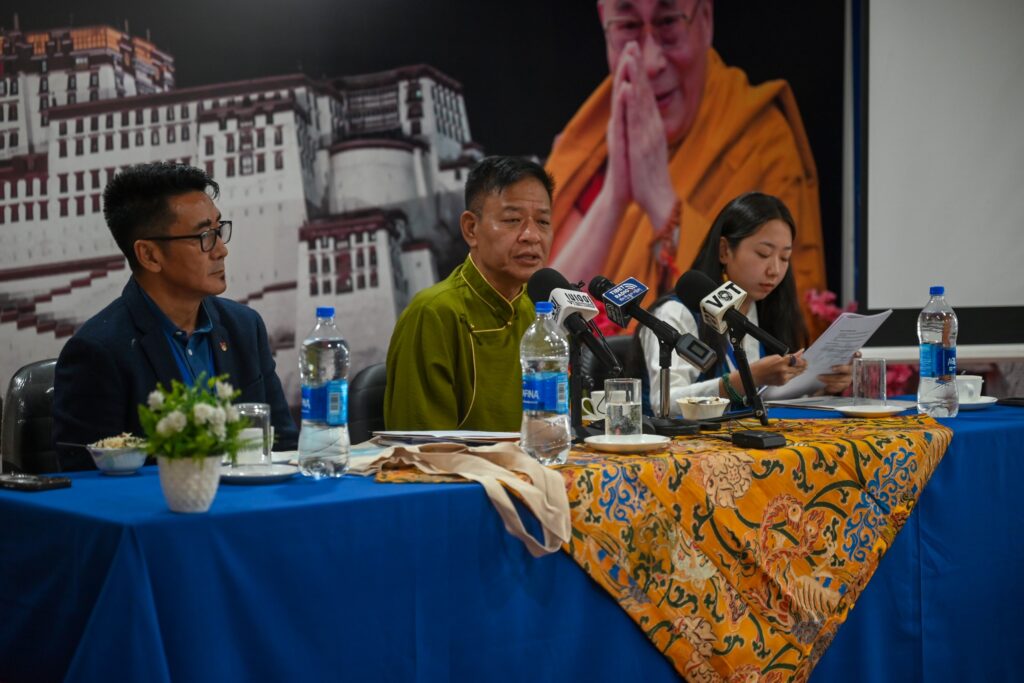
Dharamshala, 12 August 2005– “In awarding this peace prize to me, a simple monk from Tibet, you also fill my people with hope,” His Holiness the Dalai Lama said in a message to the award ceremony of the 2005 Manhae Grand Prize for Peace today at the Backdam Temple in Gangwon province of South Korea.

The representative of His Holiness the Dalai Lama for Japan and East Asian countries, Chope Paljor Tsering, received the award on behalf of His Holiness.
“Despite the fact that we have not drawn attention to our difficulties by means of violence, it means that we Tibetans have not been forgotten,” His Holiness said.
“It also means that the values we cherish, in particular our respect for all forms of life and the belief in the power of truth, are today recognised and encouraged.”
The citation of the Manhae Peace Prize recognises that “His Holiness the Dalai Lama, in his struggle for the freedom of the Tibetan people, has consistently opposed the use of violence.”
“He has instead advocated peaceful solutions based upon tolerance and mutual respect in order to preserve the unique Buddhist cultural heritage of his people.”
The Manhae Grand Prize, one of the most prestigious prizes in Korea, is given to commemorate Han Yong-woon (1879-1944), known by the pen name “Manhae.” Han was a Buddhist monk, poet and a great thinker.
Below are the full texts of His Holiness the Dalai Lama’s message and the citation of the Manhae Peace Prize.
Brothers and sisters,
I am honoured that you have chosen to award me your esteemed Peace Prize. As you know working to secure peace in the world is something that concerns me deeply as a human being, as a Buddhist monk and, finally as a Tibetan.
Until very recently, many people felt that disagreements and conflicts between nations and communities could only be resolved through war or the threat of force. Everyone wishes to live in peace, but we are often confused about how it can be achieved. Mahatma Gandhi pointed out that violence inevitably leads to more violence and that therefore, if we are seriously interested in peace, it must be achieved through peaceful and non-violent means. Today, more and more people are coming to realise that the proper way of resolving differences is through dialogue, compromise and negotiations; through human understanding and humility. There is a growing appreciation that genuine peace comes about through mutual understanding, respect and trust. This is an encouraging and positive sign.
In addition, the need to work for genuine disarmament and demilitarisation continues to be pressingly urgent. However, I believe that in order to have the confidence to eliminate physical weapons, some kind of inner disarmament is necessary. To begin with we need to embark on the difficult task of developing love and compassion within ourselves. Only in this way can we address the underlying causes that disturb and prevent peace and happiness. There are many methods, some of them religious and others derived from what I think of as fundamental human values, that we can employ to develop these qualities and become better people, yet there is no machine that can produce inner peace; there is no shop that sells inner peace. It is something that has to come from inside, through mental transformation.
In awarding this peace prize to me, a simple monk from Tibet, you also fill my people with hope. Despite the fact that we have not drawn attention to our difficulties by means of violence, it means that we Tibetans have not been forgotten. It also means that the values we cherish, in particular our respect for all forms of life and the belief in the power of truth, are today recognised and encouraged.
I have a deep respect for the work the Manhae Peace Foundation is doing. Your commitment to the welfare of your fellow human beings is beyond dispute. In working to secure peace, you are serving not only those of us who are alive today, but even the generations who are yet to come. That is wonderful. Your efforts make an important contribution to creating peace and harmony in the world and reminding our fellow human beings of the great need for love, kindness and compassion in all our lives.
July 18, 2005
The Manhae Foundation has decided to award the 2005 Manhae Peace Prize to His Holiness the 14th Dalai Lama, Tenzin Gyatso, the religious and temporal leader of Tibet.
The Peace Prize Committee of the Manhae Foundation wants to emphasize the fact that His Holiness the Dalai Lama, in his struggle for the freedom of the Tibetan people has consistently opposed the use of violence. He has instead advocated peaceful solutions based upon tolerance and mutual respect in order to preserve the unique Buddhist cultural heritage of his people.
His Holiness the Dalai Lama’s travels throughout the world, lecturing on the importance of ‘human values and inter-religious harmony’ has brought about peace and harmony in human society.
In the opinion of the committee, His Holiness the Dalai Lama has effectively expounded the Buddha Dharma in bringing about peaceful proposals for the solution of international conflicts, human rights issues and global environmental concerns.
January 1, 2005. Seoul, Korea
Manhae Foundation
Honorary President The Most Ven. Kim Bob-jang
(President of The Jogye Order of Korean Buddhism)
The Chief Director The Most Ven. Cho Oh-hyum
(The Spiritual Master, The Third Diocese of the …)