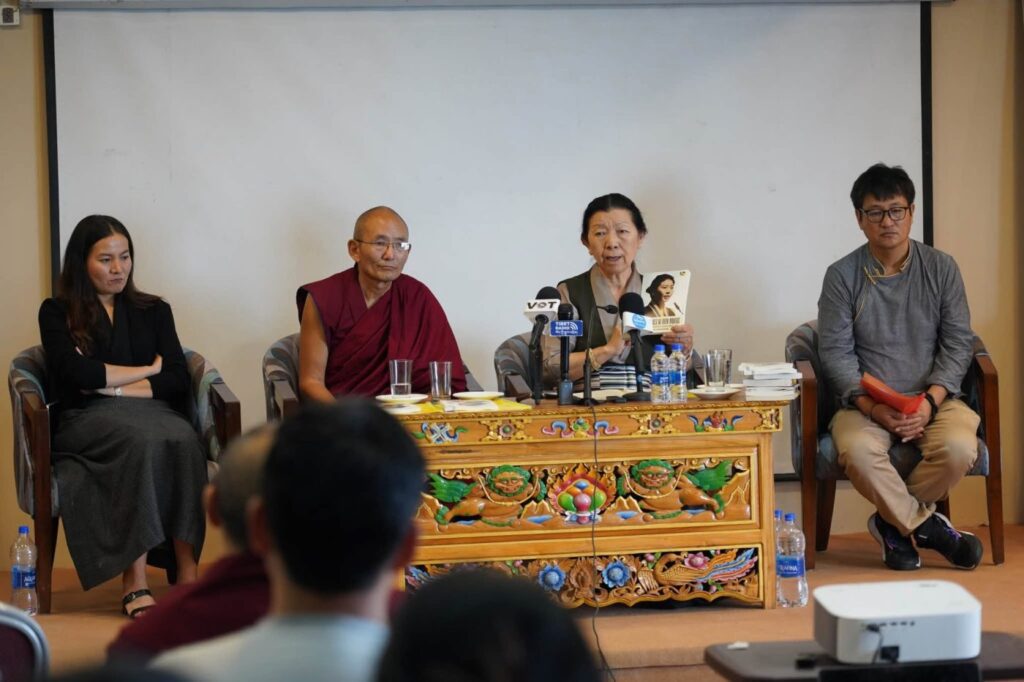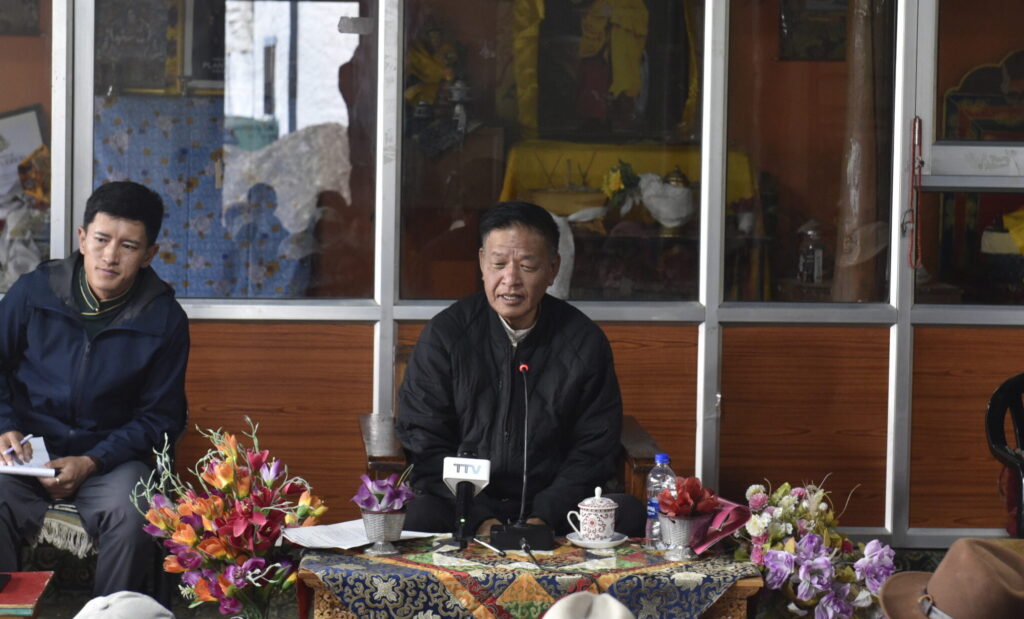


Dharamshala: The two-day 7th Young Indian Scholars’ Conference on Tibetan Studies commenced this morning, 8 October 2025, at the Administrative Tibetan Welfare Society (ATWS) Hall, in the presence of Sikyong Penpa Tsering as its Chief Guest.
The opening ceremony was compered by Dr Tsering Dolma, the conference coordinator, followed by welcome remarks from Tempa Gyaltsen Zamlha, Deputy Director of the Tibet Policy Institute (TPI). He extended a warm welcome to the Chief Guest and all participants, explaining that during the two-day conference, scholars would present papers on Tibet’s history, culture, environment, geopolitics, and India–Tibet relations. He noted that the conference serves as a platform for young scholars in India to exchange ideas and engage in academic discussions on Tibetan studies.
The conference was officially inaugurated with an address by Sikyong Penpa Tsering, who underlined the importance of academic engagement and scholarly dialogue in advancing Tibetan studies among young Indian researchers. Commending the Tibet Policy Institute for organising the conference, Sikyong lauded its role in fostering intellectual exchange and deepening understanding of Tibet’s historical, cultural, and geopolitical significance. He stressed that academic research plays a crucial role in countering distorted narratives about Tibet and preserving the truth of its history.
In his address, Sikyong elaborated on the evolution of the Middle Way Policy, explaining that after China’s occupation of Tibet, Tibetans in exile initially advocated for independence from 1959 to 1974. However, under the guidance of His Holiness the Dalai Lama, the Tibetan leadership later adopted the Middle Way Policy seeking genuine autonomy within the framework of the People’s Republic of China. This approach was formally approved by the Tibetan Parliament-in-Exile (TPiE) through consensus, and remains the official policy of the Central Tibetan Administration.
Reaffirming the CTA’s renewed strategic focus on reinforcing Tibet’s historical status as an independent nation, Sikyong explained that this approach aims to strengthen the legitimacy and moral foundation of the Middle Way Policy proposed by His Holiness the 14th Dalai Lama. He highlighted the two fundamental pillars underpinning the CTA’s political stance: the historical independence of Tibet and the continued occupation of Tibet by the People’s Republic of China under a repressive regime.
“When His Holiness the Dalai Lama speaks of the Middle Way, it is a call for a peaceful resolution — one that neither seeks separation nor accepts the current repression,” Sikyong remarked. “However, in the face of Beijing’s continued denial and lack of response, we must reinforce the legitimacy of our position by seeking international recognition of Tibet’s past independence.”
He further noted that during official engagements with governments, NGOs, and parliamentary advocacy bodies worldwide, the CTA consistently raises awareness about the worsening human rights situation inside Tibet. These efforts, he said, are aimed at ensuring that Tibet remains a matter of international concern and moral responsibility.
Speaking about the Resolve Tibet Act passed by the United States Congress and signed into law by former President Joe Biden, Sikyong underscored that the legislation rejects China’s false claim that Tibet has been part of China since ancient times. He reiterated that His Holiness the Dalai Lama has never accepted such a narrative, and that the U.S. government likewise does not recognise it. The Act, he explained, also urges cooperation with like-minded nations to counter China’s disinformation on Tibetan history, and clearly defines Tibet’s territorial space to include all three traditional provinces—U-Tsang, Kham, and Amdo. He acknowledged the extensive effort involved in getting the bill passed through both the House and the Senate.
Sikyong also drew attention to the parallel between Tibet and Ukraine, observing that what the world is witnessing in Ukraine today is similar to what happened to Tibet more than seven decades ago. “Tibet was invaded, occupied, and forced to sign the 17-Point Agreement under duress in 1951 — a clear violation of international law,” he said.
He further emphasised that the Middle Way Approach must be supported by historical truth, particularly in light of China’s persistent attempts to distort Tibet’s history for political ends. “We have sent a clear message to the Chinese government — history cannot be changed by force. Tibet has always existed as an independent nation. The truth of our past cannot be erased by political agendas or military occupation,” he stated.
Sikyong also reflected on his discussions with the U.S. Council officials and the complex geopolitical dynamics involving China and Tibetan religious institutions. He observed that while China seeks to politicise Tibetan Buddhism, the tradition itself remains rooted in spiritual principles that transcend political control. He explained the concept of Tibetan reincarnation, noting the importance of educating international audiences to dispel misconceptions and help them understand the spiritual and cultural significance behind it.
In conclusion, Sikyong Penpa Tsering urged young scholars to deepen their research on Tibetan religion, culture, and history, emphasising that their academic contributions can help present factual evidence to the international community about Tibet’s historical independence. He called upon the global community to support the Middle Way Approach and stand in solidarity with the Tibetan people in their peaceful struggle for genuine autonomy and the preservation of their identity.
Subsequently, Professor Srikanth Kondapalli from Jawaharlal Nehru University addressed the conference, highlighting the broader geopolitical and academic challenges affecting Tibet.
Professor Srikanth noted China’s growing influence through trade, investment, tourism, and other concessions, which have strengthened its domestic control and international leverage. He cited historical and recent developments, including President Xi Jinping’s address at the Tibet Forum on 29 August 2020.
He further emphasised that the Chinese government has sought to “sinicise” Tibetan Buddhism by altering texts and reshaping religious practices. These measures, alongside colonial-style schooling, confinement of Tibetan communities, and exploitation of natural resources, aim to transform ethnic minorities into Han Chinese by imposing Chinese customs, traditions, and worship practices.
Drawing on Sikyong Penpa Tsering’s earlier remarks, Professor Srikanth emphasised the need to engage international audiences, particularly the International audiences, to raise awareness and strengthen support for Tibet-related issues. He underscored the value of global outreach in ensuring that Tibet’s narrative receives wider recognition.
On academic matters, he highlighted disruptions in Tibetan studies research, noting that Chinese programs are tightly controlled by the Communist Party. He explained that China follows a Stalinist approach toward ethnic minorities, integrating Tibetans into a state-conceived “pomegranate” model that closely binds all 55 ethnic groups under central authority.
Professor Srikanth concluded by urging scholars and institutions, including the Tibet Policy Institute community, to remain vigilant, adaptable, and proactive in global outreach to ensure Tibet’s narrative receives wider recognition.
The 7th Conference of Young Indian Scholars’ Conference on Tibetan Studies will be held for two days from 8 to 9 October 2025, during which scholars will discuss various topics, including research papers on India-Tibet relations, geopolitics, trade relations, history, Tibet’s environmental issues, foreign policy and other related topics.