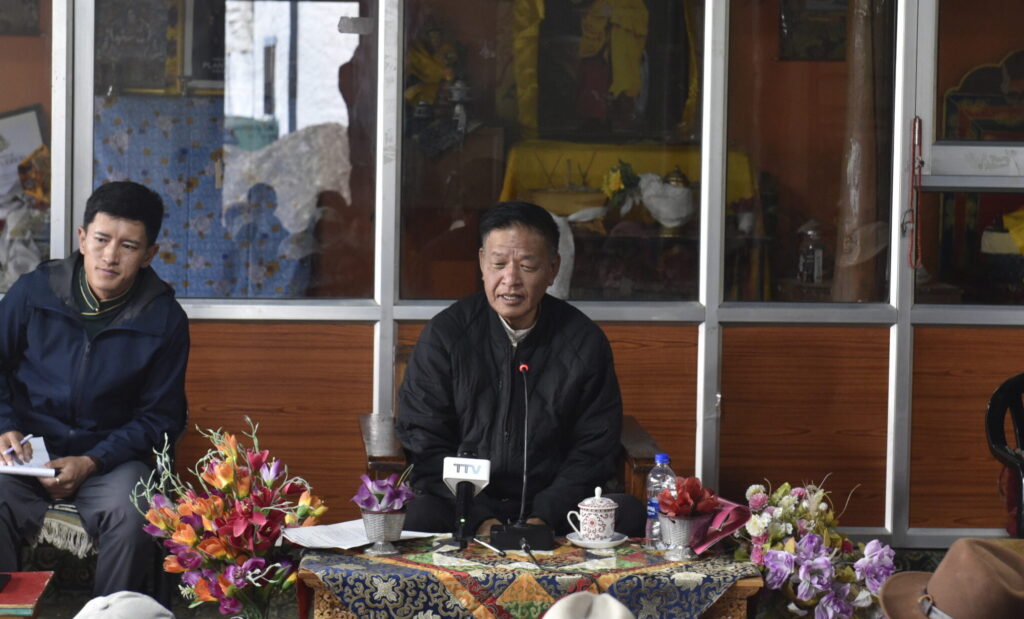


Guwahati, Assam: On 21 November 2025, Sikyong Penpa Tsering gave an interview to Pratidin Time, a leading news channel of Assam, and spoke about the historical and present status of Tibet and Tibetans at Gauhati University and Royal Global University.
Beginning with the interview at Pratidin Time—conducted by Mrinal Talukdar, the Consultant Editor of Assam’s Pratidin Time—Sikyong visited Gauhati University in the morning and Royal Global University in the afternoon as part of his day-long official programme.
At Gauhati University, Sikyong was graciously received by Vice-Chancellor Professor Nani Gopal Mahanta and Registrar Professor Utpal Sarma. There, he addressed an audience consisting of students and faculty members.
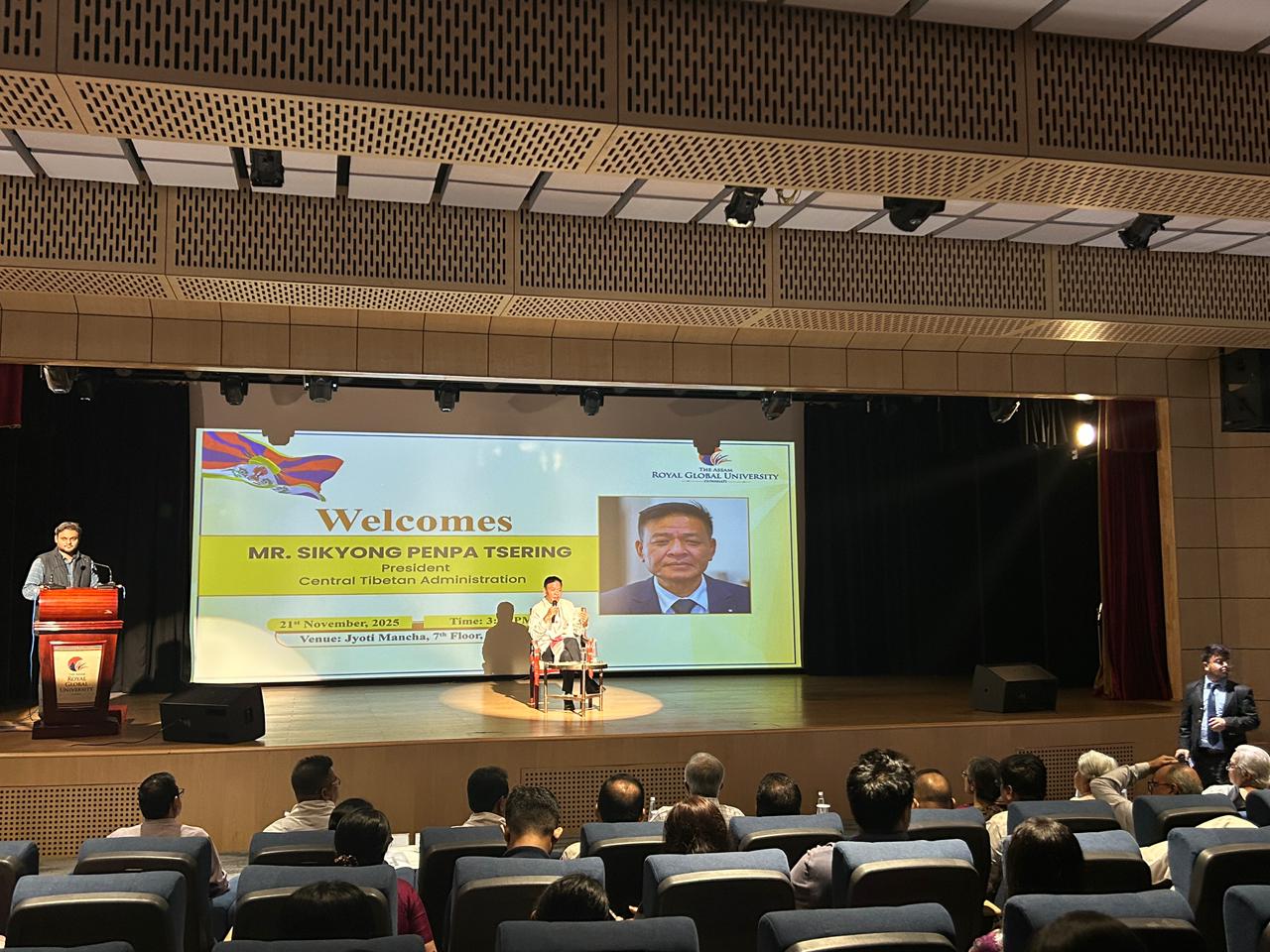
Later that afternoon, a similar talk session was held at Royal Global University, where Sikyong and his aides were accorded a warm reception by Registrars Dr. Dignata Miunshi and Dr. D. N. Singh. Sikyong visited the university’s exhibition hall, and a sapling was planted on the campus as a mark of his visit. Thereafter, the university hosted a luncheon in honour of the visiting Sikyong.
Before speaking to a gathering of students and faculty, Sikyong also participated in a recorded interview for the university’s official podcast.
In his addresses at both universities, Sikyong explained that Tibet’s unique geographical position has long held strategic and political significance, emphasising the importance of understanding political developments in neighbouring regions. He introduced the Middle Way Approach policy—inspired by the vision of His Holiness the Dalai Lama—explaining that a peaceful resolution of the Sino-Tibetan conflict through this approach would not only serve the interests of Tibetans but would also positively contribute to the stability and security of surrounding border regions. Offering a concise historical overview, Sikyong traced Tibet’s past from the imperial era of its early kings to the period of fragmentation, and further to the centuries of priest-patron relationships with the Mongols and the Yuan, Ming, and Qing dynasties. He recounted how, during the early 20th century, invasions from the Republic of China and British India forced His Holiness the 13th Dalai Lama into exile twice, and how, upon his return in 1913, the 13th Dalai Lama reaffirmed Tibet’s independence. The following year, Tibet—functioning as an independent nation—signed the 1914 agreement with British India that defined the McMahon Line between Tibet and present-day Arunachal Pradesh. He clarified unequivocally that claims by the Chinese government asserting Tibet’s ancient integration into China are historical distortions.
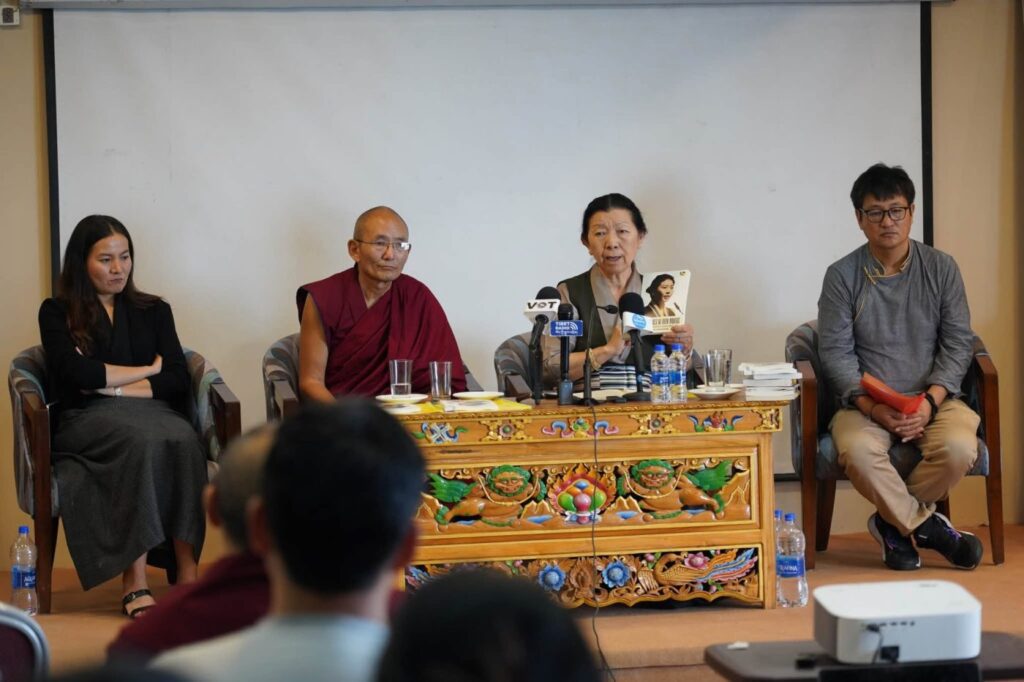
To deepen students’ understanding of the complex Tibet-China relationship, Sikyong recommended key readings, including Tibet Brief 20/20 by legal scholar Michael van Walt van Praag and the work of Professor Lao, whose research into Ming and Qing records provides further evidence that Tibet was not historically a part of China. He encouraged students to explore these works for further insights. Reflecting on the global celebrations of His Holiness the 14th Dalai Lama’s 90th birthday, commemorated as the “Year of Compassion”, Sikyong highlighted how His Holiness’ teachings on non-violence and compassion continue to resonate both within the Tibetan community and across the world. He further outlined His Holiness’ four principal commitments: the promotion of universal human values, the promotion of religious harmony, the preservation of Tibet’s culture and environment, and the revival of ancient Indian wisdom.
Sikyong also underscored Tibet’s enduring strategic role as a historical buffer between India and China, noting that the Tibetan language—one of the world’s fifteen oldest languages with a script—originated in India and remains a vital cultural treasure. He praised the remarkable efforts of Geshe Monlam, who, assisted by scholars from both inside and outside Tibet, has produced a monumental 223-volume Tibetan dictionary. Yet, Sikyong expressed grave concern about the ongoing systematic erosion of the Tibetan language and culture inside Tibet.
During the visits, Shri Soumyadeep Datta, Convener of Free Tibet: A Voice from Assam, who accompanied Sikyong, highlighted the longstanding connections between Tibet and India, especially the historical trade and cultural interactions between Tibet and Assam, in his addresses to the gatherings.