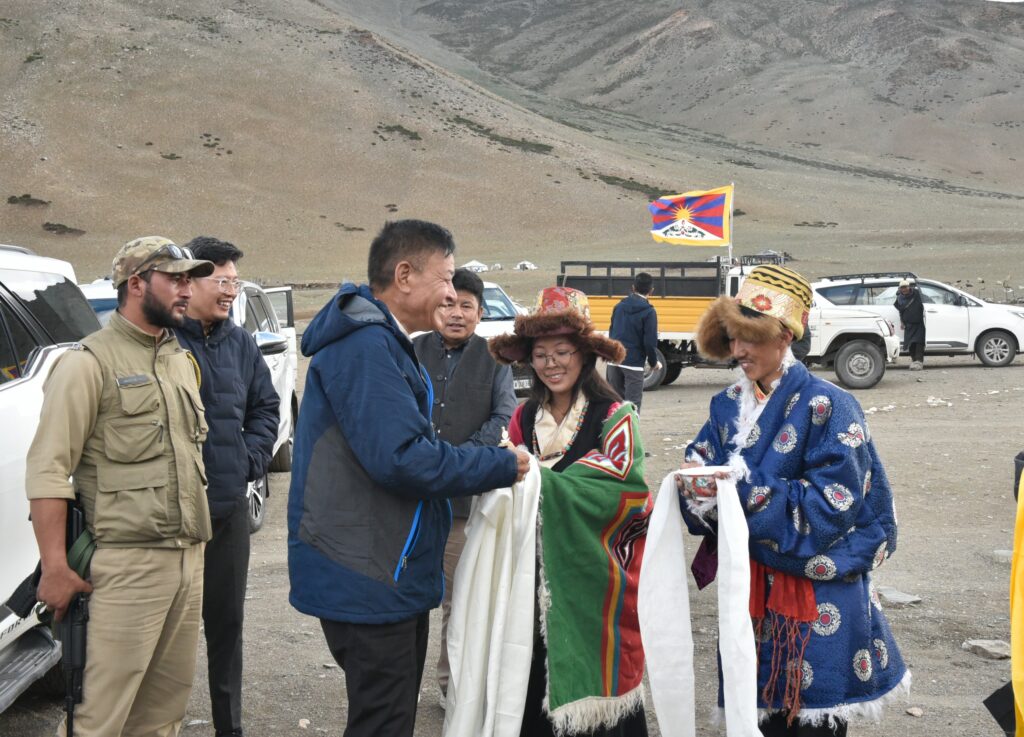


Lucknow, Uttar Pradesh: After successfully concluding his official engagements in Guwahati, Sikyong Penpa Tsering arrived in Lucknow in the afternoon of 22 November 2025 to a warm welcome reception from the members of the Core Group for the Tibetan Cause (CGTC) from Uttarakhand and Uttar Pradesh, including Dr. Sanjay Shukla, Regional Convenor of CGTC and President of Bharat Tibbat Samvad Manch (BTSM); Dimeep Shukla, Uttar Pradesh State Bureau Chief and journalist with Hindustan Samachar; Dr. Rajesh Barnwal, Director of Deoria Medical College; and Advocate Strughan Shah of the Lucknow High Court.
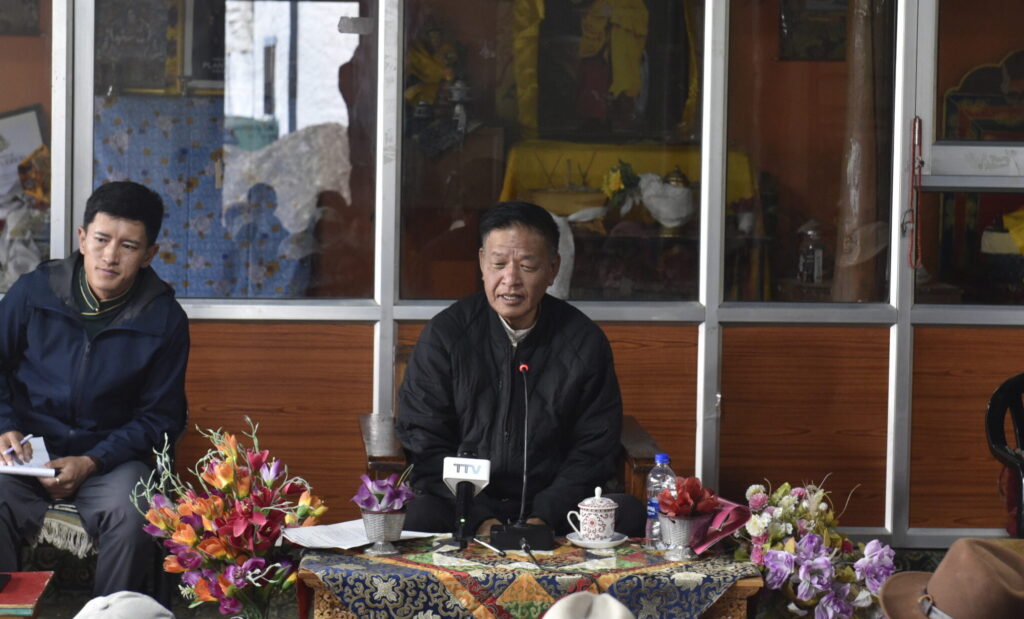
In Lucknow, on the following day, Sikyong held a series of media engagements, interviewing media personnel from Press Trust of India, Hindustan Samachar, NBT, Dainik Bhaskar, Newstrack, Samvaad Live, ETV Bharat, Univarta/United News of India, and Republic News/R. Bharat News.
As part of his packed programme, Sikyong also visited the Warriors Defence Academy in Lucknow, where he was received by Academy Chairman Gulab Singh, retired intelligence officer and Indo-Tibetan-China relations expert Brigadier Rakesh Bhatiya, and Major Anand Tandon, Organising Secretary of the Akhil Bharatiya Poorwa Senik Sewa Parishad.
Following a brief reception, Sikyong addressed the gathering as the chief guest, highlighting the political significance of the Tibetan cause and India’s continued support. Around 600 attendees were present, including academy officials such as Ghanshyam Singh, JP Singh, Radhey Shyam Singh, and students preparing for NDA and CDS examinations.
The programme was organised by Sanjay Shukla, Regional Convenor of the Core Group for the Tibetan Cause (Uttar Pradesh and Uttarakhand) and National President of the Bharat Tibbat Samvad Manch, along with Dilip Shukla, Media Coordinator of the Tibet Support Group, and Tashi Dekyi, Coordinator of the India-Tibet Coordination Office.
The gathering began with an introduction of Sikyong Penpa Tsering by Academy Chairman Gulab Singh, who then provided a brief overview of the Academy and its key curricula. Thereafter, Dr. Sanjay Shukla, Brigadier Rakesh Bhatiya, and Ghanshyam Singh, in their respective remarks, highlighted the shared civilisational, cultural, and religious bonds between India and Tibet throughout history, as well as Tibet’s status as an independent nation prior to the PLA’s invasion.
In his keynote speech for the students, Sikyong emphasised the importance of understanding the situation of one’s neighbouring countries, noting that they would become defenders of the nation in the future. Hence, Sikyong highlighted Tibet’s global significance in terms of geopolitics, environmental concerns, and cultural heritage in his address.
Reflecting on Tibet’s historical and cultural legacy, Sikyong explained that Tibet possesses thousands of years of history. During the 8th-century Tibetan Empire, its dominion extended from the capital of the Tang Dynasty in China to Eastern Turkistan. Under King Songtsen Gampo’s reign, the Tibetan script was developed based on the Indian Gupta script. Scholars such as Khenchen Shantarakshita and realised tantric master Guru Padmasambhava were invited from India, facilitating the spread of the Nalanda Buddhist tradition throughout Tibet. The complete Buddhist canon in Sanskrit was translated into Tibetan, and today, the study of Buddhism remains inseparable from the Tibetan language, which bears closer ties to Indian languages than to Chinese.
Turning to current challenges, Sikyong revealed that the PRC government is attempting to erase Tibetan language, culture, and identity. Tibetan children under the age of four are reportedly being forcibly separated from their families and placed in permanent boarding schools, implementing policies aimed at Sinicization.
On environmental issues, Sikyong emphasised Tibet’s crucial role as the water source for many Asian countries and its recognition as the world’s third pole. Rising temperatures in the region are causing glaciers to melt, which will have severe repercussions on the climate of neighbouring nations and the global environment.
Discussing the Tibetans’ struggle for freedom and justice, Sikyong highlighted that it follows the path of compassion and non-violence inspired by India’s ancient culture, seeking resolution through dialogue with China. Since 1973, His Holiness the Dalai Lama has not demanded independence but has promoted the Middle Way Approach policy, formulated in line with international political realities and the circumstances of the Tibetan people. The Middle Way Approach recognises Tibet’s historical status as an independent nation while addressing its current occupation by the PRC. Sikyong stressed that international acknowledgment of Tibet as a historically independent nation is essential for building confidence in the Middle Way Approach.
Sikyong further noted the significance of the Resolve Tibet Act, passed through bipartisan efforts by the U.S. Congress in 2022 and 2024, which recognises Tibet as an unresolved international issue and affirms its historical independence. This represents the first instance of such legislation internationally, and efforts are ongoing to introduce similar measures in other countries.
Concluding his remarks, Sikyong congratulated and presented awards to students Ravi Gupta and Vatsal Gupta for their outstanding performance in the National Defence Academy (NDA) national examinations.