

Bir: Beginning with a warm and vibrant reception led by Tibetan Settlement Officer Karma Namgyal, Sikyong Penpa Tsering visited the Bir Bhoetsog Tibetan Settlement on the morning of 21 August 2025, as part of his ongoing official engagements in Bir. Accompanied by Additional Secretary Tashi Dekyi from the Department of Home, Sikyong toured the settlement office, the Regional Tibetan Freedom Movement (BRDL), the Local Tibetan Assembly, offices of local Tibetan civil societies, as well as Tibetan schools and monasteries within the settlement.
At the Tibetan Children’s Village School in Suja, Sikyong briefly addressed the students on the global significance of the Tibetan Plateau and shared insights into Tibet’s history.
In the afternoon, Sikyong visited Lily Tibetan Village & Welfare Society, Pema Ewam Chogar Gyurme Ling Monastery, and the Nyingma Buddhist Charitable Institute in the Bir Dege Tibetan Settlement.
Sikyong was accompanied by Additional Secretary of the Department of Home, Tashi Dekyi, and Tibetan Settlement Officer Kunchok Lhamo during these visits.
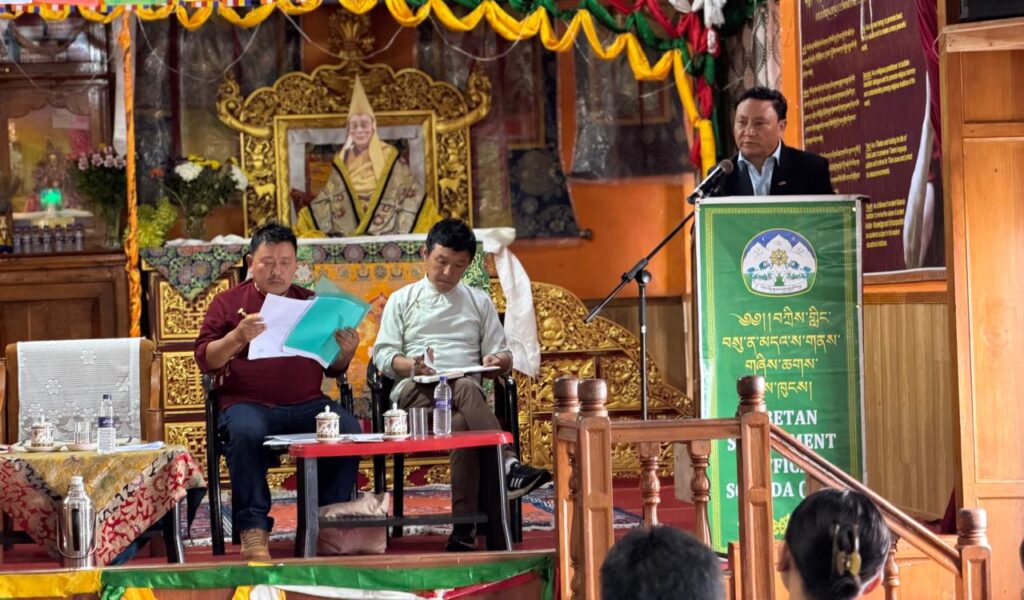
Later, Sikyong addressed members of the Tibetan community from Bir Tibetan Society, Chauntara Nangchen Tibetan Settlement, and Bir Dege Tibetan Settlement at the community hall of the Bir Tibetan Society.
The gathering commenced with opening remarks from Nangchen Tibetan Settlement Officer Meri Kyab, who briefly introduced Sikyong Penpa Tsering and highlighted his lifelong service to the Tibetan community.
In his keynote address, Sikyong spoke about the recent Ghoton celebration, which garnered unprecedented global attention on the Tibetan cause and the issue of the reincarnation of His Holiness the Great 14th Dalai Lama. He noted that the event received global media coverage comparable only to that of His Holiness receiving the Nobel Peace Prize in 1989. This, Sikyong emphasised, is a testament to the continued relevance of His Holiness and his teachings of non-violence amidst rising global conflicts.
Updating the public on the key undertakings of the 16th Kashag, Sikyong mentioned that in order to ensure the preservation of Tibetan Buddhism and the Yungdrung Bon tradition, the Kashag has launched the Buddhist Digital Library Initiative to digitise all existing scriptures, thereby safeguarding Tibetan religion against growing challenges.
Sikyong also addressed the structural reforms implemented by the Department of Home under 16th Kashag, which has reorganised the Tibetan settlements into four zonal categories to enable more effective coordination. Sikyong further highlighted the 16th Kashag’s major infrastructure initiatives and the provision of land and housing for numerous Tibetan families who still lack basic facilities.
“Continuous sustenance of Tibetan settlements and institutions is vital to ensure the survival of the Tibetan freedom struggle,” said Sikyong, while underscoring the importance of proper maintenance of community infrastructure. “Until and unless the Tibet-China dispute is resolved, sustaining these aspects is essential to keep our efforts and movement alive.”
Sikyong further emphasised the importance of compliance with the Foreign Contribution (Regulation) Act (FCRA) by all Tibetan institutions, noting that such adherence is crucial to the smooth and effective functioning of organisations.
Speaking about Tibetan institutions, Sikyong elaborated on the recent assumption of the Education Kalon as the President of the Board of Directors of all four major Tibetan school administrations in exile.
“Despite our continued efforts in various welfare initiatives, we must never forget that our primary objective as an exile community is to resolve the existing conflict between Tibet and China,” Sikyong highlighted. He described the enactment of the Resolve Tibet Act as a significant milestone, noting that it is a major diplomatic achievement for the Central Tibetan Administration to receive such support from the United States in declaring the Tibet-China conflict an unresolved international dispute.
Building on that point, Sikyong stressed the importance of understanding Tibet’s factual history to strengthen international advocacy. “One must understand that Tibet was an independent country prior to the illegal occupation by the PLA. To prove this historically and legally, I highly recommend reading the works of Professor Michael van Walt van Praag and Professor Lau Han Shiang for a deeper understanding of Tibet’s historical and legal status,” stressed Sikyong.
During a Q&A session following his address, Sikyong further delved into the practical application of the Middle Way Approach, China’s current global political standing, the prospects for Tibetans within this context, and other relevant matters.
The gathering concluded with a vote of thanks from Bir Bhoetsog Tibetan Settlement Officer Karma Namgyal.
Later that evening, Sikyong gave an interview to Voice of Tibet, sharing his perspective on Chinese President Xi Jinping’s recent visit to Tibet in celebration of the so-called 60th anniversary of the establishment of the Tibet Autonomous Region. Sikyong described the visit as part of a broader effort by the PRC to legitimise its claim over Tibet, a move he firmly rejected.