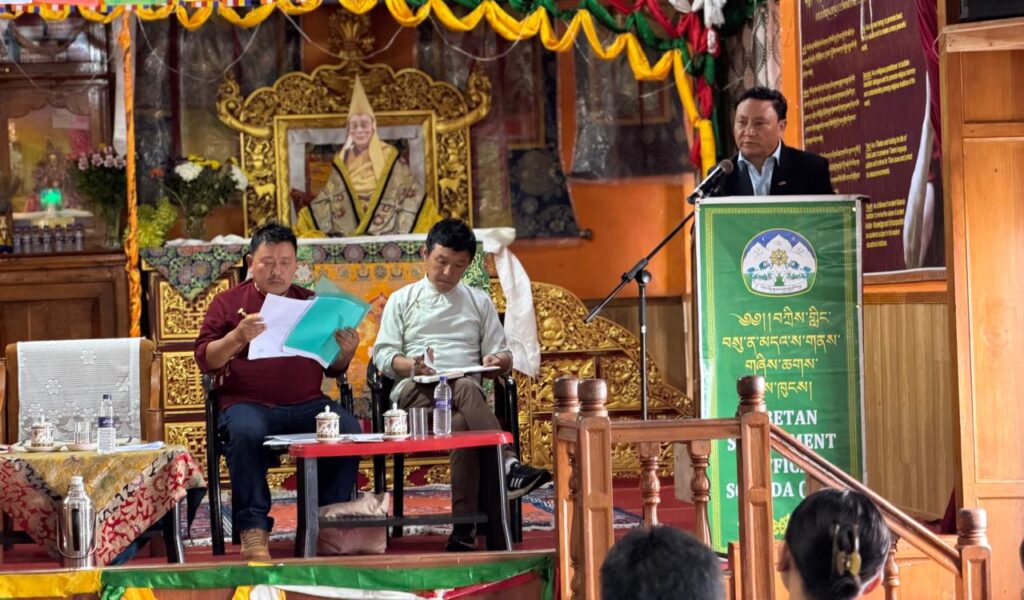


Dharamshala: The Public Service Commission (PSC) of the Central Tibetan Administration (CTA) inaugurated a one-day training-cum-workshop on policy dissemination this morning for secretaries and training nodal officials of the respective CTA offices at Norbu House in Dharamshala, aimed at strengthening institutional capacity and standardising training practices across departments.
The opening session was attended by Chairman of the Public Service Commission Karma Yeshi, along with training instructor Vivek Sharma, a PSC consultant with over 25 years of experience in capacity building, training system design, and institutional development. The workshop seeks to promote systematic skill development and continuous professional growth among CTA staff, while building a cohesive training ecosystem that integrates people, technology, culture, and strategy.
The training also focuses on familiarising officials with key provisions of the newly introduced CTA staff Training Policy, which came into effect on 24 February 2025 and is set for full implementation by 22 April 2026. Applicable to all CTA employees under relevant Charter provisions and PSC rules, the policy provides a structured framework for planning, implementing, and monitoring training programmes. It consists of six chapters and around 100 provisions, developed in consultation with the Kashag, CTA departments, and autonomous bodies.
In his address, Karma Yeshi, the Chairman of the Public Service Commission underscored the importance of grounding administrative work in the Tibetan Charter, urging all staff to study key sections, particularly Chapter Ill and related clauses on governance and welfare. He highlighted that these principles emphasise resolving the Tibetan issue, promoting social justice and equality, safeguarding the environment, and ensuring the welfare of Tibetans in exile. The Chairman noted that the new training policy aligns closely with these Charter values and will enhance the efficiency and potential of CTA officials.
He further pointed out that while trainings have been conducted in the past, the absence of a formal policy limited their impact. The new framework aims to address this gap by standardising training approaches, ensuring that all staff undergo at least three trainings during their service, and improving competencies in administration, technology, language, and cultural preservation. He also stressed that the policy remains flexible, allowing for future amendments based on feedback and evolving needs.
The workshop is designed to equip departmental secretaries and nodal officers, who will play a key role in executing the policy with a clear understanding of different types of training. Departments will later develop their own training modules within this unified framework.
PSC Secretary Tenzin Legdup briefly explained that the initiative distinguishes between general and job-specific training, with each department responsible for organising programmes through designated training officers. The overarching goal, he said, is to establish a consistent and effective training system across the CTA.
The one-day workshop serves as an initial policy dissemination stage which includes policy understanding, training systems and its implementations and monitoring.
The workshop-cum-training is supported by US state department, the Tibet Fund, and SARD, reflecting a collaborative effort to strengthen institutional development within the Tibetan administration.