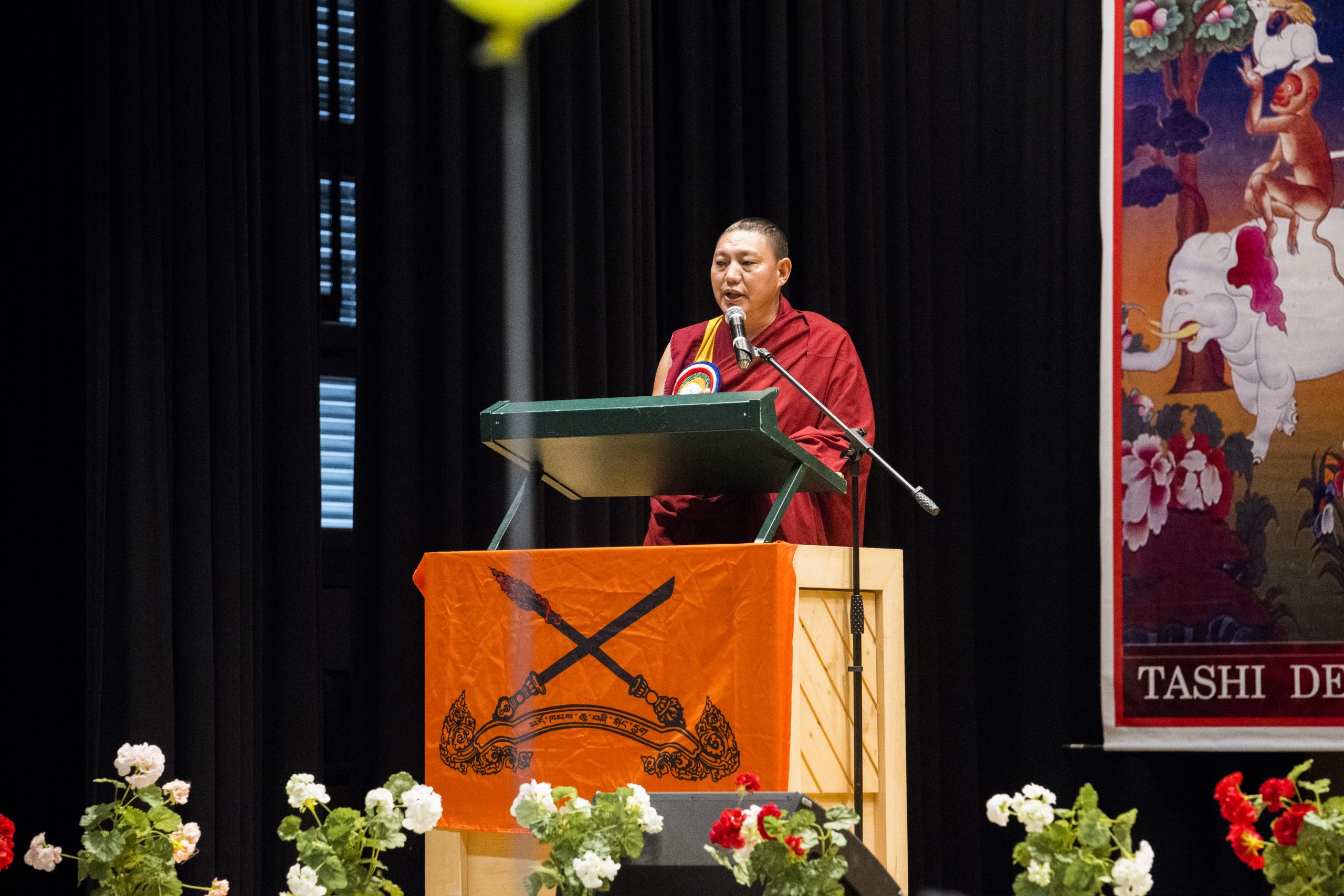


Switzerland: On 4 October 2025, the Europe Chushi Gangdruk Association commemorated its 46th founding anniversary alongside the 90th birthday celebration of His Holiness the 14th Dalai Lama with a grand event held at Rapperswilstrasse, Switzerland. The celebration brought together over 1,500 Tibetans from across Europe to pay tribute to His Holiness’s extraordinary leadership, boundless compassion, and enduring vision for the Tibetan people.
The event was attended by many distinguished guests, including Khen Rinpoche of Rikon Monastery, the President of the Central Chushi Gangdruk, Former Tibetan Parliamentarians Tsering Dorjee and Samdho Jampa, Kanam Dewa, the Officiating President of TCSL, the President of the Tibetan Women’s Association, as well as the Presidents of the Three Provinces Associations and other community leaders. The function was graced by Phuntsok Topgyal, UN Advocacy Officer of the Office of Tibet, Geneva.
The program began with the traditional Tibetan ceremony of offering khatags (white ceremonial scarves) to the portrait of His Holiness the Dalai Lama, a gesture symbolising deep respect and devotion. Participants were then served sweet rice and Tibetan butter tea, marking an auspicious beginning to the event.
Following the ceremonial offerings, attendees stood together to sing the Tibetan National Anthem and observed a minute of silence in solemn remembrance of the countless Tibetans who have sacrificed their lives for the freedom and dignity of Tibet. This moment of silence unified the gathering in shared reflection and gratitude, reinforcing the collective spirit of resilience that has sustained the Tibetan community in exile for more than six decades.
The President of the Europe Chushi Gangdruk Association, Tempa Tsering Radutsang, delivered the welcome address, extending heartfelt greetings to all guests, participants, and supporters. He acknowledged the continued strength and unity of the Tibetan community in Europe, emphasising the importance of preserving Tibet’s cultural heritage, national identity, and solidarity among the three traditional provinces of Tibet.
Phuntsok Topgyal highlighted the Central Tibetan Administration’s (CTA) declaration of 2025 as the “Year of Compassion.” He explained that this declaration aims to remind Tibetans everywhere of the core value that His Holiness the Dalai Lama has devoted his life to — compassion for all sentient beings.
Topgyal also spoke passionately about His Holiness’s visionary leadership during the early years of Tibetan exile. Recalling the events of 1959, he explained that when Tibetans first arrived in India as refugees, His Holiness foresaw that the Tibetan struggle for freedom might be a long one. Despite the immense hardship of displacement, His Holiness emphasised that the survival of the Tibetan language, culture, and religion would be the foundation for preserving Tibetan identity. Acting upon this vision, His Holiness established Tibetan schools, monasteries, settlements, and hospitals, ensuring that future generations would remain connected to their heritage.
Topgyal reminded the audience that even after seven decades in exile, the Tibetan identity remains vibrant — a living testament to His Holiness’s wisdom and far-sightedness. However, he also urged the community to engage in self-reflection:
“Today, while we have Tibetan schools, monasteries, and settlements, we see fewer students and less participation in our communities. This should make us reflect deeply on His Holiness’s expectations of us. Offering long-life prayers is meaningful, but not sufficient. The greatest offering we can make is to take responsibility and continue His Holiness’s mission with determination and unity.”
Topgyal further reflected on His Holiness’s repeated statements expressing his wish to live beyond 130 years or more, interpreting this not as a personal desire but as an act of deep compassion:
“His Holiness, as the manifestation of Avalokiteshvara, the Buddha of Compassion, remains in this world to alleviate the suffering of beings. He endures life for the sake of others — especially for the Tibetan people, whose struggle for justice continues. Therefore, when His Holiness speaks of living long, we must understand it as a call for us to shoulder greater responsibility and to work for the Tibetan cause with renewed commitment.”
Addressing the situation of Tibetans both inside Tibet and in the diaspora, Topgyal cautioned the audience about the evolving nature of Chinese repression. He noted that while China’s oppression inside Tibet may no longer appear as openly violent as in the past, it has taken a more insidious form of “soft power suppression.” This includes cultural assimilation, economic manipulation, and subtle propaganda aimed at eroding Tibetan identity from within.
He warned that even in countries like Switzerland, the Chinese government attempts to influence Tibetans through business ventures, cultural organisations, and social networks, often using them to shift narratives and weaken unity among the Tibetan diaspora:
“Such efforts may seem beneficial in the short term,” he said, “but they carry the risk of destroying our collective identity in the long run. Therefore, every Tibetan living abroad must remain vigilant and avoid falling into the trap of Chinese narratives that seek to divide us.”
In his concluding remarks, Topgyal urged Tibetan associations and community leaders to recognise and empower capable individuals within their circles — those with education, resources, leadership skills, and advocacy experience — so that their talents can be utilised for the benefit of the community:
“Our society can only thrive when capable individuals are given opportunities to contribute. Neglecting such people leads to disunity and stagnation. We must build a strong and inclusive community where everyone’s potential is valued and used for the common good.”
In conclusion, the formal program ended with traditional Tibetan cultural performances, songs, and heartfelt expressions of devotion to His Holiness the Dalai Lama. Attendees offered sincere prayers for His Holiness’s long life and for the freedom, unity, and prosperity of the Tibetan people.
-Report filed by Office of Tibet, Geneva