
– By Cheng Lei for THE AUSTRALIAN, 18 July 2026
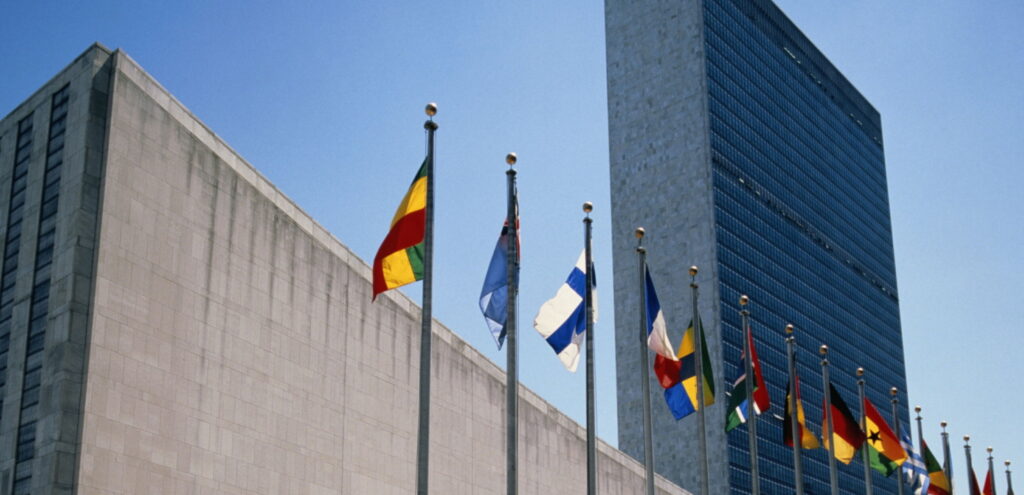
Tibetan activist Lobga Rangzen set himself on fire in front of UN headquarters in New York on July 2. His death came just a day after Beijing’s new Ethnic Unity Law took effect – legislation that expands Mandarin-language mandates in ethnic minority regions and pushes for the “Sinicisation” of religion.
For most of us, the desperate act is almost impossible to comprehend. For Tibetans, it is heartbreakingly familiar. Since 2009, more than 150 Tibetans have set themselves alight, hoping the world might notice the suffering of their people. Many have died.
The protest prompted the US State Department again to urge Beijing to resume dialogue with the Dalai Lama, while Time magazine placed the Tibetan spiritual leader on its latest cover. It took such a human tragedy to briefly return Tibet to the world’s attention.
A few months earlier I travelled to Dharamsala,a town in northern India that has been the Dalai Lama’s home and the seat of the Tibetan government in exile since he fled Tibet after the failed 1959 uprising against Chinese rule.
At this year’s 67th anniversary of the uprising, exiles and supporters from Italy, the Czech Republic, Australia, the US, Latvia and Germany gathered in the Himalayan foothill town.
Many, like me, can no longer enter China. That exclusion brings a strange freedom: to speak openly, to criticise and to stand with those Beijing seeks to silence. People often respond with sympathy to my experience of having been wrongly imprisoned for three years by China. Yet I have rarely felt less deserving of it than in Dharamsala.
A Tibetan woman embraces me and says she has not seen her parents in more than 20 years. She had grown up in the Children’s Village, founded to house thousands of children who escaped from Tibet without their parents or who had lost them on the treacherous journey through the Himalayas.
A recent exile shows me a scar on his scalp from beatings during detention in the Tibetan capital, Lhasa. Another says her teacher lost his hand crossing the Himalayas during the escape. Their stories dwarf mine. Their exile could be likened to a life sentence.
A town suspended between worlds
Perched at 2000m in India’s Kangra Valley, McLeod Ganj – the upper part of Dharamsala – is a tangle of narrow streets clinging to steep hillsides, backed by the snow-capped Dhauladhar range. It is the political heart of the Tibetan diaspora and is home to about 20,000 people.
On my arrival, the first sign of proximity to the Dalai Lama is unexpected: a shopping complex with a cinema, KFC and Pizza Hut, topped by a large portrait of the spiritual leader.
The town feels transient and symbolic. At the small busy junction locals nickname “Times Square”, Tibetan flags flutter while Bollywood music competes with vendors hawking pastries and pashminas. Monks in maroon and saffron robes weave through enlightenment-seeking tourists, but the demographic is shifting.
Monks seen on the streets of Dharamshala, India, headquarters of the The Tibetan government-in-exile.
Increasingly, Indian-run businesses replace Tibetan ones. The exile community is ageing and thinning. Since China tightened border controls after the 2008 unrest, very few Tibetans have managed to leave. The once-bustling Tibetan Children’s Village now has spare capacity.
Stateless in India and unable to own property, nearly half of the roughly 140,000 exiles have immigrated onward to countries such as Australia and the US. In China, there are still close to seven million ethnic Tibetans.
At the Norbulingka Institute, dedicated to preserving Tibetan culture, more Indians than Tibetans now learn traditional thangka painting. The gardens are serene – bamboo groves, delicate bridges, spring flowers – but there is a sense of cultural preservation becoming cultural display.
Losing visibility
Many Tibetans we spoke to were eager to know how their cause was seen beyond Dharamsala. The answer is uneasy: it has drifted from global attention, particularly as the Dalai Lama stepped back from the world stage. Other protest voices – Hong Kong activists, Uighurs – have taken its place. Meanwhile, China has made the price of solidarity ever higher.
The movement still has its figures of resistance. Activist Tenzin Tsundue, born in exile, has been arrested 16 times, including after scaling a 60m tower in Bangalore to unfurl a “Free Tibet” banner during a visit by then Chinese premier Wen Jiabao.
Small in stature but large in presence, his signature red headband unmistakeable, Tsundue quips that in New Delhi the zoo and the Chinese embassy are the two places most encircled by barbed wire.
The energy feels diminished. Funding has fluctuated. Activists and politicians are struggling with the risk of the cause becoming a memory rather than a movement.
The weight of China’s narrative
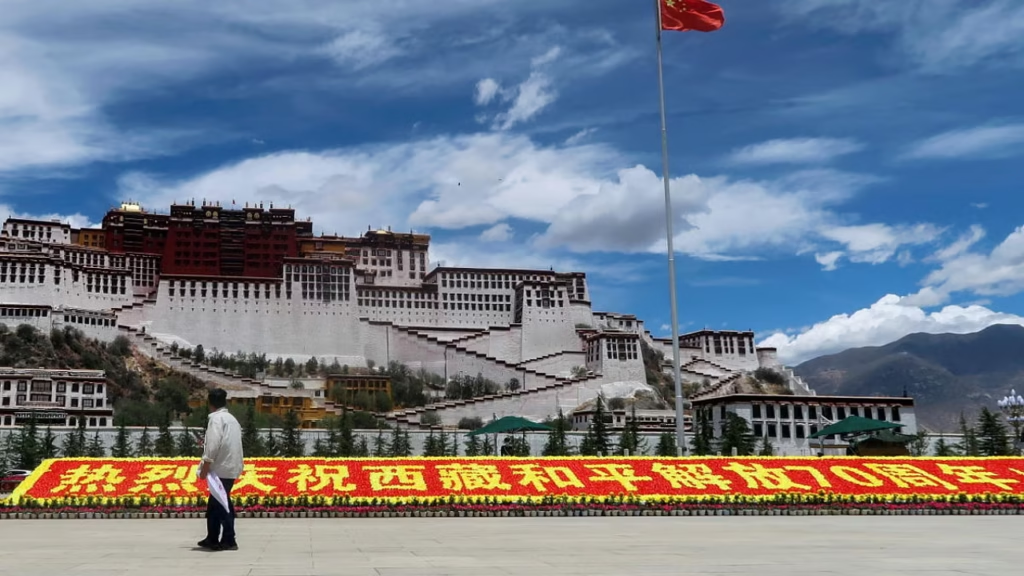
China’s framing of Tibet – as a backward feudal society liberated by the Communist Party – remains powerful, both domestically and increasingly abroad. Even informed Han Chinese audiences often accept accounts of old Tibet as a brutal serfdom and expect gratitude for the change.
When I raised some of these claims with Tibetans, they admitted the serfdom did exist but those were old times. As to the sensational claims of killing children to make ritual objects, they expressed surprise. Practices such as using human skin referred to remains of the deceased – similar in spirit to sky burials, where bodies are offered to vultures as part of a spiritual cycle.
Language, too, is a battleground. From 2023, official Chinese documents have increasingly used Xizang rather than Tibet, reinforcing a China-defined identity.
But in Dharamsala, the Tibet Museum lays out a clear narrative: a 1934 National Geographic showing the Tibetan flag among those of sovereign states; a 1940s Tibetan passport; currency from the same period.
Tibetans argue that their historical territory extends well beyond the current Tibetan Autonomous Region and that the 17-Point Agreement was signed under duress. Former Chinese paramount leader Deng Xiaoping reportedly once said “everything is negotiable except independence” – a remark later denied by successors. There has been no official dialogue between China’s leaders and the Dalai Lama or his envoys since 2011.
Politics in exile
At the Central Tibetan Administration, the government in exile, bold slogans greet visitors: “Even the Great Wall of China Can’t Stop the Truth” and “Tibet is not a province, it’s a stolen nation”.
What struck me most was the openness. There is no pretence of unity of opinion. Some activists support the Dalai Lama’s “Middle Way” approach – seeking autonomy within China – while others advocate independence.
Deputy Speaker Dolma Tsering Teykhang, with her warm crescent-shaped eyes and smile, describes lively parliamentary debates that are streamed. Women are prominent in leadership. Even nunneries now have debating halls, reflecting progressive attitudes in Tibetan society.
Meeting the Dalai Lama
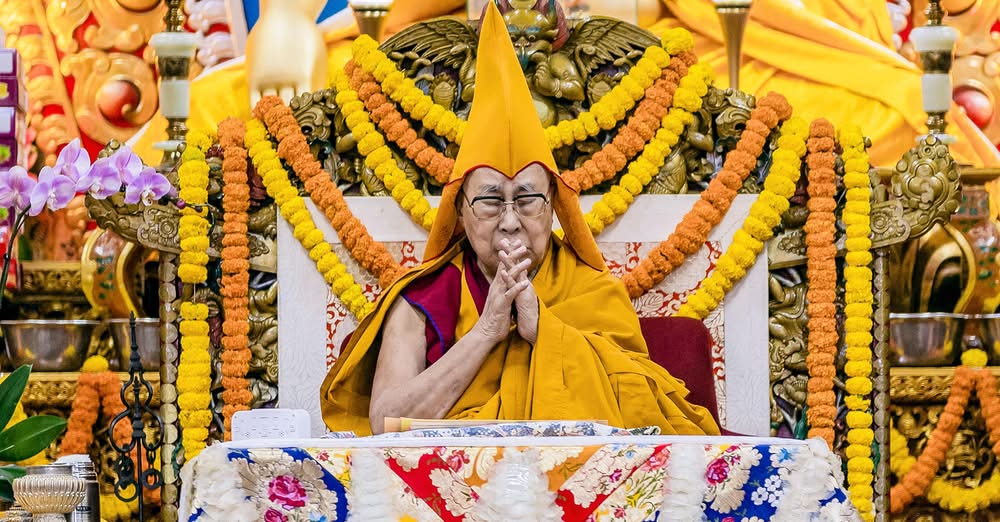
The Dalai Lama, who turned 91 last week, has been a constant figure in global consciousness for decades. He remains energetic, speaking in a clear, steady voice with a distinctive Tibetan-Indian lilt.
He is also playful. During our meeting he jokes, flexing his bare arm under his robes: “Guns are cheating. I only have this.” He grabs the beard of Chinese-born Australian political cartoonist Badiucao.
Australian journalist Cheng Lei with the Dalai Lama at an event commemorating the 67th anniversary of the Tibetan National Uprising in Dharamshala.
When asked what he would say to world leaders sceptical of nonviolence, he replies simply: “Even a child prefers peace.” He often cites India as an example of religious coexistence, calling it a precious model.
Recalling a meeting with Mao Zedong, the young Dalai Lama had said: “Peace is not guns, peace is peace of mind.”
Mao – famous for telling Soviet leader Nikita Khrushchev “So what?” about the prospect of nuclear warfare killing 300 million Chinese – leant forward and gave the Dalai Lama a hard stare that made him a little afraid.
When I ask what he would say to Xi Jinping about declining civil liberties in China, the Dalai Lama pauses before answering: “Communism is supposed to mean freedom for the public … but under communist China, it’s the opposite.” Then, after a beat: “I would rather live in India.”
A Han Chinese perspective
As a Han Chinese who grew up in central China, for me Tibet in primary school geography was simply one among many “ethnic minorities”. Their existence felt abstract.
Later, I encountered ethnicity more concretely. My first husband was officially classified as Hui, one of China’s largest recognised ethnic minorities, descendants of Persian and central Asian traders.
Most Hui are traditionally Muslim and, unlike Tibetans or Uighurs, generally speak Mandarin as their first language. His mother, a Hui, said the designation brought advantages – you could have more kids, get easier university access.
Because the Hui, numbering at about 11 million, are so assimilated and dispersed – with no single autonomous homeland to defend the way Tibetans or Uighurs do – Beijing has treated them as the “model minority”, largely spared the surveillance and restrictions imposed on Xinjiang or Tibet.
In Beijing, neighbourhoods such as Niujie preserved Hui culture through food and customs. There were far more Han-Hui marriages than those between Han and Tibetans or Uighurs.
In Xinjiang, where my relatives live, I have seen control tighten over the years, especially after the 2009 massacre in which hundreds were killed in violent Han-Uighur clashes. When I asked about the reason for the social unrest, my relatives thought the change started to happen after Han and Uighur kids started going to different schools.
The official narrative celebrates unity with a cliche made famous in song: 56 ethnic groups bound together like seeds in a pomegranate. But unity seemed to allow only one acceptable voice. Ethnicities are all born equal, some are more equal than others.
A Han sense of superiority, shaped by stereotypes and decades of propaganda praising the advantage of togetherness, has left perspectives deeply divided. Most contemporary Hans have never known heterogeneity; the monoculture of CCP-rule overrides all distinct identity.
I wondered how my Han friends would see Dharamsala: would they recognise its freedoms and aspire to the calm of Buddhist devotion, or fixate on the broken roads and its visible lack of material prosperity? Could they see a Middle Way?
Sikyong Tsering, the equivalent of the prime minister for the Tibetan government in exile, and the Dalai Lama both speak of the rise in Buddhism in present-day China and the hope is that one day Buddhists can help provide mental wellbeing for the material-saturated but spiritually bereft Han.
It is doubtful that the narcissistic disorder of the CCP would permit anything other than party ideology to fill people’s minds.
Assimilation and identity
China’s current direction – emphasising “ethnic unity” under formal legislation that came into effect this month and mandating Mandarin language usage – reflects a broader push toward cultural integration.
Some observers argue this helps minorities compete economically. Others see it as eroding identities and repressing freedoms.
The question is not unique to China. In Australia, too, debates over multiculturalism and national identity are intensifying. How much difference can a society accommodate while maintaining cohesion? Too much fragmentation can fuel nationalism; so can forced uniformity.
Where to next?
As older generations of Tibetan activists die and fewer new exiles arrive, the movement faces an uncertain future. China appears content to wait. Each side may eventually recognise its own Dalai Lama.
As time wears on, China is betting on its narrative overpowering voices of protest. “Obedient children” such as Macau are rewarded with policy candy and “ungratefuls” such as Hong Kong are beaten into line with sticks; and as more old China hands are pushed out, visa-free policies turn foreign tourists into propagandists who, based on superficial experience, reject every criticism of China. Even in Australia, the Chinese embassy recently bought space on small media outlets to publish its version of the Tibetan story.
In 2016 I had been part of a “foreign experts” group that visited the Tibet Autonomous Region. The two-week reporting trip was organised by the local government and included monasteries, a dairy factory, a yak farmer’s home, the Tibetan medicine college, a primary school and a thermal power plant. While I wasn’t chaperoned at all times, the interviews were monitored. I also felt the interviewees had been briefed and were careful in what they said.
Together, the two visits underscored how profoundly the understanding of Tibet can differ depending on which side of the Himalayas the story is told.
My 2016 trip focused on development and material progress against a background of carefully managed stability. Dharamsala in 2026 was filled with conversations about identity, freedom of belief and culture.
China argues that life has improved materially under its rule. Some Han Chinese even complain that autonomous regions such as Tibet and Xinjiang receive disproportionate resources and that so many Han workers helped build their infrastructure.
But the central question remains: should Tibetans not have a say in their own development?
Why are there restrictions on their movement? Why are images of the Dalai Lama forbidden? Why had Rangzen joined the more than 100 Tibetans to self-immolate in protest?
China is seeking to win the long game – through control, narrative and patience. But beneath that, unresolved questions persist.
Melbourne writer and broadcaster Cheng Lei’s travel was facilitated by the Tibet Information Office, Canberra.