
Department of Information and International Relations
By Kalon Dicki Chhoyang
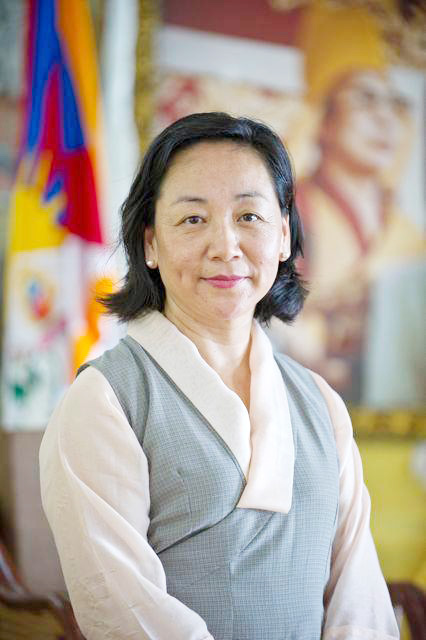
First of all I would like to extend my warm Tashi Delek to you all on the occasion of the 1st anniversary of the new Kashag. Taking this opportunity I want to speak a few words on the Department of Information and International Relations, and its activities.
The most important work of the DIIR is to create awareness about the situation inside and outside Tibet and garner as much support from the world community for the issue of Tibet. And especially considering the urgent situation prevailing inside Tibet, our work has become even more important. And to fulfill these objectives, we have various sections in our department. The sections are Audio/Visual section, Media Desk (English/Tibetan/Chinese), Tibetan Computer Resource Centre (TCRC), Environment and Development Desk (EDD), Tibet Museum, Tibet Support Groups Desk, UN, EU and Human Rights Desk, Narthang printing press etc. All these sections carry out their day to day work to the best of their abilities.
Speaking a few words on international relations, due to the critical situation prevailing inside Tibet, many countries have passed resolutions in their parliaments on Tibet. All these resolutions are available on our official website for all to see. Especially the resolutions passed in the European Parliament and the Upper House (senate) of the US Congress has been significant for our cause. For instance, we have been able to pass two resolutions on Tibet in one year in the European Parliament. The first one was passed in late 2011 and the second one in early 2012.
One of the most important ways through which we keep touch with the governments of other countries is through the Office of Tibet located around the globe. The Office of Tibet keeps in regular touch with the governmental and non-governmental organisations as well as the Tibet support groups from that country. The Tibet support groups are very important for our movement. Currently, we have Tibet support groups in over 55 different countries. And I was able to attend the TSG conference of Asia and Europe this year. And similarly, we have another TSG conference in early December this year.
The UN, EU and Human Rights desk in our department, in collaboration with the offices of Tibet in Geneva, takes charge of raising the issue of human rights situation in Tibet at UN and EU. Since human rights conferences are held thrice every year, our HR desk and the Geneva office works to bring out the issue of human rights violations in Tibet during those conferences.
Similarly, our media sections are very important. The press officer provide whatever help we could towards the media. And we, on our part, also contact them on a regular basis. For example, during the inauguration of Kalon Tripa Dr Lobsang Sangay last year, more than 95 media persons came to cover the event. And during the Kalachakra in January this year, more than 365 reporters from 22 different countries came to cover the event. We have provided whatever help we could to them during all these occasions.
As we all know, the english section of our media desk is very important. But at the same time, the Tibetan and Chinese desk are equally important. The Tibetan desk publishes Sheja magazine, Tibetan freedom newspaper and maintains a website on which they post as much news as possible. Moreover, the Tibetan desk is one of the main source of news about the situation inside Tibet for the various news organisations in Dharamshala.
The China desk also performs a very important role. In order to solve the issue of Tibet, we need to regularly contact the Chinese public. Therefore, we have three Chinese liaison offices in Australia, New York and Europe, as well as the office of Tibet in Taiwan, which regularly tries to inform the Chinese public about Tibet. We use all sorts of mediums like videos, books, pamphlets or even the world wide web to inform the Chinese public about the situation in Tibet. With that aim in mind, we have recently released some videos in Chinese language about the CTA and the devolution of political authority by His Holiness. Similarly, Tibetonline is also a very important media outlet of our department. The number of visitors to the website keep on increasing especially from India and north America. We provide daily updates not just about Dharamshala but also about the urgent situation in Tibet. We have already released three videos about the situation in Tibet and are in the process of releasing a fourth one soon.
Moreover, unlike before, this time we are trying to bring out the speeches of the Kalon Tripa both in videos as well as the texts. Similarly, during the Kalachakra, we have shown live telecast of the teachings to the public with the collaboration of Janta TV.
The urgent situation in Tibet is not just about human rights. The environmental issues facing Tibet is also one of the main concerns requiring immediate intervention. Therefore, our Environment and Development Desk (EDD) which researches on Tibet’s environment works hard to raise the issue in various environmental conferences across the world. For example, our staff attended the Rio2012 in Brazil as well as the Copenhagen summit. The EDD also works to create awareness about environment within the Tibetan community in exile.
The Tibetan Computer Resource Centre (TCRC) worked on upgrading our official website with new features. Modern social media tools like facebook, twitter, flicker has been added in order to reach a wider section of the society. It was launched by Kalon Tripa Dr Sangay in late last year.
We also making efforts towards raising awareness about Tibet through pictorial exhibitions carried out by the Tibet Museum. We have a permanent exhibition at the Tibet Museum, Dharamshala and a traveling exhibition.
And speaking as the Kalon for the DIIR, I traveled to five different countries such as Canada, Belgium, South Korea, Japan, and Taiwan in the last one year. During my visit, I met with a lot of government officials and the local Tibetan community as well as the local Tibet support Groups and the press, and discussed with them about the urgent situation inside Tibet. I also expressed my gratitude to them for their support and urged them to continue their support. And I hope to visit other countries in the future.
And personally speaking, since it is my first time serving the CTA, I consider it important to study the work of each and every section of the department before starting my work. And under the visionary leadership of our His Holiness, the foundation of our movement is very strong. And we should utilise the foundation to strengthen our movement especially in view of the grim situation in Tibet.