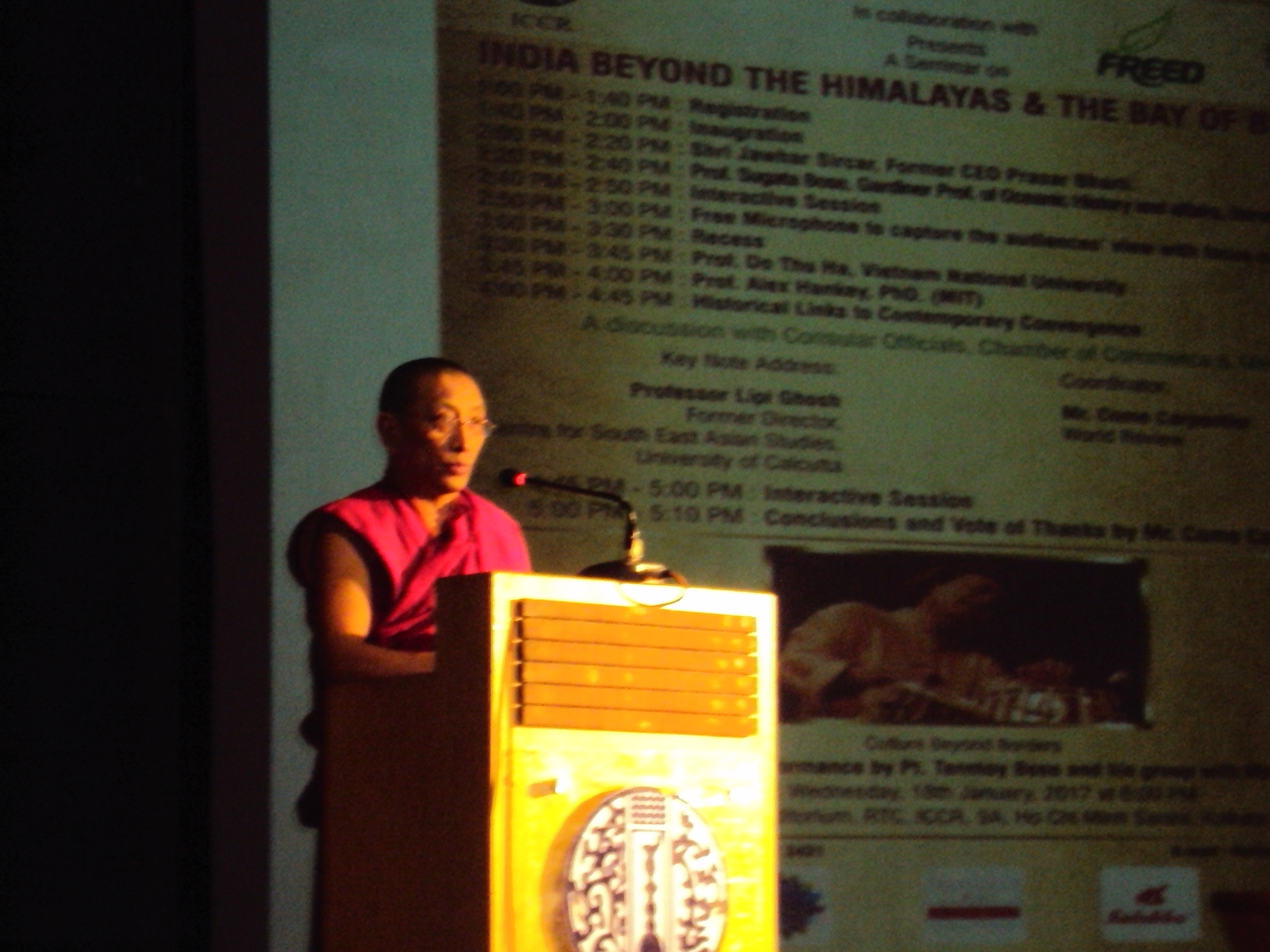

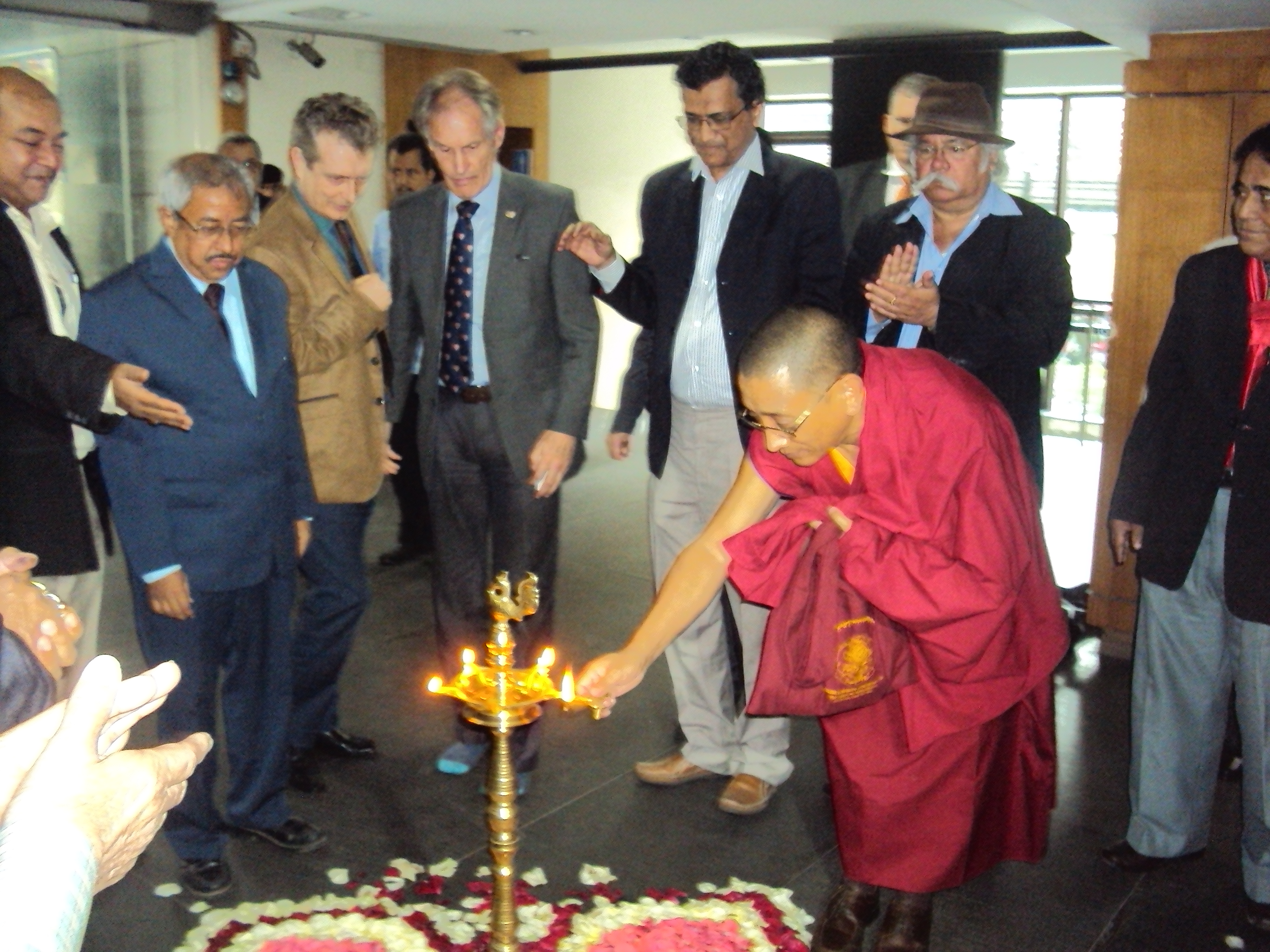
KOLKATTA: Venerable Karma Gelek Yuthok, Kalon of the Department of Religion and Culture, Central Tibetan Administration, addressed an international seminar on ‘India Beyond the Himalayas and the Bay of Bengal’ at ICCR Kolkata on 18 January 2017.
In his speech, Kalon Karma Gelek Yuthok spoke about India as a source and center of positive human developments emanating from the rich traditions of the Nalanda Buddhist university of ancient India.
“India had been, still is, and will always be the greatest source and center of positive human developments – cultural, spiritual, economic, scientific and technological, educational and political. The need of the hour as many of us see is that India must rise up to the situation, not only for the world but for herself as well,” he said.
He spoke about the three main commitments of His Holiness the Dalai Lama towards the world. He also spoke about the contribution of Indian Buddhist scholars in the introduction of Buddhism in Tibet.
“Through invitation of renowned Buddhist masters from that university to Tibet and through translation of most of the Buddhist texts into Tibetan from Sanskrit, the great tradition and treasure of Nalanda gradually moved over to Tibet in its complete form.”
He particularly outlined the contributions of Atisha Dipamkara Srijnana, a royal prince turned Buddhist saint, who was born in the land of Bengal in 982 and passed away in Tibet in 1054.
“It can be said with a very high degree of confidence that the Buddhadharma that came to Tibet over a period of four centuries – eighth to eleventh centuries – was authentic in content and complete in form.”
“It was all due to the pure motivation, the brilliant wisdom and the hard work of three sets of extraordinary people. A set of devout Tibetan Dharma Kings; a set of compassionate Indian Buddhist Masters; and a set of dedicated Tibetan Translators.”
“The great Indian Buddhist Masters who visited Tibet in person and helped the Tibetan Dharma Kings of their times to establish the doctrine of Buddhadharma in Tibet included Acharya Shantarakshita, Acharya Padmasambhava, Acharya Vimalamitra, Acharya Kamalashila, Acharya Jinamitra and Acharya Atisha Dipamkara Srijnana.”
“Acharya Atisha saw the situation and emphasized on study and practice of the Dharma in a graded manner without jumping on to the higher teachings of emptiness and Tantra. He taught that there was no way to understand and practice the higher teachings without understanding and practicing the basic teachings.”
“Atisha preached and introduced the graded method of study and practice of the Buddhist teachings with strong emphasis on the basic and primary teachings. Later all major Buddhist schools in Tibet framed their study and training systems in accordance with the Atisha’s instruction.”
“One unique and important feature of Tibetan Buddhism is the inclusion of all essential teachings of the Buddha in one package and arranging them in their proper places and order. In other words, it was indicative of the important fact that every teaching of the Buddha, irrespective of its time and place of teaching, fits somewhere in the main master plan of leading all sentient beings to the state of enlightenment,” he said, adding that Atisha’s coming to Tibet and doing what he has done is a very good example of India’s wisdom going beyond the Himalayas nearly 1000 years ago.
The speech was delivered at the Rabindranath Tagore Centre of the Indian Council for Cultural Relations (ICCR) based in Kolkatta. ICCR, founded in 1950, is the pre-eminent instrument of cultural diplomacy with a mandate to engage in a creative dialogue with other nations showcasing the diverse and rich cultural tradition of India while promoting dialogue with them through academic and cultural exchanges.