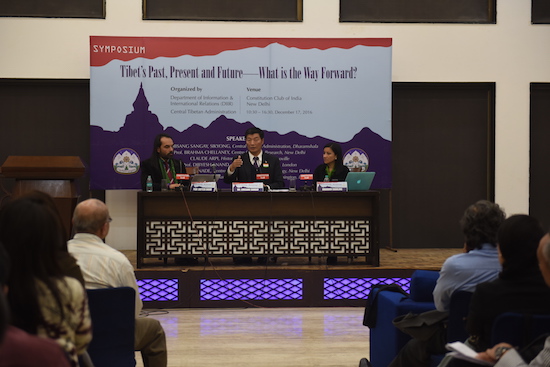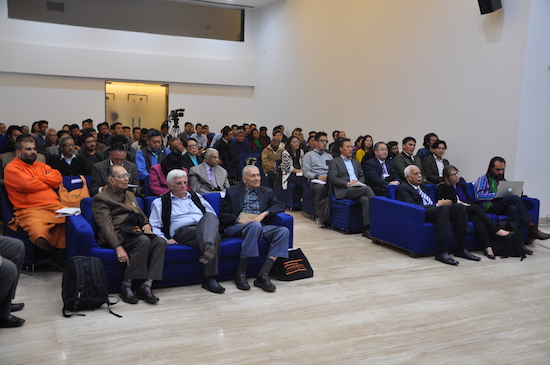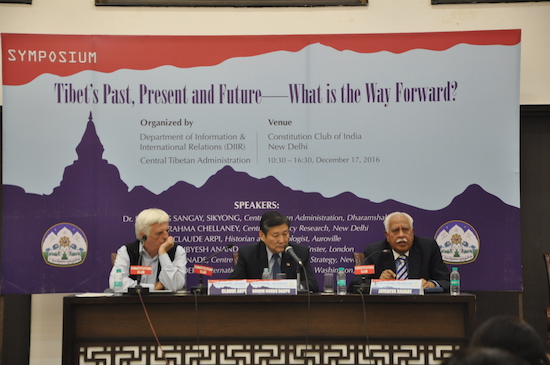
NEW DELHI: The Department of Information and International Relations (DIIR) of the Central Tibetan Administration held a daylong symposium on ‘Tibet’s Past, Present and Future – Whats the way Forward?’ at Constitution Club of India, New Delhi.
The symposium featured three plenary sessions focusing on Tibet’s historical past, the current situation inside Tibet and the Middle Way Policy of the Central Tibetan Administration to resolve the Tibet issue.
The symposium brought together a host of thinkers, scholars, intellectuals, and writers from across the academic spectrum.
The first session featured historian Claude Arpi and Mr Jayadeva Ranade from Center for China Analysis and Strategy. Mr Sonam Norbu Dagpo, Secretary of DIIR, moderated the session.
Historian Claude Arpi spoke about Tibet from a geopolitical perspective and elucidated the importance of Tibet from a security point of view for India as well as for China.
Mr Jayadeva Ranade, spoke about the hardening of the Chinese state under President Xi Jinping and how it could affect China’s Tibet policy.

The second session featured eminent environmental researcher Prof Brahma Chellaney from Center for Policy Research, and Kate Saunders from the International Campaign for Tibet. The session was moderated by Ms Kalden Tsomo.
Prof Brahma Chellaney spoke about Tibet’s rich natural resources and how with the occupation of Tibet, China has changed the water map of Asia in once stroke. He also explained the impact of environmental degradation in Tibet to immediate climate change in other parts of the world. “Tibet is Asia’s principal rainmaker and there would be no rain in India without Tibet.” He also said that the effects of global warming is more prominent in Tibet than in the south and north poles.
Kate Saunders gave a presentation on the present political situation inside Tibet particularly focusing on religious freedom. She spoke about China’s attempts to undermine Tibetan religion through demolition of the Larung and Yarchen Gar Buddhist institutes. And yet at the same time, use the influence of Tibetan Buddhism by coopting Gyaltsen Norbu as their Panchen Lama to influence Tibetan culture and perception.
The final session featured Sikyong Dr Lobsang Sangay and Prof Dibyesh Anand from the University of Westminster, London. It was moderated by Ms Tenzin Dhardon Sharling, DIIR Secretary.
Sikyong Dr Lobsang Sangay spoke about the viability of the Middle Way Approach as a realistic approach to resolving the Tibet issue and said that if Tibet succeeds, India succeeds.
Prof Dibyesh Anand argued that India, while being one of the strongest supporters of Tibet, could also do much more to advance the Tibet cause and cited a few examples where he felt the Indian government is lacking in their support for the Tibet issue. He called for a pragmatic reassessment of India’s Tibet policy, Tibet’s strategic soft power leverage for India and revitalised bureaucratic effort for the Tibetans in exile, among others.
The daylong symposium was attended by students, researchers, policymakers, retired generals, former bureaucrats and scholars.