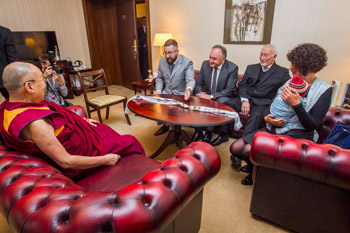
October 16, 2016. Photo/Somogyi
Bratislava, Slovakia, 16 October 2016 – Before embarking on his public commitments this morning, His Holiness the Dalai Lama received an official Slovakian Parliamentary delegation. Ms Lucia Nicholson, Deputy Speaker of the National Assembly; Mr Frantisek Sebej, Chairman Foreign Affairs Committee; Mr Martin Poliacik, MP and member of the Tibet Group and Mr Pal Csaky, MEP and former Deputy Prime Minister of Slovakia called on him in his hotel.
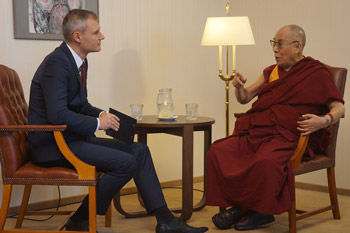
Bajanik asked if the crises in Iraq and Syria can really be solved through non-violent means and His Holiness answered that the use of violence only leads to more violence. The 20th century saw immense violence and the imposition of tight control in many places. In the end, the only way to solve problems is through talk and dialogue. In the long run he said he looks forward to a demilitarized world. And the first step, as one of his Nobel Peace Laureate colleagues declared is to stop the trade in arms.
As to whether he sees a future for Tibet as a democratic country, His Holiness observed that since his childhood he had felt there was much in the old system that needed to change. After taking responsibility for Tibet he set up a reform committee, but the Chinese opposed it because they wanted changes to be done their way. Democratisation began in early 1959 with the establishment of the Tibetan Parliament in Exile, a process that culminated in His Holiness’s retirement and devolving political responsibility to the elected leadership in 2011.
When Bajanik asked how to achieve happiness in a violent world, His Holiness told him we need to learn how to deal with our destructive emotions and conduct ourselves with honesty, transparency and warm-heartedness.
Invited to address students and faculty at Comenius University, His Holiness was welcomed at the door by Rector Karol Micietal who escorted him into the meeting to strains of triumphalist music. Prof Martin Slododnik introduced him to the 250 strong audience.
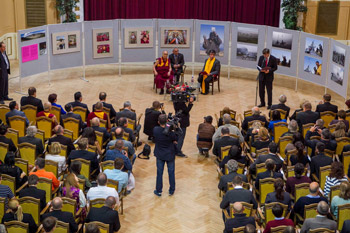
“Too often we think in terms of ‘us’ and ‘them’, a division that contains the seed of conflict. The use of force to solve problems is the wrong approach. After the bloodshed of the 20th century, it is important that we make this 21st century an era of dialogue instead, which involves solutions of mutual benefit.”
His Holiness mentioned his commitments to promoting human happiness and encouraging inter-religious understanding before inviting questions from the floor. In answering these he reiterated his view that real happiness comes from warm-heartedness. He explained that in addition to a limited instinctive, biological sense of compassion, we can develop a more extensive impartial sense of compassion through training and education. Such compassion can even be extended towards our enemies. His Holiness explained that to compensate for the inadequacies of modern education it is possible to cultivate universal values on the basis of our common experience as human beings, our common sense and scientific findings.
Photo/Jeremy Russell/OHHDL
Back in the city at the National Tennis Centre in the afternoon, His Holiness walked onto the stage waving and acknowledging the welcoming applause of the 4000 in the audience. Martin Butora, Advisor to the President told them, “I’ve been asked to do the impossible, to introduce someone who needs no introduction,” and the applause increased. His Holiness gestured to everyone to sit down and began his talk.
“Look, I’m a normal human being. One nose, two eyes, a mouth in a smile. I’m very happy to be here. This morning I met students and teachers at the University and now I’m happy to be able to talk to you. We may have different faiths and beliefs, but we are all equally human beings. Scientists have found that constant anger, fear and anxiety undermine our immune systems, so it’s in our own interest to cultivate peace of mind. Affection and compassion are the source of inner peace. They are qualities necessary for social animals like us.
“In the early part of the 20th century, when the first and second world wars broke out, people proudly and unhesitatingly joined up to serve the war effort. I feel this has changed, that people have got fed up with war. Also, in the early 20th century, no one talked about the environment or taking steps to protect it, nor were there the inter-faith meetings that we see today. After so much violence and conflict, these are all positive developments.
“My third commitment concerns my being a Tibetan. Since 2011, I have completely retired from any political responsibility and have ended any such role for Dalai Lamas in the future. However, I remain deeply committed to the welfare of the Tibetan people and encouraging the protection of Tibet’s language, culture and natural environment.”
In answering questions from the audience His Holiness told one distraught young woman, who wanted to know how to keep calm when faced with crisis, that among the 7 billion human beings, everyone has some problems. He told her that he follows the advice of an 8th century Indian master to assess the problem from a wider perspective to see if it can be overcome. If it can there is no need to worry any more, the important thing is to make the effort and do it. If it can’t be overcome, worrying about it won’t make things any better.
He told another questioner that forgiveness does not mean forgetting what may have been done to you, but it enables you not to feel angry about it any more.
Asked how competing politicians could bring more love and compassion to their work, he said,
“I’ve just had lunch with your marvellous President. We talked about how politics can often become dirty, but he told me that what he really wants is to serve the people. We found we have a lot in common. We talked about how existing education systems focus on material goals with too little attention to inner values. There needs to be a more holistic approach. I mentioned to him that a curriculum to enable young people to learn more about universal values is being prepared.”
After words of thanks His Holiness left the stage to warm applause.
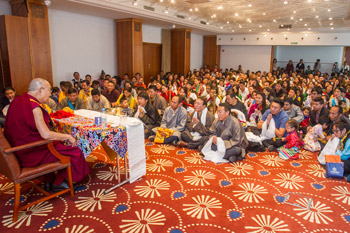
Back at his hotel His Holiness met briefly with 240 Tibetans who had mostly come to see him from Austria. He reminded them that as refugees they represent the 6 million Tibetans in Tibet. He encouraged them to be 21st century Buddhists, not only to recite the 21 Tara prayers but to study what the Buddha’s teachings mean. This includes coming to understand the workings of the mind and emotions. He asked them to ensure that their children learn Tibetan.
He observed that there are now estimated to be 400 million Buddhists in China, many of them recognising the importance of Tibetan Buddhism and wanting to know more about it. He also looked forward to the 19th National Congress of the Communist Party of China that will be held in Beijing next year and his hopes that it will result in change for the better.
Tomorrow morning, His Holiness will travel from Bratislava to Prague in the Czech Republic.