
dalailama.com
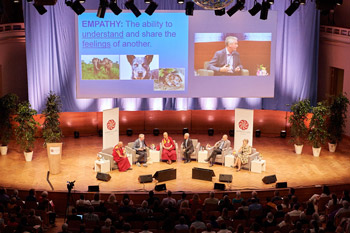
Brussels, Belgium, 9 September 2016 – This morning the streets of Brussels were still quiet as His Holiness the Dalai Lama drove to the Bozar Centre for Fine Arts. The route took him past grand government buildings, various ornate churches and the impressive equestrian statue of the Crusader Godfried of Bouillon in Royal Square. Walking from the car through the Bozar Centre to the Henry le Boeuf Hall, old friends, well-wishers and members of the public pressed forward to interact with him.
Asked to comment, His Holiness replied:
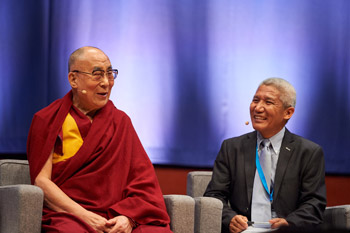
His Holiness spoke of the conflicts that have wracked Europe in the past culminating in the violence and destruction of two World Wars. In the light of this the formation of the European Union was a great idea and a sign of maturity. He quoted his one-time physics tutor Carl Friedrich Freiherr von Weizsäcker, who told him that in his childhood for the French every German was an enemy and for every German the French were viewed likewise, but no more. This has changed.
He praised Mind & Life for paying attention not only to material developments, but also to their accompanying inner values. The result he hopes to see is more widespread physical well-being and inner peace. He pointed out that it is not only those who believe in religion who need love and compassion—we all do. Although studying chimpanzees can tell us something about human behaviour, His Holiness remains sceptical about what it can reveal about human intelligence, the misuse of which leads to conflict.
His Holiness mentioned something that has intrigued him. Where human mothers are compassionate and bond with their children, turtles lay their eggs in sand and are not present when they hatch. Between young turtles and their absent mothers there is no bond of affection.
He repeated that scientific findings that basic human nature is compassionate is a source of hope. It means that if we make the effort, we can make positive change. He said that the natural openness of children, who do not care about superficial differences with their playmates, often does not survive into adulthood because of the inadequacies of an education system that has little room for inner values.
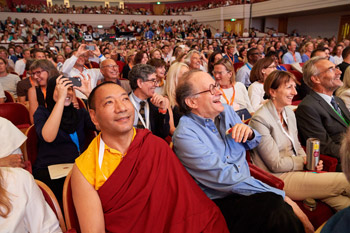
Listening with interest and concern, His Holiness’s comment was “Wonderful, thank you,” and the meeting broke for lunch.
The afternoon session, moderated by Roshi Joan Halifax, focused on perspectives from psychology, endocrinology and neuroscience. Prof Dr Alexandra Freund began by contrasting powerful people. She suggested that if asked to name someone really powerful, people might mention Hitler or Mao. However, she suggested that in taking power from the British and delivering it to the Indian people, Mahatma Gandhi exercised great power through peaceful means. She spoke of the power motive, referring to the goal to which you direct your efforts. She said power is about exerting influence, whether over people or the environment and that we can discern a dark and a bright side to power.
Prof Dr Tania Singer, a Neuroscientist talked about her findings in relation to power and care from work she has done with people undertaking secular meditation training in care and compassion. She observed that people do not just become more compassionate with age. It’s necessary to engage with compassion through training and involves effort. What’s more, meditation is not a universal panacea, the effect of your meditation depends on what meditation you do. Recent findings in neuroscience suggest that altruism and compassion can indeed be developed through training, leading to brain plasticity and pro-social behaviour.
“My message is that we should address our inner enemies with the same care and compassion that His Holiness advocates applying to our external foes.”
In his closing remarks, His Holiness said:
“I appreciate people’s taking interest in mind and emotions. This is a good beginning. I mentioned this morning that the real trouble makers are in our own minds. If you have peace within, external problems will not disturb your mind. You may even be able to manage your own pain. When it comes to meditation, analytical meditation, in contrast to concentrative meditation or mere mindfulness, require us to employ our intelligence.
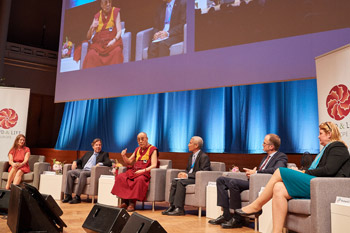
“None of us wants problems and yet we create so many for ourselves. If we want to change, where do we start? Not with the government or big institutions, but with ourselves as individuals. Through transforming our minds and developing inner values we can change ourselves, influence our families and communities and so bring about a change in humanity. Starting with ourselves we have to let compassion become part of our daily lives.”
The conference will continue tomorrow with sessions looking at perspectives from spiritual and religious traditions and from economics and society.