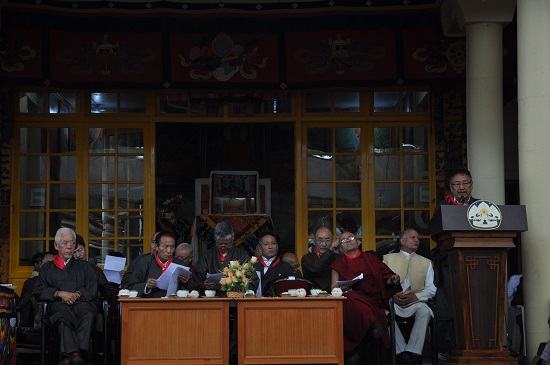
DHARAMSHALA: Tibetans, friends and devotees of His Holiness the Dalai Lama gathered in large numbers at the Tsuglagkhang, the main Tibetan temple in Dharamshala, to participate in the official 81st birthday celebration of His Holiness the Dalai Lama. His Holiness the Dalai Lama, who is currently at Mundgod Tibetan settlement in south India, is turning 81 today.
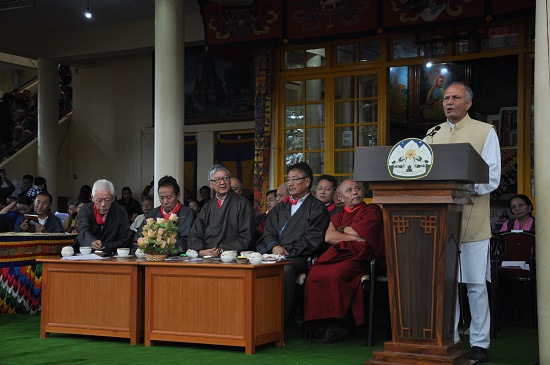
The celebration was attended by Tibetan justice commissioners, Kalons, members of the Tibetan Parliament along with staff of the Central Tibetan Administration and representatives of Tibetan non-governmental organisations. Other dignitaries include Mr Ajai Singh Mankotia, President of the Indo-Tibetan Friendship Association.
As Sikyong Dr Lobsang Sangay and Speaker Khenpo Sonam Tenphel are both in Mundgod, the official statements of the Kashag and Tibetan Parliament were read out by officiating Sikyong Kalon Sonam Topgyal Khorlatsang and Deputy Speaker Ven Acharya Yeshi Phuntsok respectively.
Expressing warm greetings to His Holiness the Dalai Lama, Kalon Sonam Topgyal Khorlatsang said: “On this joyous occasion of His Holiness the Great 14th Dalai Lama’s 81st birthday, on behalf of Kashag and Tibetans inside and outside Tibet, I would like to express our deepest reverence to His Holiness the Dalai Lama.”
“On this very day in 1935, following numerous auspicious signs and symbols, Lhamo Dhondup was born to father Choekyong Tsering and mother Dekyi Tsering in Taktser village, located in the Amdo region of Tibet. We owe deep gratitude to the great parents for blessing us with their precious son. His Holiness’ birth at the fringes of the Tibetan plateau is similar to previous great Lamas and several Dalai Lamas who have chosen specific birthplaces to signify unity in Tibet,” he added.
Applauding and paying gratitude to His Holiness the Dalai Lama’s vision for a democratic Tibetan polity, the officiating Sikyong explained the efforts exerted by His Holiness the Dalai Lama over the years to democratise the Tibetan administrative system.
“His Holiness the Great 14th Dalai Lama, even at a young age, had the vision of a strong united Tibet. Enthroned as the 14th Dalai Lama at the age of five, he had to take over the spiritual and temporal authority of Tibet at the tender age of 16, at a time when the People’s Republic of China illegally occupied Tibet. The young Dalai Lama immediately formed the Reform Committee to cater to the welfare of poor Tibetans, irrespective of their provincial or religious affiliations. This committee intrinsically helped strengthen Tibetan unity,” he said, reading from the kashag’s statement.
“At the age of 24, when His Holiness’ efforts for a peaceful resolution with China did not materialize, he declared the continuation of the Gadhen Phodrang government as the legitimate government of Tibet and its temporary establishment at Lhuntsedzong. After His Holiness sought refuge in India, it was in the hilly Indian town of Mussoorie that His Holiness instituted the Kashag of the Tibetan Administration-in-exile affirming their commitment to fostering unity among Tibetans. In May 1960, the Central Tibetan Administration was moved to Dharamsala and to ensure administrative effectiveness, His Holiness announced the portfolio of the Kalons.”
“On November 17, 1959 in Mussoorie and on July 1st, 1960 in Dalhousie, His Holiness shared his vision of democracy. He said, “It is wrong and very dangerous to harbor prejudices between U-Tsang, Amdo and Kham. You should continue to develop internal harmony and be as firmly united as an iron ball.” With a steadfast commitment to represent unity among Tibetans, leaders of all three provinces, monastic institutions and former staff members of the Gaden Phodrang government in Tibet gathered at Bodhgaya and took the Na-gyen Chenmo (great oath) and pledged iron-like unity under the leadership of His Holiness the Dalai Lama,” he added.
The Kashag’s statement also pointed out the dangers posed by sectarian and regional divisions which came into particular prominence during the recent election campaigns and strongly emphasised the importance of maintaining unity and harmony.
“Our exile history tells us that for the first few decades, there have been instances of regional and sectarian discord but they have been diluted overtime. Since the 90s, for two decades, harmony and unity among Tibetans was widespread and were at its peak. Hence in 2011, His Holiness believing in Tibetan unity and political maturity accordingly devolved his political authority to the elected leadership.”
“However, during the final round of the 2016 election of Sikyong and the members of the Tibetan Parliament-in-Exile, traits of regionalism was raised. His Holiness was hurt as made clear from his speech during the 2016 swearing-in-ceremony of Sikyong. “I was pained to see the degradation of morality and the overtones of regional biases during the election campaign. It is very unfortunate. The unity of the three traditional provinces of Tibet is of primary importance. Therefore, we should do away with this warped sense of biases to regions and move on as one. If you consider me your friend, please pay attention to what I have said.”
“This remark by His Holiness the Dalai Lama bears a disconcerting resemblance to the ones given in 1959 and 1960. Instead of progression, the final elections witnessed regression. Regional biases were not only expressed, but acted upon, thereby creating disharmony. However there is a window of opportunity for us to rectify our mistakes and redefine our destiny. Mahatma Gandhi had said, “Your beliefs become your thoughts, thoughts become words, words become actions, actions become habits, habits become values and values become your destiny.” Therefore, we urge Tibetans everywhere to remove their regional and sectarian partisanship from their thoughts, words and actions because we cannot afford to churn them into our destiny.”
Delivering the statement of the Tibetan Parliament, Deputy Speaker Acharya Yeshi Phuntsok highlighted the achievements of His Holiness the Dalai Lama and the unique, indispensable leadership provided by His Holiness the Dalai Lama during one of Tibet’s most tragic periods.
“In 1949, communist China began its invasion of Tibet from its eastern borders; as a result, the political situation in the country became highly precarious. The country was plunged into a situation of emergency and insurmountable difficulty. Such being the criticality of the situation, the deities and subjects of Tibet, without any exception, acted as one, making a spontaneous appeal to His Holiness the Dalai Lama with utmost earnestness. Accordingly, despite being only sixteen years of age at that time, he assumed his position as the temporal head and spiritual leader of the religiously and politically governed Snowland of Tibet. He then at once set up a Reform Bureau as a separate office in an effort to transform the prevailing political and administrative system in Tibet in all their aspects into one based on democracy and liberty. He thereby initiated a process to enable the citizens of Tibet to carry on their lives in an atmosphere of freedom.”
The Tibetan Parliament also lauded the middle way approach conceived by His Holiness the Dalai Lama to resolve the issue of Tibet.
“With regard to the Middle Way Policy for resolving the issue of Tibet, which is mutually beneficial to China and Tibet alike, His Holiness the Dalai Lama has, since 1974, held discussions on successive occasions with the speakers and deputy speakers of the Tibetan parliament in Exile, the Kalons, the officials of the Central Tibetan Administration, and delegates representing the Tibetan public. In 1979, Deng Xiaoping, the leader of communist-ruled China at that time, put forward the condition that anything except independence could be discussed and resolved. And on 18 September 1997, the Tibetan Parliament-in-Exile unanimously passed a resolution to adopt the Middle Way Policy for the resolution of the issue of Tibet. This has become a policy of the Central Tibetan Administration and has been repeatedly reaffirmed as such. The policy has also received support from the international community, both from collective bodies and at individual levels, including from many governments. Besides, and in particular, a truly great number of intellectuals and others in China extend support for it with gladness and this remains a continuously growing trend. Developments such as these are results of adhering with fundamental importance to the wishes of His Holiness the Dalai Lama whose practical approach to resolving the issue of Tibet is based on the reality of the current situation.”
The Tibetan parliament also highlighted the critical situation prevailing inside Tibet and appealed the world to pay extra attention towards Tibet to resolve the issue as soon as possible.
Mr Ajai Singh Mankotia, President of Indo-Tibetan Friendship Association, expressed his heartfelt greetings and birthday wishes to His Holiness the Dalai Lama on behalf of the local Indian community. He extolled the efforts of His Holiness the Dalai Lama to bring peace and foster harmony in the world and urged everyone to practice the values embodied by His Holiness.
He also appealed everyone to exert efforts towards making Dharamshala a truly spiritual destination which reflects the blessings and teachings of His Holiness the Dalai Lama.
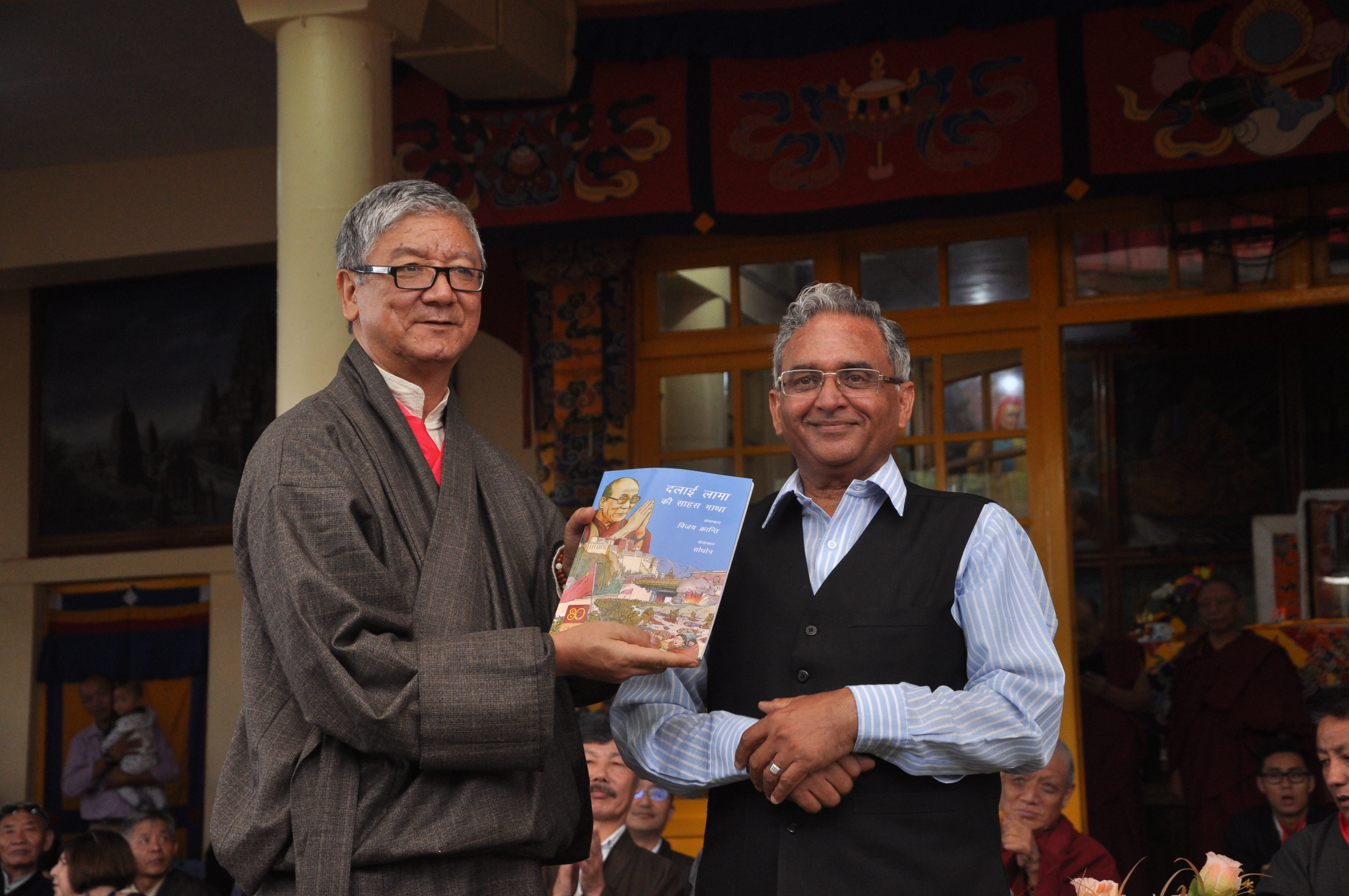
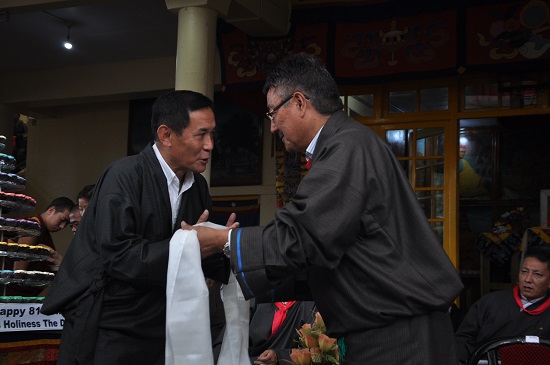
The official function also featured the launch of the Hindi version of the comic book ‘Dalai Lama – Soldier of Peace’ and a book on the life of former Tibetan political prisoner Lobsang Tenzin. Two distinguished staff and three civil servants who have served in the Tibetan administration for more than 25 years were also felicitated during the function.
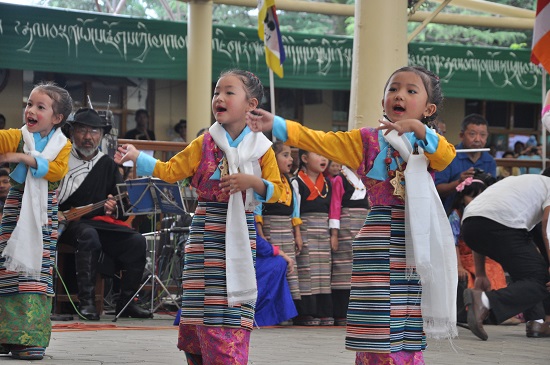
The celebration further included cultural performances by the Tibetan Institute of Performing Arts and by students of Tibetan schools. Local Indians also distributed sweets on the streets of Mcleod Ganj in celebration to mark the auspicious occasion.
Born on 6 July 1935 to a peasant family in Takster village in the Amdo region of Tibet, His Holiness the great 14 Dalai Lama was recognised as the reincarnation of the 13th Dalai Lama when he was two years old. He was enthroned to the status when he turned five, was compelled to take over both the political and spiritual responsibility of Tibet at the tender age of sixteen and unfortunately led to his flight into exile in India at the age of twenty four due to Chinese illegal invasion of Tibet from 1949.