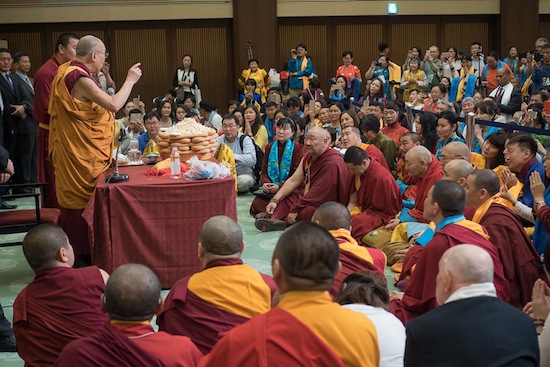


OSAKA, Japan: As His Holiness the Dalai Lama entered the convention center to resume teachings on the third and penultimate day, the audience greeted him with cheers and a round of applause.
Before beginning the formal teachings of the text, His Holiness the Dalai Lama spoke briefly about Lamrim ( A Lamp for the Path to Enlightenment ) composed by Atisha, an 11th century Indian Buddhist scholar who visited Tibet.
“I thought of talking to you a little about Lamrim today,”His Holiness said, as he started explaining the historical background of how the Lamrim text came into existence.
“A king in the kingdom of Guge located in western Tibet invited Atisha to Tibet and requested him to compose a teaching for Tibetans which will give a complete yet easily accessible summary of the Buddhist doctrine,” His Holiness said.
“Based upon this request, Atisha wrote the text known as Lamrim among Tibetan Buddhists. This text lays out the different stages of the complete path to enlightenment,” His Holiness added, and explained the three different capacities of practitioners, namely the practitioner of modest scope; practitioner of medium scope and practitioner of highest scope.
“Due to the popularity of the text, many different versions of the original text were presented by various teachers including Longchenpa of Nyingma tradition, Dagpo Lharje of Kagyu as well as Sakya and Gelug masters,” His Holiness noted.
Speaking about religion in general, His Holiness the Dalai Lama said that all religions are best suited to their own needs, time and region. “I never say Buddhism is the best religion of all. All the major religious traditions of the world are suited to the place, time and needs. The religion that gets you closer to happiness and makes you a better person is the best for you,” His Holiness said.
However, His Holiness the Dalai Lama added that Buddhism is much more than just religion. “Buddhism is beyond religion, it is a science of mind. Buddhism encourages scrutiny and analysis in contrast to adherence out of blind faith,” His Holiness explained.
‘Faith should be grounded in reason and logic. By reasoning, we can develop our understanding of the texts which will strengthen our faith,” His Holiness said, urging the audience to be 21st century Buddhists who studies, analyses and ask questions, rather than simply becoming Buddhists because our parents are Buddhists.
His Holiness also jokingly said that religion should not be used for scaring people with hell or heaven to command adherence. “Spiritual teachers should rigorously explain the concepts and philosophies of their religion. Such practices will strengthen the conviction and confidence of the believer to accept the validity of their teachings,” His Holiness said.
His Holiness then continued his teaching on ‘A Guide to the Bodhisatva’s Way of Life’ from where he has stopped yesterday. His Holiness taught the remaining chapters of the text speaking about diligence, meditation, perfection of wisdom and dedication.
On the subject of meditation, His Holiness said that meditation is not necessarily about being physically still devoid of conceptual thought. Meditation should be about developing a single-pointed mind with clarity and awareness. His Holiness also recommended a book for improving your meditative practice called ‘Stages of Meditation’ composed by the Indian master Kamalashila, during his visit to Tibet.
As His Holiness completed the final chapter of the teaching, His Holiness said that these teachings should not be treated like a history book but rather as guide to your daily development. “Think about what we’ve talked about. It’s not like a story; read it and think about it. If you do that your understanding will grow and your destructive emotions will decline gradually,” His Holiness concluded.
Tomorrow, His Holiness will give a transmission of the Manjushri permission followed by a recitation of Heart Sutra (Tib: Sherab Nyinpo) in Japanese, Chinese and other languages.