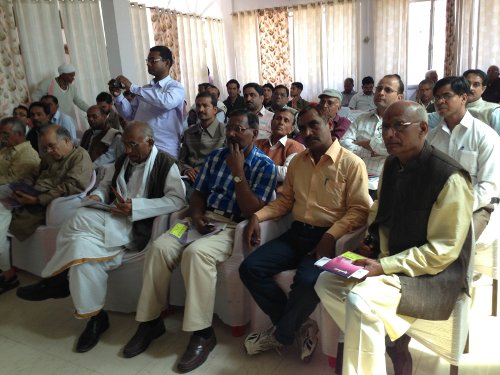

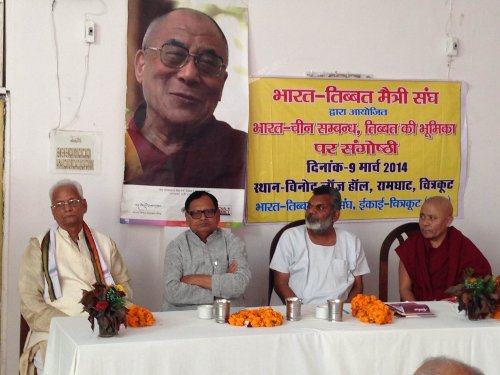
DHARAMSHALA: India-Tibet Friendship Society, a Tibet Support Group based in the northern Indian state of Uttar Pradesh, organised a seminar on the strategic role of Tibet in India-China relations on the eve of the 55th Tibetan National Uprising Day on 10 March.
Addressing the seminar, Acharya Yeshi Phuntsok, a member of Tibetan Parliament-in-Exile, spoke about the millenia old relationship between India and Tibet in religion, culture and language. He said that Tibet shares a close border with India
and China’s exploitation of Tibet’s environment and damming Tibetan rivers have a direct impact on downstream nations, including India.
Mr Surender Kumar, Secretary of Gandhi Peace Foundation, said that “Tibet’s occupation by China in 1959 had a direct impact on India’s security. The frequent Chinese military incursion into Indian border states such as Arunachal Pradesh, Jammu & Kashmir and Ladakh is a threat that resulted from colonisation of Tibet by China. He urged the Indian government to find a peaceful solution to the just cause of Tibet.”
Ms Neelam Charbha, a professor of M.G. Gramodhai University, said that the government of India needs to rethink its foreign
policy in view of frequent threats posed by China to its border areas. She said Indians consider Tibet as a sacred place where Kailash
Mansarovar, the abode of Lord Shiva.
Mr Ramesh Bhai, a long time supporter of Tibet, and Dr. K.B. Pandey, Vice Chancellor of Chitrakoot Handicapped University, said that the Tibetan people has always followed the principle of non-violence to resolve the issue of Tibet under the spiritual guidance and leadership of His Holiness the Dalai Lama. “We the people of India must be thankful to His Holiness the Dalai Lama for his contribution and devotion to the entire sentient beings. His Holiness calls himself the son of India. Therefore, India must support the Middle Way Policy to resolve the issue of Tibet,” they said.
The India-Tibet Coordination Office (ITCO) based in New Delhi distributed Tibet related books to the participants during the seminar.