
DHARAMSHALA: The President of the EU’s European Economic and Social Committee reiterated support for Middle Way Approach to resolve the Tibet issue through dialogue between the Chinese government and the Tibetan leadership.
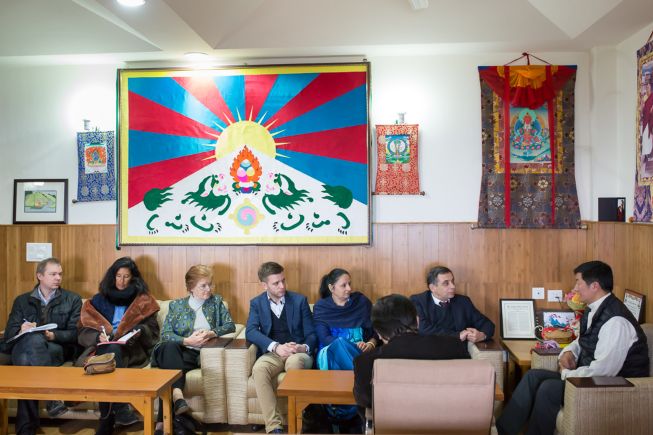
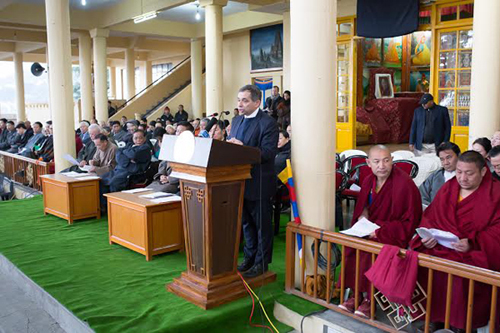
Mr Malosse said he was honoured to be the first president of the European Economic and Social Committee to visit the Central Tibetan Administration and attend the Tibetan National Uprising Day on 10 March.
“As the only president of the European Union to visit the government of Tibet in exile, he wanted to pay tribute to the victims of the repression in Tibet and through them to all the people deprived of liberty in China and everywhere in the world,” said a statement posted on his website.
“The Tibet question is universal”, said Mr Henri Malosse in his address at the Tibetan National Uprising Day in Dharamsala. “It is a question of liberty, democracy and solidarity, which are the values at the foundation of the European Union. As such, Europe has these values as a legacy and must defend them everywhere they are in danger in order to find a sustainable solution. Thus, support must be brought to the Middle Way Approach of Tibetans – Umaylam – and to the dialogue with China. It is the same approach that claims for a European involvement in the recent events in Crimea, not by following the other actors such as Russians or Americans, but by being more coherent and imposing dialogue between all the stakeholders,” he said.
“It is Europe’s duty to direct efforts towards setting up dialogue between the Tibetan people and the People’s Republic of China without pre-conditions. I thus firmly believe that civil society – in Tibet, China and Europe – has the potential to facilitate a peaceful way out of the crisis, as it has demonstrated in other conflicts in the past,” he said.
The EESC’s president praised the will of the Tibetan community in exile expressed through their level of organisation, democratic structures, and civil society’s commitment such as its active chamber of commerce. The Tibetan people have thus shown the strength of a people fighting for its dignity for more than half a century. Even if the road seems endless for Tibetans, the solution unexpectedly can be closer than it seems, such as was the case of the iron curtain in Europe even if Europeans are still struggling to prevent its return. “The Dalai Lama spoke about what is “beyond religion” such as ethics and a universal approach”, said Henri Malosse. “I will underline that we have to look for what exists “beyond empires” in politics to find a sustainable way of living together for the well-being of all peoples.”
Mr Henri Malosse finished his address by quoting His Holiness the Dalai Lama. “I hope that the 21st will be a century of peace, a century of dialogue, a century when a more caring, responsible and compassionate humanity will emerge”.