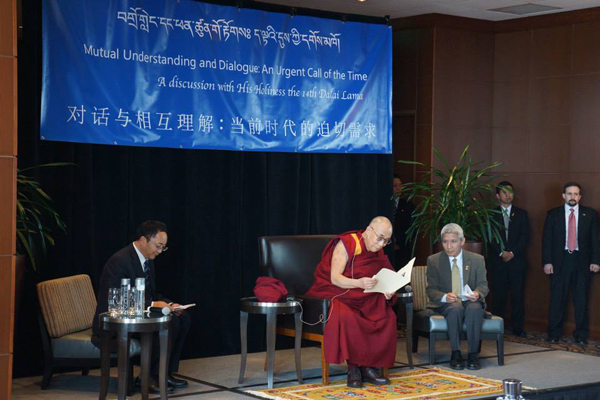
Photo/Sonam Zoksang
MINNEAPOLIS: His Holiness the Dalai Lama met with Chinese students at an event organised by the Tibetan American Students Association (TASA) at Minneapolis in Minnesota. The event brought together more than 330 students from 13 colleges among whom more than 250 were Chinese and 50 Tibetans.
Addressing them His Holiness the Dalai Lama said that he always considers himself to be just another human being because when we fail to appreciate the oneness of humanity, we tend to see people in terms of ‘them’ and ‘us’. Such a narrow, short-sighted view is the basis of conflict. He chuckled and admitted that if he was still living in the Potala Palace in Lhasa he might not have understood this, noting that while great misfortune had befallen Tibetans, it was not entirely without opportunity.
“Human problems must be solved by taking a human approach,” he said, “and dialogue is a way to find an agreeable, mutually beneficial solution.”
He explained that as early as 1974 Tibetans in exile decided not to seek independence. The Chinese constitution describes autonomy for counties, districts and so on and clearly lays down conditions for religious freedom. The trouble has been in the failure of narrow minded officials on the spot to implement these provisions. His Holiness pointed out that it was not until the Tiananmen incident in 1989 that Chinese began to express support for Tibetans. Those events overcame a long-standing misapprehension that Tibetans were against Chinese. Clearly Chinese leaders need to adopt a broader point of view. His Holiness remarked: “The People’s Republic of China has great potential to contribute to the world, but I remember the Malaysian Leader Tunku Abdul Rahman telling me that China fills its neighbours with fear. This needs to change; China needs to become more open and transparent. The generation of the 21st century are a source of hope. Such Han brothers and sisters have the opportunity to change the world for the better. Regarding the Tibetan issue, we have to find a peaceful solution.”
The first question from the audience was from a young man three of whose friends have recently died. He wanted to know about the afterlife. His Holiness told him it depends on how they led their lives, whether they were generally more helpful or harmful to others. Either way as a friend he could make prayers on their behalf. A young Chinese woman said she had realised how ill-informed Chinese could be, but that her Tibetan friends could be very emotional. His Holiness told her that most of Tibetans’ supporters in Japan, Australia, New Zealand, the USA and so on are not so much pro-Tibetan as pro-justice. But they also make clear that should the Tibetan struggle cease to be non-violent, their support will lapse.
He added: “You young Chinese shouldn’t just listen to what the government says. You have two eyes and two ears; make use of them. The 1.3 billion Chinese people have a right to know what’s really going on and have the ability to judge right from wrong. Therefore, censorship is morally and practically wrong.”
About the self-immolations that have taken place in Tibet, His Holiness repeated what he has previously said that they are very sad and from the start he has expressed doubts about their effectiveness. However, this is also a sensitive political issue and he has now retired; whatever he says hardliners attempt to manipulate.
About Xi Jinping, His Holiness acknowledged the courage with which he is tackling corruption and the positive references in the recent third plenum to rural people’s needs and the functioning of the judiciary. Observing how China has changed over the different eras of the respective leaders, His Holiness mentioned that Hu Jintao’s slogan about harmony was a good idea, but remained largely unfulfilled because he had employed the wrong method. The use of force only inspires fear and unease. Harmony on the other hand has to be based on trust.
When one young Chinese woman asked if prayers to the Buddha and to God amounted to the same thing, His Holiness recommended she study to find out and gave her a copy in English of Shantideva’s ‘Guide to the Bodhisattva’s Way of Life’. He commended Chapter 6 for its advice about anger and Chapter 8 about self-centredness and altruism.