
DHARAMSHALA: The US government said it firmly believes His Holiness the Dalai Lama can be a constructive partner for China to bring about a lasting solution to the issue of Tibet, particularly when Beijing deals with the challenge of resolving continuing tensions in Tibetan areas throughout Tibet.
“While he [His Holiness the Dalai Lama] is still vigorous and healthy, it is my great hope that Chinese leaders will seize this opportunity to pursue a substantive dialogue to resolve remaining differences and provide the next generation of Tibetans and Chinese with peace, prosperity, and genuine stability,” Maria Otero, US Special Coordinator for Tibetan Issues, said at a roundtable discussion in Washington DC. The discussion on “The Dalai Lama: What He Means For Tibetans Today” was organised by the Congressional Executive Commission on China.
“His consistent advocacy of non-violence is an important factor in reaching an eventual lasting solution. China’s engagement with the Dalai Lama, or his representatives, to resolve problems facing Tibetans is in the interests of the Chinese government and the Tibetan people,” Ms Otero said.
“We remind the Chinese government that the vast majority of Tibetans advocate non-violent solutions to Tibetan issues and genuine autonomy – not independence or sovereignty – in order to preserve Tibet’s unique culture, religion and its fragile environment,” Ms Otero said.
“We believe failure to address these problems and reexamine existing, counterproductive policies will exacerbate already existing tensions that could, in turn, undermine China’s efforts to maintain its current social and economic development,” she added.
Under Secretary Otero also reaffirmed the twofold goals of US administration to promote a substantive, results oriented dialogue on Tibet and help sustain Tibet’s unique religious, linguistic, and cultural heritages.
Ms Otero said said the US government is extremely concerned about the deteriorating human rights situation in China and in particular in the Tibet Autonomous Region and other ethnic Tibetan areas in neighboring provinces.
“Recent regulations restricting Tibetan language education, strict controls over the practice of Tibetan Buddhism, the arrests of prominent non-political Tibetans, and the heavy security presence reflect the difficult human rights situation there today. The forcible removal of monks from Kirti Monastery is also a cause for deep concern,” she said.
“Despite many challenges, we are committed to continuing our long-standing support for non-governmental organizations that work in ethnic Tibetan areas and assist Tibetan refugees in South Asia. Both the State Department and the U.S. Agency for International Development support cultural and linguistic preservation, sustainable development and environmental preservation in Tibet and Tibetan majority areas, as well as Tibetan refugee communities in other countries, through numerous programs,” Ms Otero said.
Senator Sherrod Brown chaired the roundtable discussion. The panelists were Bhuchung K. Tsering, Vice President, International Campaign for Tibet, Arjia Rinpoche, Director, Tibetan Mongolian Buddhist Cultural Center, David Germano, Professor, Department of Religious Studies, University of Virginia and Ngawang Sangdrol, former Tibetan political prisoner.
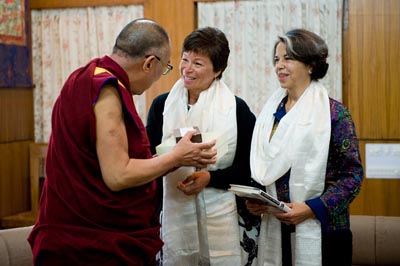
His Holiness The Dalai Lama during a meeting with the senior advisor to US president Barack Obama, Valerie Jarrett (center) along with US State Department Under Secretary Maria Otero at his residence in
Dharamshala, India, on 14 September 2009.Office of the
Dalai Lama/Tenzin Choejor/India