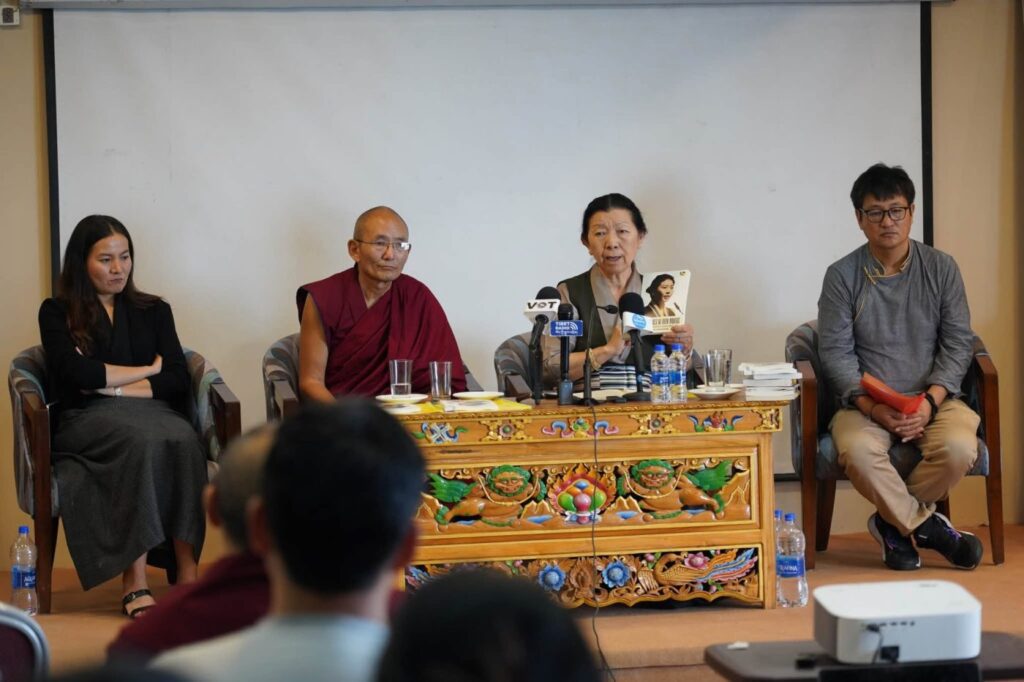
Delhi: On 17 November 2025, a special panel discussion was convened at the India International Centre (ICC), organised by the Delhi Ghoton Organising Committee to mark the 75th anniversary of His Holiness the 14th Dalai Lama assumption of spiritual and temporal leadership of Tibet at the age of 16.
The event featured Sikyong Penpa Tsering, former National Security Advisor Shivshankar Menon, foreign policy expert Dr C. Raja Mohan, former Ambassador and author Dilip Sinha, and Professor Jampa Samten of the Central University of Tibetan Studies in Varanasi, among others. Around 200 participants attended, including officials and diplomatic representatives from ten countries, as well as Tibetan and Indian students from various universities.
The discussion, moderated by former diplomat and author Dilip Sinha, opened with remarks from former Foreign Secretary Shivshankar Menon, who paid tribute to His Holiness the Dalai Lama, noting that His Holiness’ arrival in exile in India has been a blessing for the Indian government and people. He emphasised the critical importance of preserving Tibet’s unique linguistic and, in particular its Buddhist tradition, stating that the survival of the Tibetan language, culture, religion, identity, and the Tibet cause ultimately depends on the determination and courage of the Tibetan people under the leadership and guidance of His Holiness the Dalai Lama.
He further clarified that the recognition of His Holiness’ reincarnation, in accordance with the traditions of Tibetan Buddhism, is the sole responsibility of His Holiness and the Tibetan people, and that no foreign government has any political right to interfere in this process.
Following that, Professor Jampa Samten stated that His Holiness the Dalai Lama is recognised as the 75th manifestation of Avalokiteshvara, the Bodhisattva of Compassion. He further mentioned that 36 embodiments of Avalokiteshvara were born in India, and among the 41 kings of Tibet, 10 were recognised as the manifestations of Bodhisattva Avalokiteshvara.
He provided a historical overview of Tibet, highlighting that numerous Buddhist scriptures and teachings from India were translated into Tibetan over the centuries. Following the Chinese forceful invasion of Tibet, His Holiness the Dalai Lama and over a thousand Tibetans sought refuge in India. With their arrival, the Tibetan people were able to revive in India many ancient Indian Nalanda traditions that they had diligently preserved for generations.
Dr C. Raja Mohan then discussed how, unlike the 13th Dalai Lama, the 14th Dalai Lama has faced more severe political challenges. He explained that while Tibet and the Himalayan region had previously maintained independence through buffer state strategies, this approach changed during the time of the 14th Dalai Lama, with the Tibet cause now becoming a matter of global concern. He also described how the Chinese government is implementing policies of Sinicisation in Tibet and applying economic pressure on countries that support the Tibetan cause.
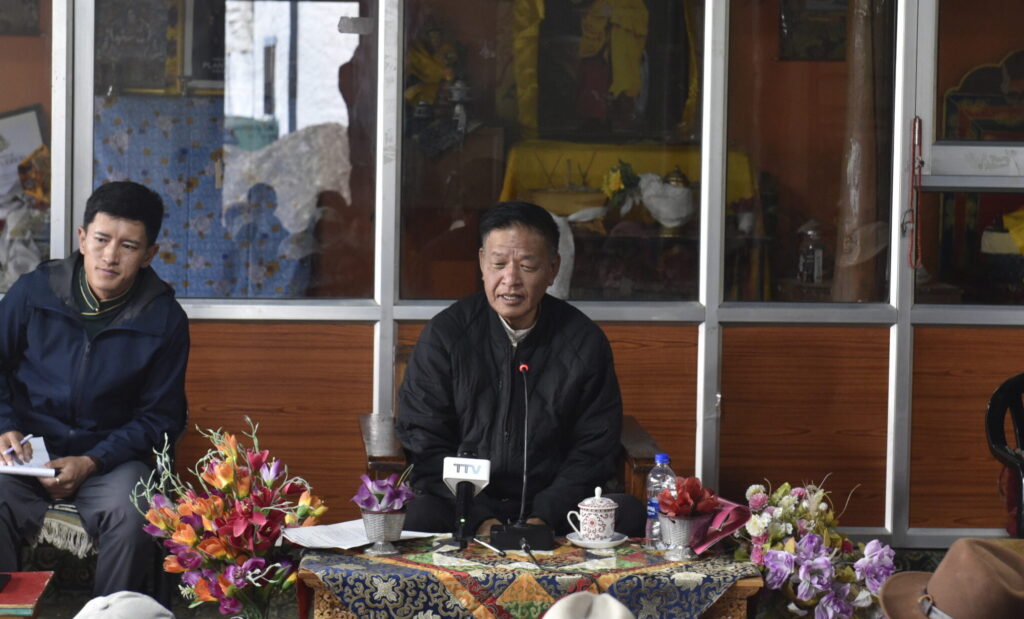
Following that, Sikyong Penpa Tsering greeted all participants and explained that earlier that morning, commemorations were held for the 75th anniversary of His Holiness the Dalai Lama’s assumption of temporal and spiritual responsibilities in Dharamshala. He recounted how, when the People’s Liberation Army invaded Chamdo in 1949 and Tibet faced an extremely critical and urgent situation, His Holiness the Dalai Lama, at only 16 years of age, assumed both temporal and spiritual leadership of Tibet on 17 November 1950.
Sikyong further elaborated on Tibet’s history spanning thousands of years, highlighting the period of the three religious kings (Dharma Kings) when Tibet reached the height of its power. He described the profound and unique spiritual and cultural relationship between India and Tibet. He emphasised that even before the 13th Dalai Lama declared Tibet’s independence, Tibet was already a fully independent nation, while citing the 1914 Simla Convention, where Tibet participated as an independent country.
Sikyong referenced Tibet Brief 20/20 by international law expert Michael van Walt van Praag, noting that the book “provides clear, evidence-based documentation of Tibet’s status as an independent nation under international law since ancient times.” He also highlighted Professor Lau’s work, explaining that it “draws extensively from historical Chinese sources from the Ming and Qing dynasties, which clearly demonstrate that Tibet was never part of China.” He encouraged the audience to read both works for a deeper understanding of Tibet’s historical status.
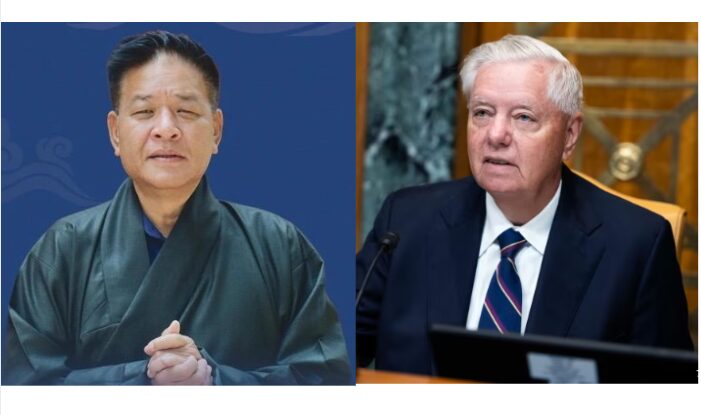
Regarding the resolution of the Sino-Tibetan conflict, Sikyong outlined His Holiness the Dalai Lama’s Middle Way Approach, explaining that it is based on two fundamental points. First, Tibet was historically an independent nation and second, the present reality of Tibet under Chinese occupation. Sikyong stressed that for the Middle Way Approach to gain broader international recognition, the global community must acknowledge both of these positions. He then highlighted the following sustained efforts from 2022 to 2024, including the U.S. government’s passage of the Resolve Tibet Act, which recognises Tibet as historically an independent nation and calls for a negotiated resolution to the Sino-Tibetan conflict.
Sikyong also noted that with far-sighted vision, His Holiness the Dalai Lama has transferred all political authority to the democratically elected leadership of the Tibetan people. He explained how the Chinese authorities are attempting to politicise and interfere with the reincarnation recognition process, using it as a political tool to further their claims over Tibet.
In conclusion, Sikyong stressed that until the Sino-Tibetan conflict is resolved through unconditional peaceful dialogue, the Central Tibetan Administration will continue its advocacy efforts on the international stage.
The programme concluded with an interactive session, during which participants raised several questions related to the Tibet cause.