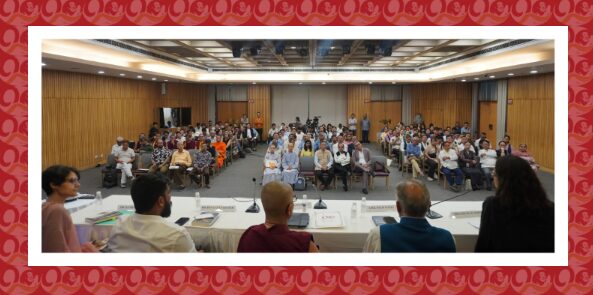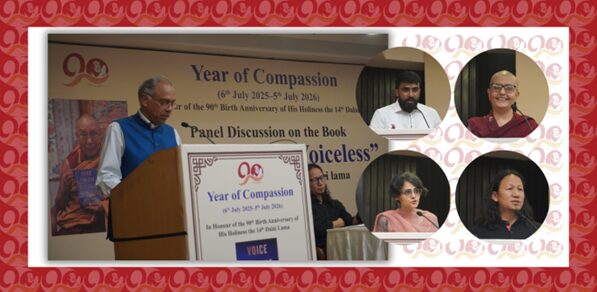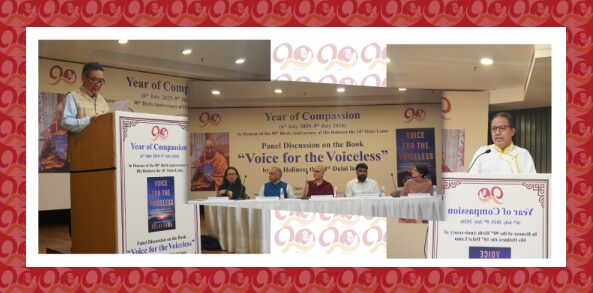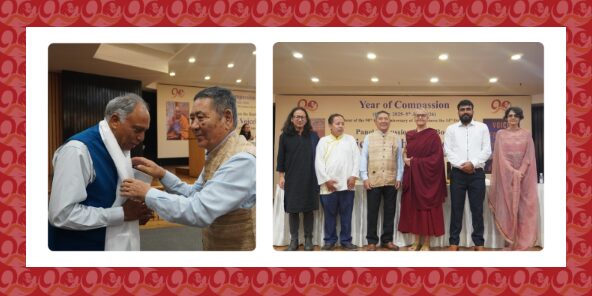

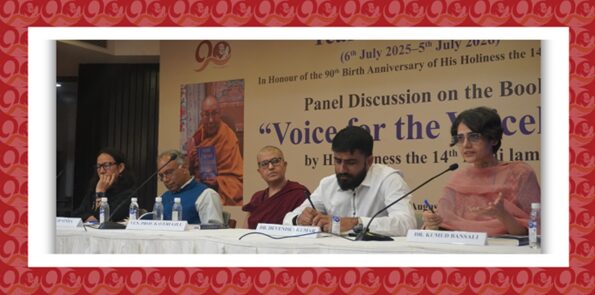
Delhi: On 16 August 2025, in honour of the 90th Birth Anniversary of His Holiness the 14th Dalai Lama, the Delhi Ghoton Organising Committee hosted a panel discussion on the book “Voice for the Voiceless” at the India International Centre (IIC), New Delhi. The event brought together a distinguished panel comprising Ambassador Dilip Sinha (Retd.), writer and public speaker, Ven. Professor Kaveri Gill, Senior Fellow at the Centre for Excellence in Himalayan Studies, Shiv Nadar Institute of Eminence, Delhi; Dr Devendra Kumar, Associate Fellow at the Centre for Excellence in Himalayan Studies, School of Humanities and Social Sciences, Shiv Nadar Institution of Eminence; Dr Kumud Bansali, Postdoctoral Research Fellow and economic anthropologist; and Bhuchung D. Sonam, writer, translator and publisher.
The program commenced with an introductory address by Jigme Jungney, Representative of His Holiness the Dalai Lama in New Delhi, who emphasised the significance of the Year of Compassion and highlighted the lifelong contribution of His Holiness the Dalai Lama towards peace and compassion.
Ven. Professor Kaveri Gill discussed important aspects of the book, including how the chronology of His Holiness’s life is deeply intertwined with Tibet’s modern history, his role as the “Voice for the Voiceless,” and his position as a global icon of non-violence and a spiritual progenitor of Mahatma Gandhi’s ideals.
Ambassador Dilip Sinha reiterated his strong support for Tibet, recalling His Holiness’s statement made on 2 July that it is inappropriate for the Chinese Communist Party, which does not believe in religion or reincarnation, to interfere in the selection of the Dalai Lama’s successor. He stressed that the continuation of the Dalai Lama institution lies with the Gaden Phodrang Trust, further adding that “this book is not just about Tibet” but should be viewed from a broader global perspective.
Dr Devendra Kumar spoke on China’s interference in Tibetan leadership since the 1990s, including the abduction of the Panchen Lama and Beijing’s attempts to control the Dalai Lama’s reincarnation, quoting the conclusion of Chapter 13 which notes that although there might once have been genuine interest in negotiation, the Chinese leadership lacked the political will and courage to resolve the issue.
Dr Kumud Bansali reflected on chapters 10, 14, 15, and 16, and connected His Holiness’s writings with contemporary academic discourse, particularly in the field of international relations, where “strategic empathy” is now being discussed as a vital approach to resolving geopolitical conflicts.
Bhuchung D. Sonam highlighted the devastating impact of China’s occupation of Tibet, citing the deaths of 1.2 million Tibetans, the destruction of 90% of monasteries and cultural institutions, the forced displacement of 2.5 million nomads, the separation of over 1 million Tibetan children into colonial-style boarding schools, and the grave environmental consequences of dam constructions that threaten downstream nations. Despite such destruction, he underlined the resilience of Tibetans who continue their non-violent struggle to survive and preserve their cultural identity.
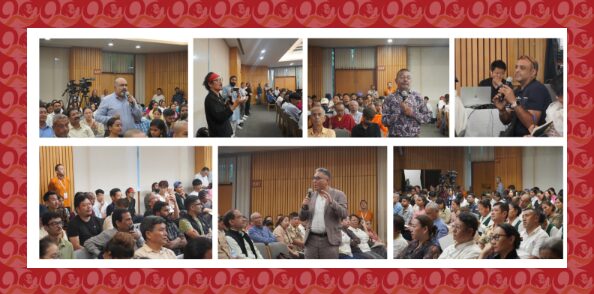
The discussion was followed by an engaging interactive Q&A session, during which the audience actively raised questions and expressed their solidarity with Tibetans. Over 100 participants attended the program, including research scholars, professors and students from various universities and think tanks, advocates from the Supreme Court, journalists, writers, engineers, teachers, and medical professionals.
The event concluded with a vote of thanks delivered by Dorjee Tsering, Settlement Officer of the Tibetan Settlement Office (TSO), Samyeling, New Delhi, and presentation of souvenirs to the panellists by Dhundup Gyalpo, Secretary, Bureau of His Holiness the Dalai Lama. The program marked a significant part of a year-long celebration of the 90th Birth Anniversary of His Holiness the Dalai Lama as the Year of Compassion, honouring His Holiness’ enduring legacy of peace, non-violence, and compassion.
-Report filed by The Bureau of His Holiness the Dalai Lama, New Delhi