
His Holiness Expands on Importance of Developing Inner Peace at Newark Peace Education Summit[Monday, 16 May 2011, 4:05 p.m.]
 |
Newark,
New Jersey, USA, 14 May 2011 – On the last day of his current trip to
the United States, 14 May 2011, His Holiness participated in two
sessions at the Newark Peace Education Summit, made a keynote address
and found agreement and support of the co-panelists on his call for
incorporating teaching of secular ethics in the education system.In
the morning, His Holiness participated in a panel on “Peace in
Education.” His co-panelists were Prof. Pedro Noguera of New York
University; CNN Broadcaster Soledad O’Brien; U.S. Assistant Deputy
Secretary for Education, James Shelton; Educationist Anzella Nelms;
Martin Luther King III, oldest son of Martin Luther King Jr.; youth
representative Kathi Lloyd; Actress Goldie Hawn; and Newark Mayor Cory
A. Booker.In his initial remarks His Holiness talked about one
of the purposes of education is to develop a realistic approach. He
said everyone wants a happy life and there needs to be a realistic
approach to attain that. In ancient times, he said, in Europe
education was closely connected to religious institutions, which (along
with family) also took the responsibility of imparting moral education
and the development of warm-heartedness. Subsequently, educational
institutions became separated from the church.
development of science and technology, people could see direct benefit
from these, including in the reduction of diseases, etc. Thus, people
began to have increasing trust in material development of science and
technology. But, His Holiness said, as society continued to develop
people could see from their own experience that material development
alone could not bring inner peace. Coupled with that there was a
development of modern science showing interest in the issue of mind, he
said.

|
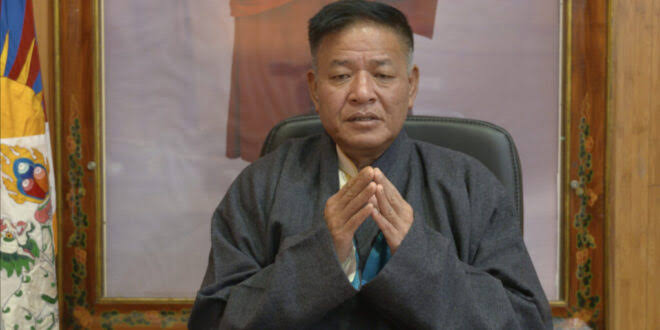
| His Holliness the Dalai Lama speaking at the Newark Peace Education Summit in Newark, New Jersey, on May 14, 2011. Photo/AP |
His Holiness said that the existing education
system mainly focused on knowledge with the learning of moral ethics
being taken for granted. His Holiness felt that research needed to be
conducted to see how to introduce the teaching of inner values in the
school curriculum. His Holiness suggested that right from the
Kindergarten stage there was the need to teach children that using force
was wrong and that while problems will be there, they needed to be
resolved through dialogue. He said that there were some who feel that
such issues as compassion and forgiveness were religious issues. His
Holiness said this was wrong. He said while all religions preached about
these, compassion, forgiveness, etc. were biological factors and that
these were needed for our survival. His Holiness added that his
ultimate dream was for the United Nations to come with some resolution
on these matters so that they can be incorporated in a universal
education system.The other panelists, in their presentation, drew from the experience
of their work on how the education system needed reform to enable the
development of positive individuals. Several of them, including Soledad
O’Brien, supported the idea of including moral ethics in schools, as
suggested by His Holiness. Martin Luther King III said he felt “truly
honored and humbled” to be with His Holiness to discuss this important
issue. Goldie Hawn related the experience of her Foundation that teaches
students social and emotional tools to lead “smarter, healthier, and
happier lives.” Newark Mayor Booker spoke passionately about the need to
understand reality citing the cases of gun violence that had taken
yesterday even as the peace conference was being held in the city. He
said that when the idea of this conference came up he was pleased that
the organizers had taken steps to include Newark residents, including
students (one newspaper reported 1,500 students were present at today’s
summit), educators and others, in it. The Mayor said, “This conference
cannot be another conference we get together and talk about problems …
We cannot do the same things we did last year and expect change this
year.” He said there was the need for good people to stand up against
violence and other social issues saying that silence and inaction of the
good people were wrong.
His Holiness then met briefly some artistes and staff of Tibet House
US. He then hosted lunch for the two Nobel Laureates Shirin Ebadi and
Jody Williams.

|
| His Holiness the Dalai Lama greeting Ed Norton at the Newark Peace Education Summit in Newark, New Jersey, on May 14, 2011. Photo/Sonam Zoksang |
New Jersey Performing Arts Center, venue of the conference, for the
afternoon session. The theme was “Peace in the Community” and His
Holiness’ co-panelists were Nobel Laureates Shirin Ebadi and Jody
Williams; human rights pioneer Van Jones; Earl “The Street Doctor” Best,
who supports the homeless; businesswoman Kirsten Giardi; actor Edward
Norton; peace-building strategist Aldo Civico; Gay & Lesbian
activist Daryl Presgraves; and Youth Representative, 11-year old Aaliyah
Beckford.
organizations that worked at the grass root level, outlined the nature
of the community and the challenges to cultivating peace therein. Many
of them referred to books and writings by His Holiness that have
encouraged them in their effort. Eleven-year-old Aaliyah Beckford, in
her remarks, said that “the Dalai Lama has influence me to make a
difference in my community.” She added that participating in the
discussions today was a life-changing opportunity to her. Similarly,
Actor Edward Norton, addressing His Holiness, said, “Your writing and
teachings have meant much to me.”

|
| Newark Peace Education Summit panelists His Holiness the Dalai Lama, Dr. Thupten Jinpa, Jody Williams and moderator Robert Thurman, taking a question from the audience in Newark, New Jersey, on May 14, 2011. Photo/Sonam Zoksang |
his reaction to the panelists as well as his Keynote statement, His
Holiness said he was really impressed by the two days of presentations
by the various speakers. He said they were all sincere and more
importantly spoken out of experiences. Referring to the passionate and
moving account of the “Street Doctor” His Holiness said, “You spoke with
very very strong feeling.”
despite the many challenges, there is no reason to be feeling
demoralized or pessimistic. Supporting this assertion, His Holiness said
that if we look at the 20th century, the latter part was more hopeful
than the earlier part. From war-dominated early period, in the latter
period there was more emphasis on the concept of co-existence. On the
ecological front the situation changed from no attention to it in the
early part of the century to universal attention that was paid to the
environment in the latter period, he said. From the situation in the
early part when science and spirituality (meaning some kind of moral
values) were separate, in the latter period they came closer. His
Holiness said in the past 30 years or so he has been having serious
discussions with scientists.
His Holiness said since the 21st century is a continuation of the
20th century, there is sound basis to be hopeful. His Holiness recalled
his meeting with the 96-year old Queen Mother of England in 1996 when
he asked her whether the world was getting better or worse. He said
without any hesitation, she had responded that it was getting better and
cited two indicators. She said when she was young concept of human
rights and right to self-determination did not exist whereas these were
now actively paid attention to.
His Holiness asked the people to maintain optimism. He said while
prayer may be useful for individuals, action was more important to
generate peace in the community.

|
| The New Jersey Performing Arts Center, the venue for the Newark Peace Education Summit held in Newark, New Jersey, on May 13-15, 2011. Photo/Sonam Zoksang |
nature of the world today saying the new reality is that America’s
future depends on the future of other countries. Thus, he said people
needed to realize that destruction of others is really destruction of
self. He said that it is in human nature to be selfish but he
encouraged people to be wise selfish involving fuller knowledge and a
holistic approach while dealing with any issue. He added that too much
self-centered attitude is foolish.
His Holiness also explained his thoughts on the nature of
forgiveness that he had been advocating. He said forgiveness does not
mean bowing down to the other side or let them do whatever they like. He
said it involved differentiating between the action and the actor. We
have to oppose the action of wrongdoing, without any negative feeling,
but to the actor we have to give the same treatment as any other human
being. From a theistic perspective, His Holiness said while the actor is
God’s creation, the action is not so. It is an issue of Free Will being
used wrongly, he added.
Addressing the young members in the audience, His Holiness told them
that the 21st century belonged to them and that they had an immense
responsibility to create a better world. He said that the 20th century
to which his generation belonged saw much wrongdoing and the result is
the mess we are in today. He said the potential for conflict is always
there and the people needed to realize that the spirit of reconciliation
is the only realistic approach. He called for schools to teach the
importance of the concept of dialogue.

|
| His Holiness holding hands with a participant from Columbia at the Newark Peace Education Summit in Newark, New Jersey, on May 14, 2011. Photo/Sonam Zoksang |
His Holiness said the younger generation
needed to have a clear vision to make this world a demilitarized one and
for a more equal distribution of resources. He said he identified
himself as a Marxist but not as a Leninist, which he was totally
against. He called for the reduction in the gap between the rich and
the poor, but said just giving money was not the solution. He said
there was the need for education to give courage and self-confidence to
the weaker section of the society. He recalled visiting a family in
Soweto in South Africa where a man seemed to hold the view that the
Black people’s brain was little inferior. His Holiness said he felt
saddened at hearing this and took the opportunity to explain to this
individual that this was a narrow-minded perspective that did not
conform to reality. He also cited the experience with the Chinese
authorizes, who also had a different perspective of the different
nationalities in China. His Holiness said he was eventually able to
convince this individual that he was same as any other person.His Holiness advised the educators and the teachers to promote a
sense of global responsibility among the students. He also said the
students should learn to investigate for themselves and not to take
anything at face value. Here he quoted the Buddhist philosophy of
education that not only included hearing (from the teachers) but also
self-investigation.
His Holiness concluded by thanking the organizers for holding this
important conference.
Prof. Robert Thurman of Tibet House moderated the panel sessions.
His Holiness left the hotel in the evening for the airport on his
return journey to India. His Holiness began this trip to the United
States on May 1, 2011 and participated in programs in six universities
in the states of California, Minnesota, Arkansas, and Texas as well as a
peace conference in New Jersey.