

SANKISA: When representatives of the organizers, the Youth Buddhist Society of India, came to see him this morning, His Holiness the Dalai Lama first of all thanked them for inviting him to this important Buddhist place. He said:
“Although the historical Buddhist site is in ruins, the Buddha’s teaching is not ruined. In fact many intelligent people today are taking an interest in it.”
He mentioned that since he first came to Sankisa in 1960 several temples have been built. However, he stressed, as he said he always does, that the teachings are more important than temples and statues. Publishing books and establishing a library, as the YBS is doing, is more effective. He advised that work has begun on extracting Buddhist scientific and philosophical explanations from the 220 volumes of the Tengyur that include the works of the masters of Nalanda University. He hopes these can become the basis not so much of religious as academic study.
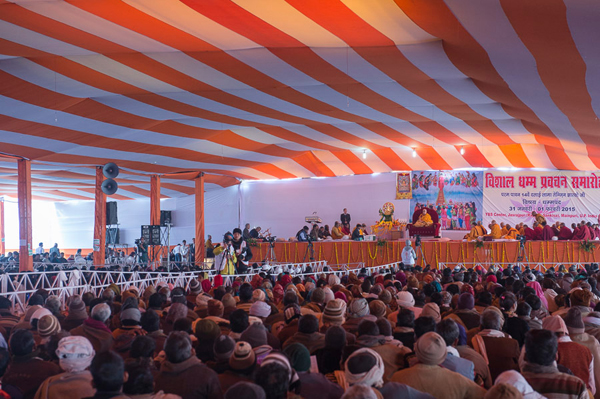
At the YBS grounds he was asked to bless an impressive new replica of the Sankisa Ashokan pillar that stands some 40 metres tall and is topped by a whole elephant capital complete with trunk and tail. Taking his seat on the stage at the teaching ground before an audience of several hundred monks, several thousand local laypeople, many hundred Tibetans and a handful of foreigners, he began:
“This is the place where the Buddha descended to earth after teaching his mother. I came here once before and I’m here again at your invitation. The YBS has started a library here and I’d like to express my appreciation of all the hard work that has gone into it. In this place that is sacred to the Buddha I pray there may be more such development.

Mind precedes its objects. They are mind-governed and mind-made. To speak or act with a defiled mind is to draw pain after yourself, like a wheel behind the feet of the animal drawing it.
Mind precedes its objects. They are mind-governed and mind-made. To speak or act with a peaceful mind is to draw happiness after yourself, like an inseparable shadow.

His Holiness explained that among the major religions are those who believe in a creator god and those who don’t. Among the non-theistic are Buddhists, Jains and part of the Samkhyas. The two latter traditions believe in an intrinsically existent self, while Buddhists don’t. Nevertheless, the purpose of all religious traditions is the same, to help us become better people. For this reason they are all beneficial and therefore should live in harmony with one another. This harmony that has existed for centuries in India is a treasure that should be preserved and protected.

His Holiness read three verses from Chapter 20 of the text:
All processes are impermanent. When you see this with understanding, then you are disillusioned with the things of suffering. This is the Path of Purification. 277
All processes are painful. When you see this with understanding, then you are disillusioned with the things of suffering. This is the Path of Purification. 278
All processes are out of my control. When you see this with understanding, then you are disillusioned with the things of suffering. This is the Path of Purification. 279
He said that the solution to suffering will not be found merely through praying to the Three Jewels. We need to take action on the basis of the four aspects of suffering, the first Noble Truth, that it is impermanent, miserable, empty and selfless. He clarified that ignorance can be a matter of simply not knowing, but it can also involve wrong conceptions that distort reality.
His Holiness reminded his audience that following his enlightenment, the Buddha spent 49 days pondering what he had realized. He thought that while he had discovered the path to liberation, no one else would understand it, which is why we now have to make an effort too.

Another questioner wanted to know if he had anything to say about Mahatma Gandhi, the anniversary of whose death by assassination fell yesterday. He answered that Gandhi had dedicated himself to fostering the ancient Indian traditions of non-violence and inter-religious tolerance and harmony. Regarding Indo-Chinese relations he remarked that these two great countries have to live together and it would be better to work to build trust and better relations between them.
His Holiness resumed his reading of the Dhammapada with verses 11 and 12 of Chapter 1.
To see the essence in the unessential and to see the essence as unessential means you can never get to the essence, wandering as you are in the road of wrong intentions. 11

But to see the essence in the essential and the unessential as the unessential it is means you get to the essence, being on the road of right intentions. 12
He concluded the first chapter with the observation that “Even if he is fond of quoting appropriate texts, the thoughtless man who does not put them into practice himself is like cowherd counting other people’s cows.”
In this spirit, His Holiness suggested that it is more effective to take refuge in the Three Jewels if you understand what they are. Faith supported by reason will lead to liberation, which means we need to use our brains to the full.
Coming to the end of the session he undertook to continue tomorrow.