DHARAMSHALA: The Chinese government under president Xi Jinping has unleashed the harshest campaign of politically motivated investigations, detentions, and sentencing in the past decade, marking a sharp turn toward intolerance of criticism, Human Rights Watch said yesterday in its World Report 2015. In its 656-page world report, the rights group reviewed human rights practices in more than 90 countries.
“Under President Xi, China is rapidly retreating from rights reforms and the Party’s promise to ‘govern the country according to law,’” said Sophie Richardson, China director at Human Rights Watch. “Repression of critics is the worst in a decade, and there appears to be no end in sight.”
In China, the report said, authorities have unleashed an extraordinary assault on basic human rights and their defenders with a ferocity unseen in recent years. The government targets activists and their family members for harassment, arbitrary detention, legally baseless imprisonment, torture, and denial of access to adequate medical treatment.
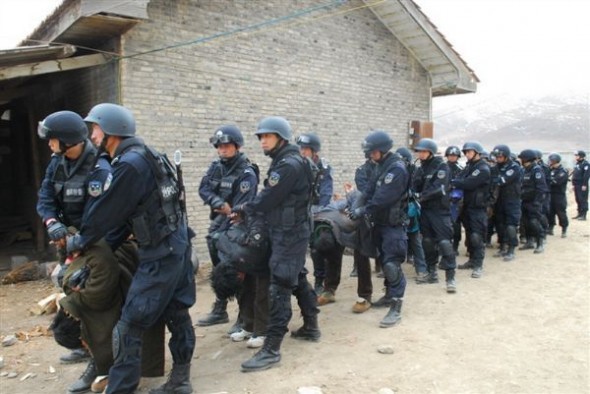
The Chinese government’s hardline approach was particularly discernible in Xinjiang and Tibet, areas that are nominally autonomous. Indiscriminate anti-separatism campaigns fueled rising tensions, resulting in several clashes on the Tibetan plateau – including at least one in which security forces used live fire against unarmed demonstrators – and a marked increase in violence in Xinjiang, the report said.
A series of self-immolations by Tibetans protesting Chinese government repression appeared to have abated by early 2014, the report said, adding that the authorities punished families and communities for allegedly inciting or being involved in these protests; punishment of individuals included imprisonment, hefty fines, and restrictions of movement.
Authorities were intolerant of peaceful protests by Tibetans, harshly responding with beatings and arrests to protests against mines on land considered sacred and against detention of local Tibetan leaders, it said.
China’s mass rehousing and relocation policy has radically changed Tibetans’ way of life and livelihoods, in some cases impoverishing them or making them dependent on state subsidies. Since 2006, over 2 million Tibetans, both farmers and herders, have been involuntarily “rehoused”—through government-ordered renovation or construction of new houses—in the TAR; hundreds of thousands of nomadic herders in the eastern part of the Tibetan plateau have been relocated or settled in “New Socialist Villages,” the report noted.
“The most significant legal trend in 2014 has been the government’s effort to further strengthen an already powerful, unaccountable state security apparatus. It adopted an overly broad counter-espionage law and the publication of a draft counterterrorism law that equates peaceful dissent with terrorism, strengthens control over civil society groups that receive foreign funding, and appears to target specific ethnic minority groups,” the report said.
This year’s report also flagged weakening international concern about human rights abuses in China. Some, including United Nations Secretary General Ban Ki-moon, instead praised the government for “its contributions to the promotion of … human rights.” China continues to refuse meaningful engagement with UN human rights mechanisms and voted down resolutions spotlighting abuses in Belarus, Iran, North Korea, Sri Lanka, Syria, and Ukraine. China repeated its calls for “political solutions” in Syria, Sudan, and South Sudan in 2014, but took steps that prolonged human rights crises in all three.
In his introductory essay, HRW’s Executive Director Kenneth Roth has urged governments to recognize that human rights offer an effective moral guide in turbulent times, and that violating rights can spark or aggravate serious security challenges. The short-term gains of undermining core values of freedom and non-discrimination are rarely worth the long-term price.
“China under Xi Jinping is escalating hostility to human rights and democratic pressures, at home and abroad, yet the international community remains largely silent,” Richardson said. “Abetting the systematic suppression of basic freedoms is a short-sighted and dangerous policy, one that only encourages Beijing’s growing intransigence.”