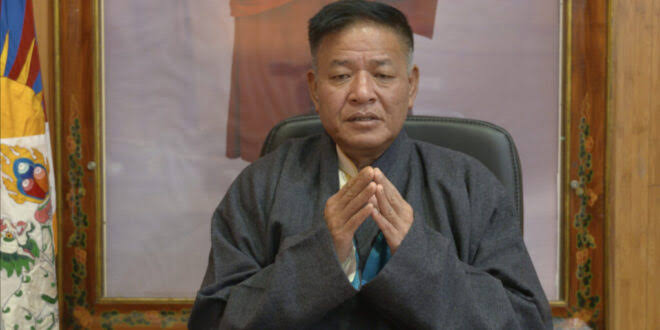
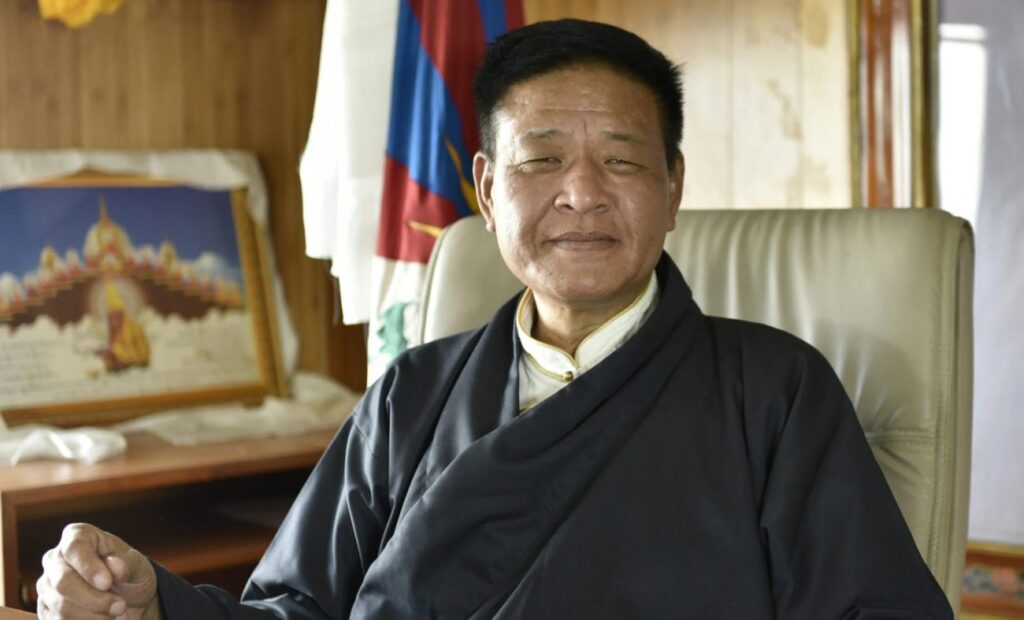
DHARAMSHALA: Speaking at the Forum 2000 conference in the Czech capital Prague yesterday, Tibetan political leader Dr. Lobsang Sangay underscored that given a choice nations should choose moral acts and democracy over money as the cornerstones of their policies.
The Forum 2000 is initiated to pursue the Czech Republic’s first democratically-elected President Václav Havel’s legacy of values of democracy and respect for human rights. This year’s theme is ‘Democracy and Its Discontents: A Quarter-Century After the Iron Curtain and Tiananmen’.
Sikyong Dr. Lobsang Sangay, the democratically-elected leader and political successor to His Holiness the Dalai Lama of Tibet, participated in a panel discussion on “The Significance of Václav Havel’s Value-Based Foreign Policy” on the second day of the Forum. The panelists include Andrew Schapiro, Ambassador of US to Czech Republic, Carl Gershman, the President of National Endowment for Democracy, US, Ales Bialiatski, President, Viasna Human Rights Centre, Belarus and Yoani Sanchez, Bloger and Activist from Cuba.
Sikyong said how former president Václav Havel recognised that both morals and money are important, but if you have to choose between the two you must always choose morals.
The Tibetan political leader called Mr Václav “a moral warrior.” He connected this to the Tibetan democracy and freedom struggle, stating, “what we need is basic freedom; what we expect is moral supporters from around the world.” He said President Václav Havel invited His Holiness the Dalai Lama to the Czech Republic as a visiting head of the state soon after he became the president of young republic in 1990.
He responded to queries on the reluctance of government representatives of European countries from meeting the Tibetan spiritual leader His Holiness the Dalai Lama.
The representatives of the Norwegian government decided not to meet His Holiness the Dalai Lama during his visit to Oslo in May this year, he said, adding such action comes from a country which awarded His Holiness with the Nobel Peace Prize.
Sikyong spoke about the aberration in view of the Czech Republic’s growing ties with the Chinese government for economic interests, which he said does not conform to the principles on which late president Havel fought for morality, democracy and for human rights.
He said no one has imagined that democratic movements like Charter 77 and Velvet Revolution led by Mr Vaclav Havel and other leaders preceding the disintegration of Soviet Union, and the fall of Berlin Wall, would happen. The Charter 08 authored by Chinese intellectual Liu Xiaobo was inspired by Charter 77 initiated by former president Havel which called for human rights and democracy in Communist Czechoslovakia. Liu Xiaobo was imprisoned by the Chinese government and subsequently honoured with the Nobel Peace Prize in 2008. Charter 08 is a manifesto calling for Chinese people’s wish for democratic reforms like end of one party rule, and equality and human rights. The ongoing democracy movement in Hong Kong clearly reflects the aspirations of the Chinese people for democracy, said Sikyong.
He spoke on the resurgence of democratic movements in the form of Arab Spring across the Middle East and North Africa triggered by the self-immolation by a street vendor named Mohamed Bouazizi in Tunisia in 2010 in protest against the authoritarian rule.
The Tibetan political leader said since 2009 over 132 Tibetans have set themselves on fire as a non-violent campaign to protest against the repressive policies of the Chinese government. “The Chinese government’s continued occupation of Tibet and policies of political repression, cultural assimilation economic marginalisation, environmental destruction are solely responsible for pushing Tibetans to take drastic forms of protests, including self-immolations. We have consistently urged Tibetans not to resort to drastic actions, including self-immolations. However, the vicious cycle of self-immolation protests have taken place in Tibet because Tibetans are denied basic human rights,” he said.
He also spoke on the importance of rule of law, fight against corruption and education to further democracy.
Around 200 global leaders from the areas of politics, academia, civil society, media, business and religion are attending the Forum 2000 conference. They reflect on the last 20–30 years of democratic transitions, assess the current state of democracy, and explore aspirations for the future of democracy.
Earlier in the morning, Sikyong briefly met Mr Marek Benda, a member of Czech Parliament, on his arrival at the airport in Prague. He then gave interviews to the Czech language Magazine Respekt and Czech news agency.
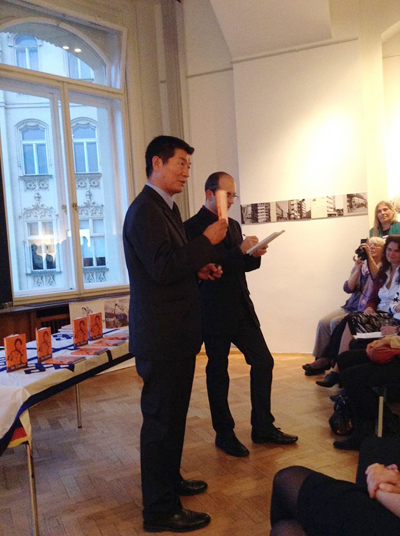
Later in the evening, Sikyong launched “We Tibetans”, the Czech edition of book written by Rinchen Lhamo, the first Tibetan woman who came to the West at the beginning of the 20th century as wife of a British diplomat. Sikyong spoke on the need to preserve Tibet language, culture, religion and way of life. He expressed gratitude to government and people of the Czech Republic for their long-standing support for the Tibet issue and asked for their continued support.