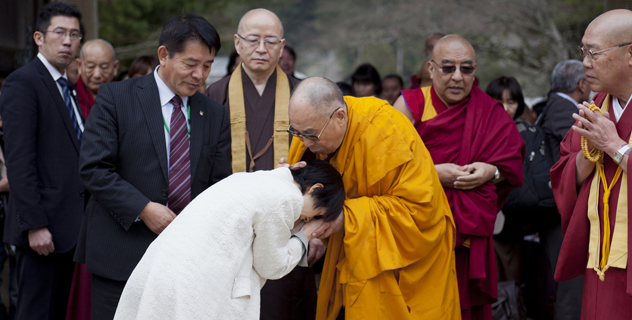
KOYASAN, Japan: On his fifth day of visit to Japan, His Holiness the Dalai Lama today began a two-day teaching on Mount Koya or Koyasan, a sacred religious site for followers of Japan’s Shingon Buddhism.
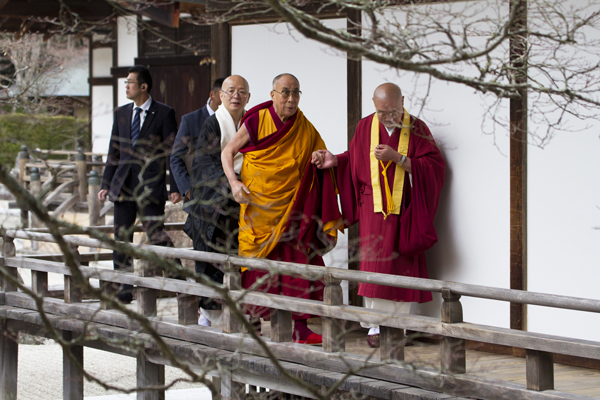
Prior to starting the teaching series, His Holiness the Dalai Lama went on a pilgrimage to Kongobuji Temple accompanied by gVen. Yukei Matsunaga, the head priest of Shingon Buddhism founded by Kobo Daishi in 805. Located in an 800 m high valley amid the eight peaks of the mountain (which was the reason this location was selected, in that the terrain is supposed to resemble a lotus plant), the original monastery has grown into the town of Koya, featuring a university dedicated to religious studies and 120 temples, many of which offer lodging to pilgrims.
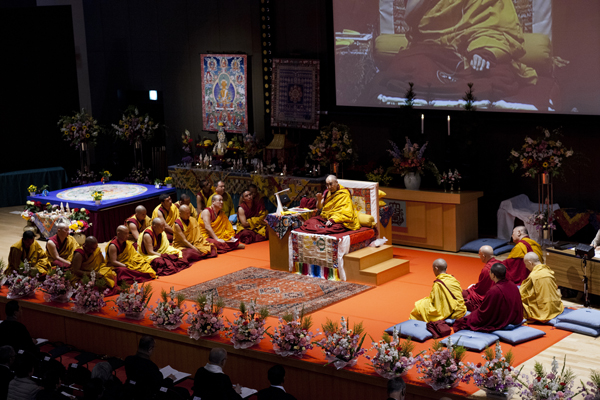
After having his lunch, His Holiness began a two-day teachings on Tsongkhapa’s Concise Stages of the Path to Enlightenment and Geshe Langri Thangpa’s Eight Verses of Training the Mind at Koyasan University.
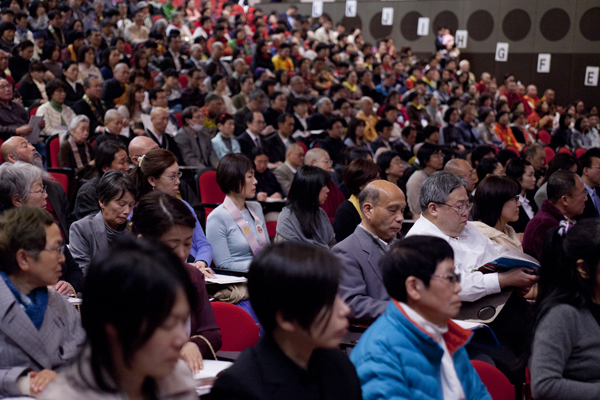
Addressing a packed auditorium comprising Japanese, followers from Korea, China and Mongolia, His Holiness the Dalai Lama said: “I am indeed very happy to be able to visit this sacred place for the third time. But what is different this time is that the weather is very cold.”
His Holiness said all the religious traditions in the world, despite having different ideologies, have a common purpose of promoting positive human values like love and affection. All of them preach tolerance, forgiveness, contentment and self-discipline as antidotes to negative emotions like anger and hatred, which he said are the real causes of problems facing the world. So different religious traditions should respect each other as they have a common purpose.
“All the world’s major religious traditions preach a same message to eliminate negative emotions which give rise to violence and conflicts in the world. But it is very sad that violence is still taking place between followers of different religious traditions, involving Sunis and Shias in Arab, Buddhists and Muslims in Sri Lanka and Burma,” he said.
He said in India, all the world’s major religious traditions and their own native faiths, has lived peacefully and harmoniously. “India is a model for other countries. If we make an effort, peace and harmony among the world’s major religious traditions could be achieved,” he said.
His Holiness said Buddhism, which also preach promotion of love, affection, tolerance and contentment like other religions, its ideology of dependent arising holds the key to eliminate negative emotions like ignorance that give rise to all the ills in the world.
“It is not enough to pray to the Buddha. What is more important is to study and understand his teaching not of faith but through experiment,” he added.
His Holiness also underscored that collaboration between Buddhist science and modern science has the potential to create a peaceful and happier world.
He encouraged Japanese to pay same attention to enrich their inner values like that do material development. “The effort Japanese people to make to improve the quality of the rice for their physical health is also required for development of inner human values through study of Buddha’s teachings.”
Tomorrow, His Holiness will continue the teachings and confer the Vairocana-abhisambodhi Initiation (namnang ngoenjang wang). These will take place at at Koyasan Monastery.
On 15 April, His Holiness will conclude his three-day visit to Koyasan with a public talk on a theme titled “How should live our lives? – Religion and Ethics in the 21st century.”
(View video of first day of teaching in Koyasan)