
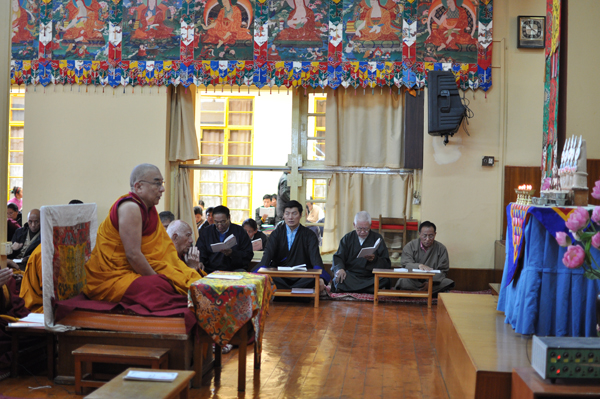
DHARAMSHALA: The two Tibetan monks who set fire to themselves in protest against the Chinese repression recently have died, reports coming out of Tibet say. The Central Tibetan Administration today organised a special prayer in Dharamshala to express solidarity with all those Tibetans who have sacrificed their lives for the cause of Tibet and those undergoing immeasurable suffering under the Chinese government’s repression in Tibet.
The monk, who self-immolated at Tsekhog county in Malho Tibetan Autonomous Prefecture (incorporated into China’s Qinghai Province) on 16 March, has been identified as Jigme Tenzin, a monk of Gaden Tashi Choeling monastery. Some sources say he belonged to Rongwo monastery in Rebgong. The incident was first reported by the Chinese state media. Following the incident, the Chinese authorities arrested many Tibetan monks and cut off phone and internet in the region.
On the same day, which marked the 6th anniversary of the massacre of his fellow monks by the Chinese security forces in 2008, Lobsang Palden, a 23-year-old monk of Kirti Monastery in Ngaba county (incorporated into China’s Sichuan Province), set himself on fire in protest against the Chinese government’s repression. Few minutes after the monk set himself on fire, the Chinese police bundled him away in a vehicle. Three days later, he succumbed to his injuries at a military hospital in Barkham.
The number of Tibetans who set themselves on fire to protest against the Chinese government’s repressive rule has risen to 128, out of which 111 have died. The self-immolators have called for the return of His Holiness the Dalai Lama to Tibet and freedom for Tibetans. (Fact-sheet)
Despite repeated appeals by the Tibetan leadership in exile not to engage in such drastic actions, the self-immolations have continued.
A white paper released by the Tibetan leadership in Dharamshala last year explains the fundamental reasons behind the ongoing wave of self-immolations inside Tibet and the alarming escalation in the protests witnessed in the last few years.
The principle reasons listed in the 91-page report for Tibet’s fiery protests are political repression, Chinese communist leader’s views and policies on Tibet, and cultural assimilation, destruction of Tibetan Buddhism. Besides, social discrimination, strangling the Tibetan language, environment destruction, Tibetan Nomads and ending their way of life and economic marginalisation, population transfer and western China Development Programme are the other reasons given in the report. (Read and download White Paper)