
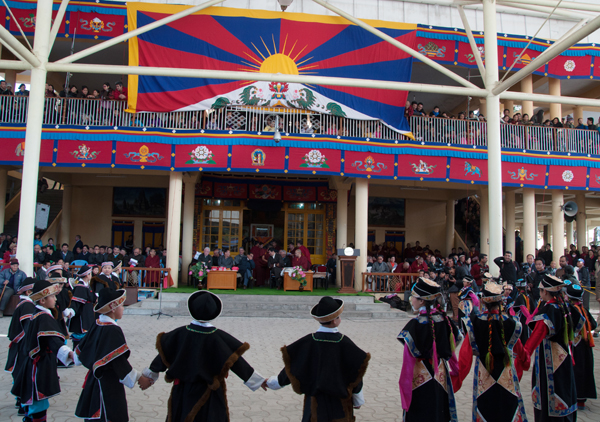
DHARAMSHALA: Tibetans around the world celebrated the 24th anniversary of the conferment of the Nobel Peace Prize on His Holiness the 14th Dalai Lama, with the Tibetan leadership reassuring the new Chinese leadership that Tibetans do not seek separation but genuine autonomy for all the Tibetan people under a single administration as guaranteed in the Chinese constitution.
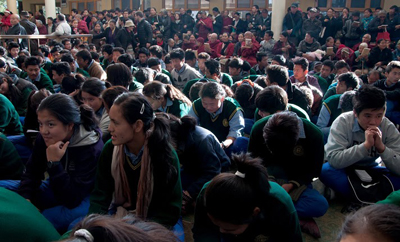
“The Nobel Peace Prize awarded to His Holiness the Dalai Lama for his consistent resistance to the use of violence in his people’s struggle for freedom strengthened and catapulted the Tibetan struggle to greater international visibility. Tibet became synonymous with non-violence and justice,” Sikyong Dr Lobsang Sangay told thousands of Tibetans at a ceremony marking the day in Dharamsala. Other senior officials of the Central Tibetan Administration present on the occasion include the chief justice commissioner, two justice commissioners and deputy speaker of the Tibetan Parliament-in-Exile.
Sikyong called on Tibetans to remain united and dedicate themselves to fulfill the auspicious words of His Holiness the Dalai Lama that he would live a very long life and see the day when the Tibet issue is resolved through the Middle-Way Approach.
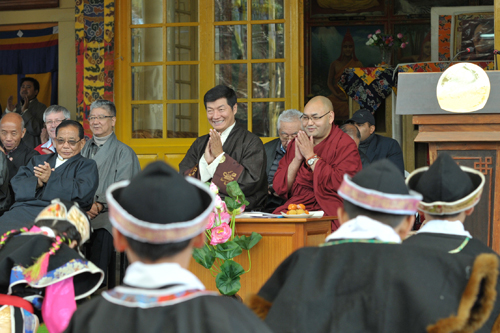
“Tibet’s cause and its struggle for human rights will triumph. Non-violence and peace are a universal aspiration not only for us, but for all humanity. The success of the Tibetan struggle will be a success of non-violence and peace,” he said.
In a message to Tibetans inside Tibet, the Tibetan political leader said: “Though your suffering is unbearable and seems endless, the only certainty in life is change. Things never stay the same forever. Though we remain separated by political force, we will never stop working to be reunited with basic freedoms and with His Holiness the Dalai Lama in Tibet.”
Sikyong reassured China that Tibetans neither seek separation nor “high degree of autonomy”, but genuine autonomy for all the Tibetan people under a single administration as guaranteed in the National Regional Autonomy Law and the Constitution of the People’s Republic of China.
Rejecting China’s allegation that Tibetans are seeking “Greater Tibet”, Sikyong said the three traditional provinces of U-Tsang, Kham and Amdo have always been essential parts of Tibet, and they share not just the same geography and topography but also culture, language and religion.
“Division of Tibet into several provinces of China is a clear violation of Chinese laws and of Article 4 of the Constitution which recognises the right of minority nationalities to practice regional autonomy in the areas where they live in concentrated communities and to set up organ of self government for the exercise of power of autonomy,” Sikyong added.
Sikyong also allayed the Chinese government’s concern that it would loss one-fourth of its territory Tibet be granted genuine autonomy. “Tibet constituting one-fourth of China is not a recent political creation but a natural outcome of Tibetans inhabiting the Tibetan plateau for thousands of years. The fact that Tibet constitutes one-fourth of China should not be a concern for the Chinese government because one-fifth of China is already established as Xinjiang Uyghur Autonomous Region and one-eighth as Inner Mongolia Autonomous Region,” he said.
He said allowing Tibetans to live under a single administration would be an efficient and effective form of governance rather than dividing them into the so-called Tibet Autonomous Region and four Chinese provinces.
The Memorandum on Genuine Autonomy for the Tibetan People, presented to the Chinese leadership in 2008, clearly explained that it is not our intention to expel “all Chinese” from the Tibetan areas as alleged by the Chinese authorities. But the Tibetan areas should have Tibetan majority for the preservation and promotion of the unique Tibetan identity, Sikyong said.
Sikyong said the moderation and pragmatism of the Middle-Way Approach has attracted support and recognition among intellectuals, parliamentarians, leaders and individuals, including Chinese scholars, writers and Chinese Buddhists. He thanked them for their consistent support for the Middle-Way Approach.
He expressed deep gratitude to India, Tibet Support Groups and individual supporters for their long-standing support for the issue of Tibet.