
Washington DC, USA, 20 February 2014 – His Holiness the Dalai Lama returned to the American Enterprise Institute (AEI) this morning to participate in two panel discussions, the first involving members of the AEI and the second involving members of the Mind & Life Institute (MLI). President of AEI, Arthur Brooks’s question for the morning was whether the free enterprise system is the best way to deal with our situation. He first introduced His Holiness and the other panel members: Glenn Hubbard, Dean of Columbia Business School, Dan Loeb, Hedge Fund Manager and New York University Professor Jon Haidt, before asking His Holiness if he had any initial reflections. He responded:
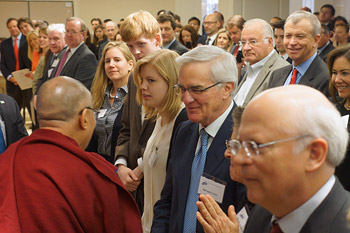
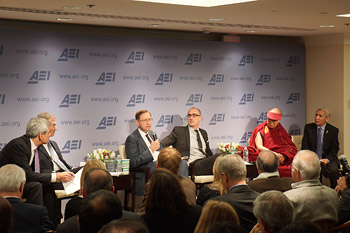
Dan Loeb expressed his sense of honour to be sharing a platform with the spiritual leader of the Tibetan people, His Holiness the Dalai Lama and the spiritual leader of modern capitalism, Glenn Hubbard. He mentioned that when he started his fund, he also began to practise Ashtanga Yoga, which made him aware of the fluctuations of the mind and finding himself in difficult positions. He meets both of these in decision making, and making decisions is what he does all day long, about people, markets and stocks. He spoke of how when someone has an idea they need support and it’s difficult for them without a system that provides credit. Hence the need for liquidity and low cost capital. He said that no other system than free enterprise funds innovation. Within this context the most important element he sees is education; with that even the poor can succeed.
Arthur Brooks asked His Holiness what can be done to lead more out of poverty. He replied that because things are interconnected, we have to look at the larger picture. We need education that is more realistic. We need the protection of a sound system of law and we need trust. To develop trust we need to be honest, truthful and transparent. He stressed that as long as we take care of others’ well-being, there will be no room for cheating or exploitation. For the benefit of humanity we need a sense of universal responsibility.
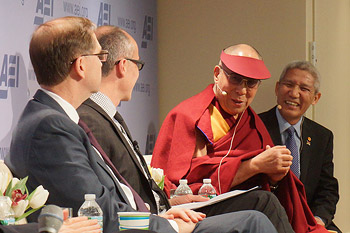
Arthur Brooks noted that while capitalism can be a great achiever it is not without danger. He asked for His Holiness’s advice on how to help the poor to benefit from the capitalist system we enjoy today.
“I don’t know,” he replied. “Every day I engage in extensive analysis of the nature of self and phenomena. We are self-centred and selfish, but we need to be wisely selfish, not foolishly so. If we neglect others, we too lose. We have to support others. This is the common message of all major religious traditions. Because greed is dangerous, these traditions all advise contentment in our daily lives. We can educate people to understand that the best way to fulfil their own interest is to be concerned about the welfare of others. But this will take time.”
Arthur Brooks summarized what had been learned. Each of us is just one among 7 billion, but understanding our common interests is a source of blessing; this has to be based on moral living; moral living is a practice; and the potential for building brotherhood and sisterhood is in our hands. He thanked everyone who had contributed to the success of the meeting.
As the second panel discussion began, Arthur Zajonc explained that the Mind & Life Institute served as a meeting point between science and the contemplative traditions of Asia. It has grown over a period of 30 years, during which there have been 27 major meetings and a wealth of publications. Today, MLI is actively engaged in developing education strategies and a project to map the mind. He said that when we begin a practice, we set our motivation, we ask: “What is our purpose?” and that the answer is “We care for one another”.
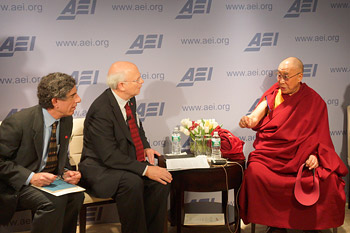
Recalling the four factors that Arthur Brooks suggested have a role in well-being, faith, family, community and work, Davidson said that modern research shows that generosity and conscientiousness are important too. With regard to enhancing these factors through education, research shows that there are periods when the brain is especially sensitive to being trained. He concluded that well-being can be learned. The brain is plastic during early development, so programs can be designed to educate it in generosity and conscientiousness. Early investment like this brings a good return through education.
His Holiness joked that his old friend had mentioned that between the ages of 4 and 7 the brain was particularly sensitive to training and laughing explained that he had been a reluctant and anxious student until his early teens. However, he said that his training had then continued through his 20s, 30s and 40s. He felt that as long as the brain remains active, change can go on.
In relation to education and training in early childhood Arthur Zajonc mentioned three modes of care: receiving care, caring for self, and caring for others.
Diana Chapman-Walsh expressed her pleasure to be present, saying that she had come in the spirit of warm-hearted enquiry. Thanking the three AEI delegates for their presentations she began by asking what price we pay in happiness when we focus too much on ourselves. How much of our interest in individual happiness is a projection of self-centredness? She suggested that if we are to address the problems we face, we will need a different kind of leadership; people skilled in leading with compassion. People who lead from within. She said we have to ask what kinds of people we want to lead us and what we expect of them. She recounted that in her time as President of Wellesley College she learned that an aspect of leadership was allowing others to find their own goals. There is value in diversity. Our path to happiness entails a capacity to find and awaken the best in others and ourselves. Responding with his own reflections on leadership, His Holiness said:
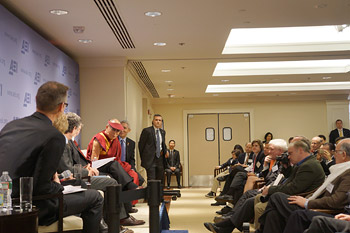
In addition to the two sources of learning, leaders need an open mind, akin to mindfulness, an open heart – compassion – and an open will that enables them to act. One of the first leadership challenges is to shift the interest to a shared awareness of the whole. His question for His Holiness was that having seen the effects of mindfulness on individuals, how can this be applied to the system as a whole? His Holiness’s response was:
“You know better than I do. But we need to begin our new approach to education right from the beginning, from childhood.”
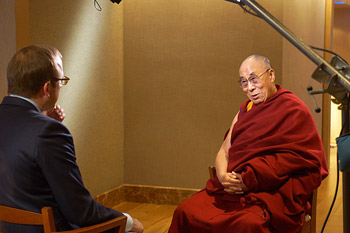
Later in the afternoon, His Holiness gave an interview to Jonathan Karl of ABC TV in which he extolled the need for secular ethics in the world today. He also explained his position regarding whether there might be a 15th Dalai Lama and whether the candidate could be a woman. Asked what makes him stressed, he replied that he is always relaxed, even if he occasionally gets irritated.
Meeting with Tibetans, most of whom live in the Washington region, he noted that they have been in exile for nearly 55 years and that for more than 60 years Tibetans in Tibet have suffered immensely.
“But,” he said, “at least we in exile have kept the struggle going. Our culture is on the brink of destruction, and yet we have been able share its virtues with others, which is something we can be proud of. Over the last two days I have been meeting with people at the American Enterprise Institute for discussions related to economics and happiness. I mentioned there that Buddhist science is something that can be of help and interest to everyone.”
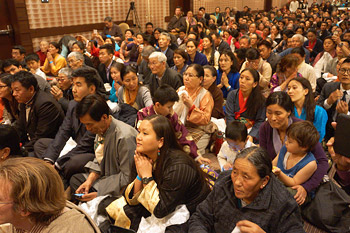
“We need to keep up our self-confidence. By and large Tibetans have a reputation for kindness and honesty. People trust us. You should keep this up and keep our culture of compassion alive. As for political issues, the Sikyong here has responsibility for those. That’s all, thank you.”
Tomorrow, His Holiness will fly to San Francisco.