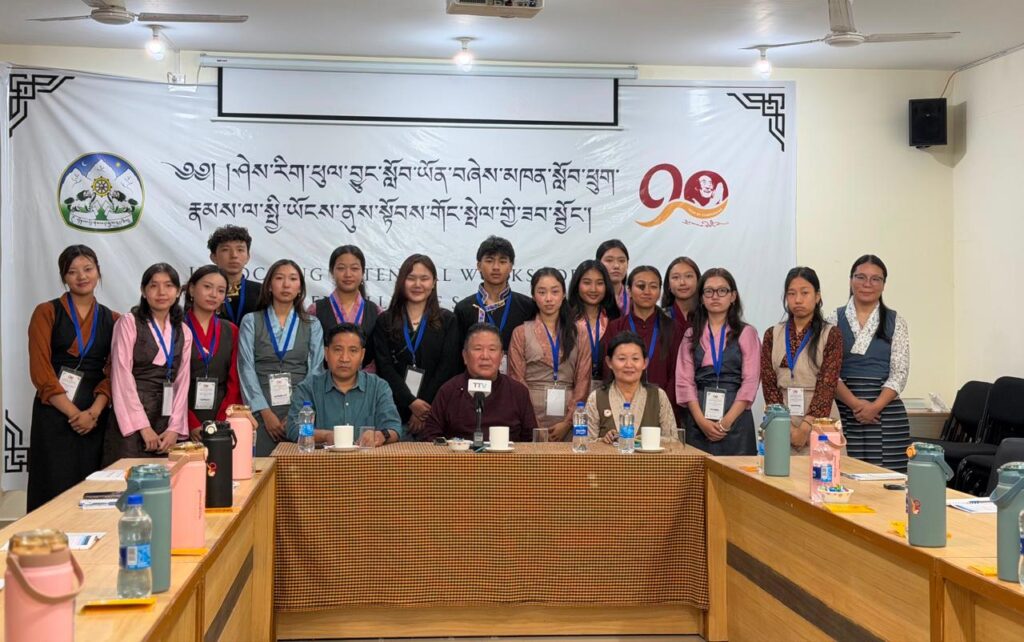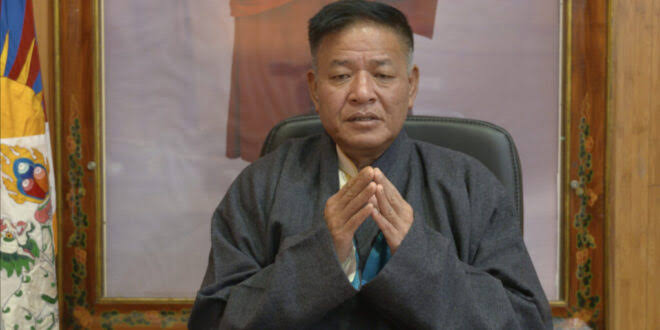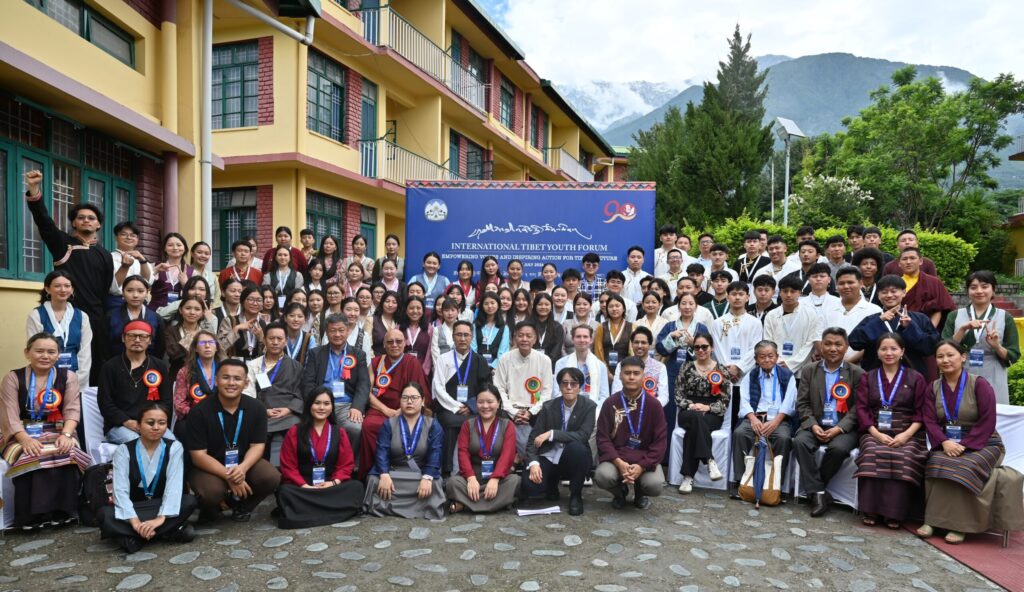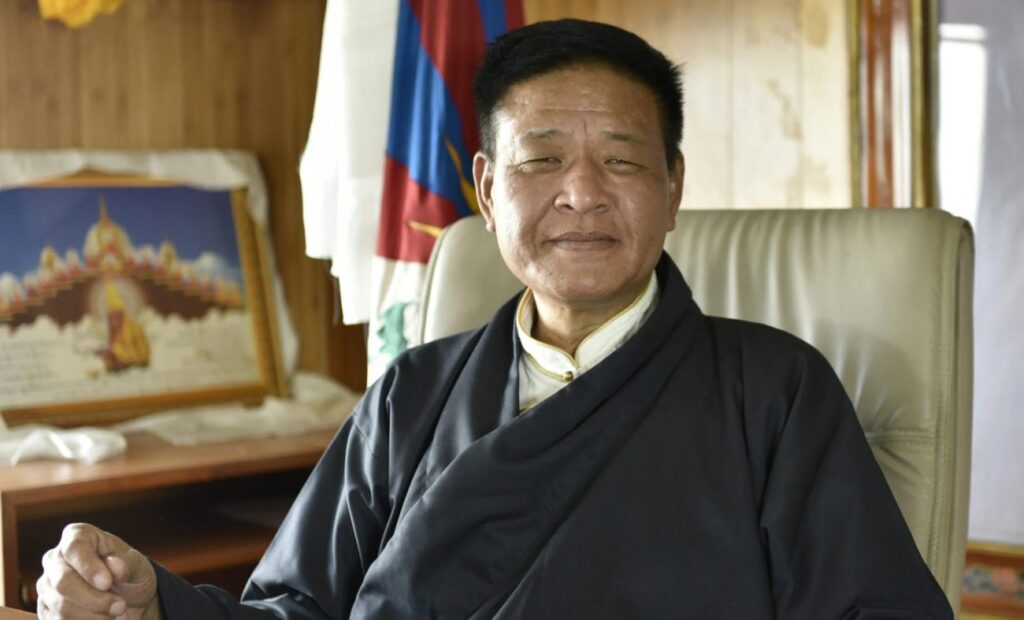

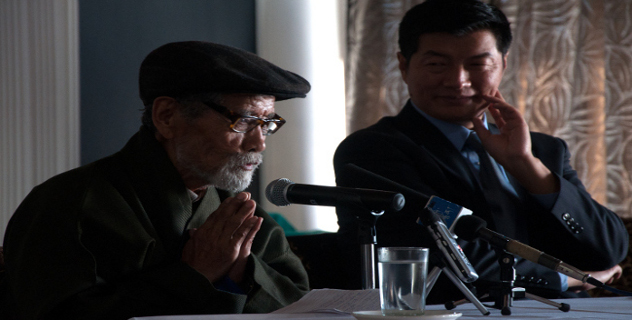
DHARAMSHALA: The Central Tibetan Administration today honoured 86-year-old Takna Jigme Sangpo, Tibet’s longest-serving political prisoner, describing as the “shining example of Tibetan freedom fighter.” Takna Jigme was felicitated by Sikyong during a talk by the former to civil servants of CTA today..
“Personally, having read about the sacrifices made by him with unwavering determination in the Tibetan freedom struggle, I applaud his contribution to the just cause of Tibet. He is a shining example of Tibetan freedom fighter. Through him, I pay my respect to all the former political prisoners and those who are suffering under the Chinese occupation of Tibet,” Sikyong Dr. Lobsang Sangay said.
Takna Jigme Sangpo, Tibet’s longest serving political prisoner, was released on medical parole on March 31, 2002, after serving more than three decades in prison. He was first reportedly arrested in 1960 while teaching at the Lhasa Primary School on charges of “corrupting the minds of children with reactionary ideas.” In 1964 he received a second sentence, where he served three years in Sangyip Prison for making comments regarding Chinese repression of Tibetans.
He was again sentenced to ten years’ imprisonment in Sangyip Prison for ‘counter-revolutionary’ propaganda in 1970. He had been caught attempting to send a document reporting Chinese atrocities to His Holiness the Dalai Lama via his niece, who was trying to flee Tibet. At the age of 53, Takna Jigme was released from prison in 1979 and transferred to the ‘reform-through-labour’ Unit No. 1 in Nyethang, 60 km west of Lhasa.
Takna Jigme was re-arrested on 3 September 1983 for pasting a ‘personally written’ wall-poster protesting against Chinese authority on the main gate of the Jokhang Temple in Lhasa, and sentenced him on 24 November 1983 to 15 years imprisonment for “spreading and inciting counter revolutionary propaganda,” and five years deprivation of political rights. On 1 December 1988, his sentence was increased by another five years for “spreading and inciting counter-revolutionary propaganda”.
On 6 December 1991, Takna Jigme made another bold attempt at an individual protest. During an official visit by a Swiss delegation, Jigme shouted “Free Tibet” in English, a phrase he had especially learnt for the occasion, and slogans in Chinese and Tibetan, from his cell. The authorities tried to explain away the incident by claiming to the delegates that he was ‘mad’.
Takna Jigme was subsequently sentenced on 4 April 1992 to a further eight years imprisonment, and an additional three years deprivation of civil and political rights, bringing his sentence to 28 years and by his released on 3 September 2011, he would have spent 41 years in prison.
He lost his eyesight as a result of suffering forced labour, prison atrocities and harsh prison conditions. “Torture and degrading ill-treatment, inhuman interrogation, solitary confinement, forced labour and indoctrination sessions are common practices used by the Chinese authorities in Tibet’s prisons,” he testified in 2003.
As a result of sustained efforts by the Central Tibetan Administration and international community pressing the Chinese government for his release, Takna Jigme was released on medical parole at the age of 76 in March 2002.
Invasion and genesis of political activism in Tibet
The political activism of Tibetans including Takna Jigme Sangpo unfolded amid the National Uprising of Tibetans against the complete invasion of Tibet by the Chinese communist government in 1959 and the systematic destruction of every vestige of Tibet’s identity during the Cultural Revolution from 1966-1976.
In Lhasa alone, the PLA operation to crush the Tibetan national uprising of March 10, 1959 resulted in 10,000 to 15,000 deaths within three days. According to an internal PLA report, 87000 Tibetans were wiped out in Lhasa and its environs between March 1959 and October 1960.
In the following two decades, a massive number of Tibetans died in prisons and labour camps. Tens of thousands of Tibetan prisoners were forced to work on road and railway construction and state farms for the People’s Liberation Army. At least 200,000 inmates were reported to have starved to death.
With the resurgence of cultural and religious activities in Tibet in the 1970’s, after Chinese paramount leader Deng Xiaping’s liberalisation policy, the Chinese authorities began to feel concerned about potential unrest in the region. Consequently, the authorities used informant system, “active policing” and preemptive measures to curtail protests. When any sort of control is exerted, reactions are but natural. The second wave of political protests took place in the late 1980s in Tibet and lessened only after the imposition of Martial Law in March 1989.
The causes of the 1987 demonstrations were attributed to various incidents. One major cause of the demonstrations happened on 24 September 1987 when a mass meeting of 15,000 Tibetans were held at Lhasa Stadium. The crowd there witnessed two Tibetans being executed and nine sentenced to lengthy prison terms.
Therefore, the mass meeting, executions and lengthy sentences were particularly timed and used to intimidate the Tibetans against involving in political activism. Just three days after the public executions on 27 September 1987, 21 monks and five lay Tibetans held the first major political protests of the eighties on the streets of Lhasa. The protesters shouted:
“Tibet is Independent” and “Chinese Quit Tibet”. As many as 36 protesters were arrested at the time.
According to Tibet Information Network, nearly 213 political protests were reported from Tibet between 1987 and 1996. Ronald D. Schwartz, author of Circle of Protest and a witness to the demonstrations in Lhasa, said, “During the period from 1987 through 1992, some 140 demonstrations by Tibetans have taken place, countless leaflets and posters demanding independence have been distributed, and many hundreds of Tibetans have been arrested.
According to Robert Barnett, “Political street protests by Tibetans against Chinese rule, even small-scale incidents, had come to an end in 1996, apparently because the increasingly rapid responses of security forces and the severity of prison sentences for protesters (an average of around 6.5 years for any public protest, however brief) had made the practice no longer worthwhile for protesters, especially since news of such incidents rarely reached the outside world or attracted press attention. There had been no large-scale protests in Lhasa explicitly against the government for 19 years.