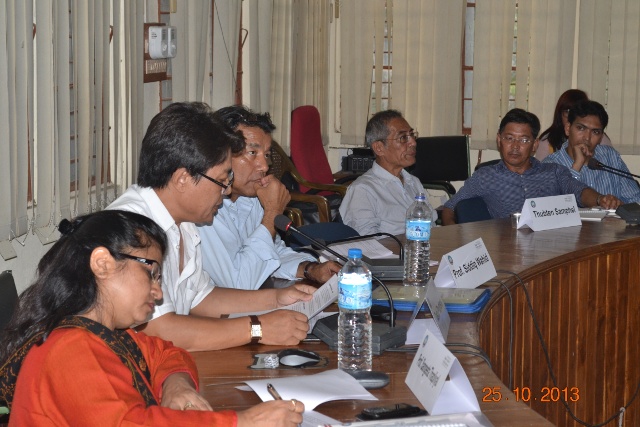


Itanagar, 25 October, 2013: The third series of the conference, ‘Tibet’s Relations with the Himalayas’ took place this morning at Rajiv Gandhi University, Doimukh, Itanagar, Arunachal Pradesh. The earlier two series of this conference were held in Ladakh (October, 2012) and in Sikkim (April, 2013). The three-day conference at Rajiv Gandhi University, Itanagar, would discuss and have separate sessions related to Tibet’s historical and political treaties, agreements and negotiations, the security issue, the plurality of the Himalayas, geopolitics of Tibet and social/religious issues, environment of Tibet and Himalaya and Border trade and commerce.
This conference was organised by FNVA New Delhi (www.fnvaworld.org) in collaboration with the Department of Political Science, Rajiv Gandhi University. The opening session was chaired by former Ambassador Ranjit Gupta and was presided over by Prof Tamo Mibang, the Vice Chancellor of Rajiv Gandhi University, Prof Siddiq Wahid, former professor and director of the Institute of Kashmir studies, Dr Nani Bath, head of the Department of Political Science and Mr O.P Tandon, trustee of FNVA. Amongst other learned speakers and researchers from different universities and think tanks across India, three participants from the Central Tibetan Administration would also be presenting their papers during this conference.
In his opening remarks, Prof Tamo Mibang, remarked that the ongoing series of conferences are highly relevant for the people living in the Himalayan belts. He further said the people of Arunachal Pradesh claimed their ancestral origin from Lhasa in Tibet and had migrated towards the south along the Siang river valley. He mentioned about the trade links and routes that existed before 1950 and how these routes had served as the main lifeline. He cited that in all the tribal folklores there was no mention of China but of Tibet. It clearly indicates the close connections of Arunachal Pradesh with Tibet and not with China.
In the afternoon session, Mr Tashi Phuntsok, secretary of DIIR presented his paper on the “Current Relations between the Himalayan Region and Tibetan People”. It briefly reflected on the past ear and traced to the present situation, in particular from 1959. It detailed the Tibetan monastic and educational institutions in India which have contributed in the growth of the religious and spiritual aspects in the Himalayan region. His paper was well received by the participants.
On 26 October, Mr Thupten Samphel, (Executive Director of TPI) will be speaking on the geopolitical significance of Tibet and later on Mr Tenzin Norbu, Executive head of the Environment and Development Desk under the Department of Information and International Relations will be presenting paper on the environment of Tibet and the Himalayan region.
Apart from the faculty and students from the Department of Political Science and members of some NGO also attended the first day of the conference.