
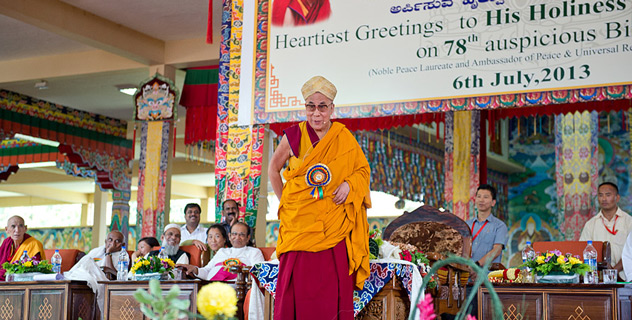
DHARAMSHALA: Tibetans across the world today celebrated the 78th birthday of His Holiness the Dalai Lama, who made a clarion call to the people, especially youth, to promote world peace through love and compassion.
Addressing tens of thousands of people at Bylakuppe in the southern Indian state of Karnataka, His Holiness the Dalai Lama said: “People should embrace love and promote world peace through compassion to live in harmony. The present-day generation can create better conditions and build a world where everyone can live in harmony and in a spirit of co-existence.”
“You should not think of your and your family welfare alone but of your fellow beings and the country you are living and the whole world eventually,” he said.
He expressed gratitude to the people and government of Karnataka for providing shelter to Tibetans during the most difficult period of Tibet’s history. He remembered former Mysore chief minister, S. Nijalingappa, who on the advice of India’s first minister Jawaharlal Nehru allotted 3,000 acres of land to resettle about 3,000 exiled Tibetans at Bylakuppe in 1960.
Top Indian government officials, including chief ministers of Karnataka and Arunachal Pradesh, attended the birthday of His Holiness the Dalai Lama. Chief Minister Siddaramaiah offered his heartfelt greetings to His Holiness the Dalai Lama and wished him a long healthy life. “We are all fortunate to celebrate the Dalai Lama’s birthday as he is a symbol of love, brotherhood and compassion,” the chief minister said on the occasion.
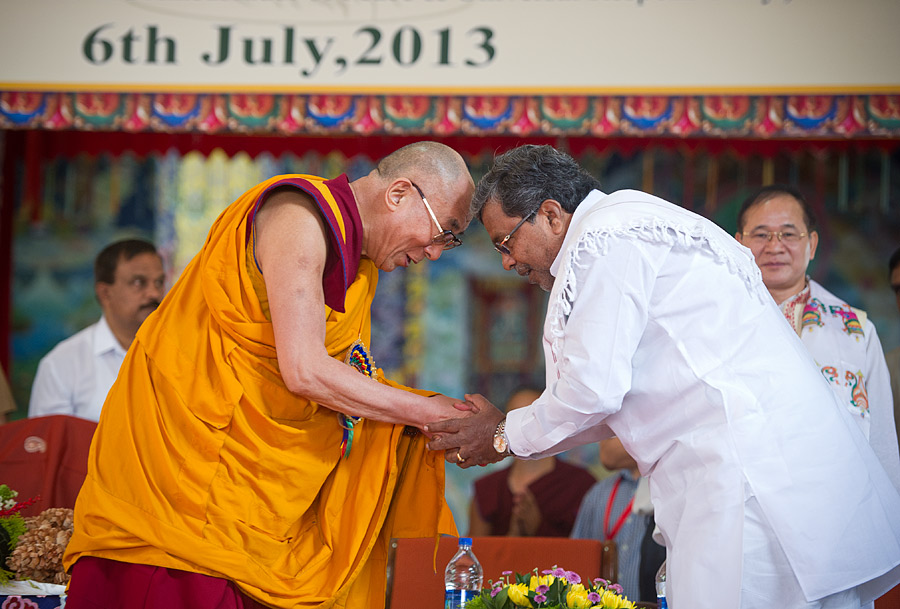
“India and Tibet shared a unique historical and cultural relationship,” he said.
“The bond of friendship between Kannadigas and Tibetans dates backs to 1960. We have always treated them as our own people and sheltered them in their hour of crises,” the chief minister recalled.
Sikyong reiterates CTA’s commitment to Middle-Way Approach
Sikyong Dr Lobsang Sangay, the democratically-elected leader and political successor to His Holiness the Dalai Lama, was present on the occasion. “We offer prayers and re-affirm their unflinching devotion and loyalty to His Holiness the Dalai Lama,” Sikyong said while greeting him on behalf of Tibetans in and outside Tibet.
“On the auspicious occasion of His Holiness the Dalai Lama’s 78th birthday, the Central Tibetan Administration reiterates its firm commitment to the Middle Way Approach in resolving the Tibet issue,” Sikyong said.
Sikyong said the Middle-Way Approach proposed by His Holiness the Dalai Lama to resolve the issue of Tibet is steadily bearing results is in the minds of many Chinese people, in particular among the intellectuals. “His Holiness the Dalai Lama’s outreach to Chinese students and scholars and his teachings to Chinese Buddhist practitioners are shaping Chinese attitudes towards Tibet and Tibetans. Some of the brightest Chinese intellectual luminaries, including Liu Xiaobo, the imprisoned Nobel Laureate, were signatories of a courageous open letter in 2008 that expressed support for His Holiness the Dalai Lama’s peace initiatives,” he said.
“The Middle Way Approach has enabled Dharamsala and Beijing to establish contact through a series of talks held between Chinese representatives and envoys of His Holiness the Dalai Lama. Tibetans inside and outside Tibet were for the first time able to contact and visit one another. Thousands of Tibetan students and monks in Tibet were able to visit India and receive secular and monastic education, which also contributed to the revival of Buddhism inside Tibet and awareness about the Central Tibetan Administration,” Sikyong said.
Sikyong further said: “The Middle Way Approach is supported by many prominent Tibetans inside Tibet as they view it as a realistic approach to peacefully resolving the issue of Tibet. Furthermore, this approach is also enabling many governments to support a solution-oriented Tibet policy and helps them to raise the Tibet issue in their bilateral dialogue with China. After President Barack Obama’s meeting with His Holiness the Dalai Lama on July 16, 2011, the White House applauded “the Dalai Lama’s commitment to non-violence and dialogue with China and his pursuit of the Middle Way Approach,” and encouraged “direct dialogue to resolve long-standing differences and that a dialogue that produces results would be positive for China and Tibetans.”
“Additional investment is being made to educate both Tibetan and external audiences on the Middle Way Approach. The Task Force on Negotiations will be enlarged and members will have their 26th meeting in September 2013 during which the recent developments in Tibet and China will be discussed,” he said.