[dalailama.com]
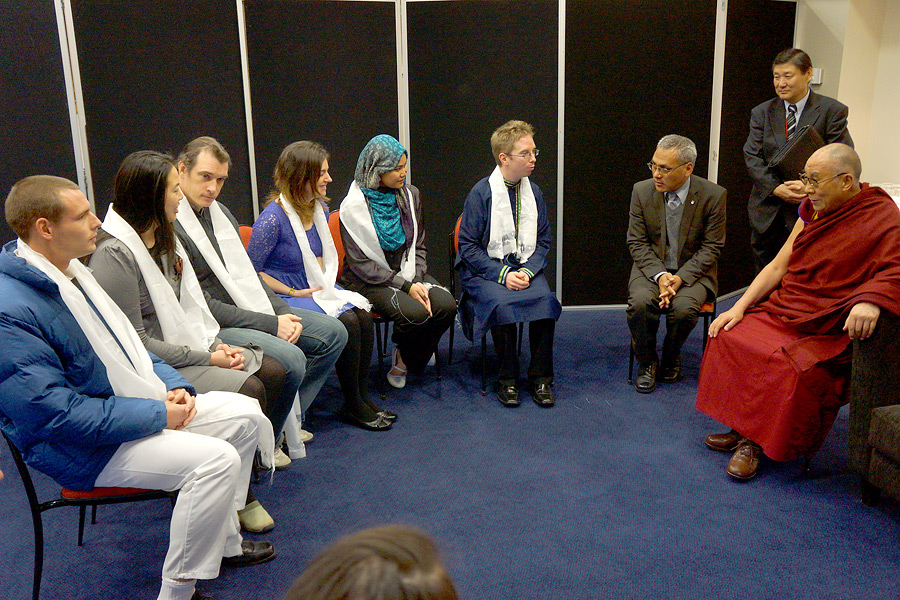
Dunedin, New Zealand, 10 June 2013 – The first people His Holiness the Dalai Lama met with today were New Zealand Youth Representatives of the Council for a Parliament of World Religions, who belonged to a wide range of faiths. His Holiness encouraged them, but stressed that working for inter-religious harmony requires us to be really active.
The twelve New Zealand parliamentarians he met next coming from all parties represented 10% of the members of parliament. He thanked them for their support. He came straight to the point about relations between Tibet and China stating that as a country and a people the Chinese are wonderful. The problem is the closed totalitarian system.
“1.3 billion Chinese people have a right to know about the reality in which they live and on the basis of that they are quite capable of judging right from wrong. So the censorship they face is morally wrong. Secondly, the judiciary at present only serves the party’s interests. The whole judicial system needs to be raised to international standards.”
Xi Jinping’s elevation to the leadership opens a fifth. In a society of 1.3 billion people harmony is essential, which is why former Prime Minister Wen Jiabao spoke of China’s need to reform. His Holiness said it is time to watch and see what happens.
“We are not seeking independence,” he declared, “although Tibet was clearly independent in the 7th, 8th and 9th centuries, even according to Chinese records. But times change. Look at India. Before independence from Britain it consisted of many smaller and larger kingdoms and princely states that functioned like independent entities. Once independence was won, they joined the new India. The peoples living in these areas have maintained their languages, scripts and distinct cultures and gained the benefits of development.
He mentioned the irony that reliable reports speak of 400 million Buddhists in China, which means that the country is home to the world’s biggest Buddhist population. Since last year, His Holiness has been offering teachings to Chinese Buddhists.
His Holiness said that he sees it as free countries’ responsibility to encourage China on the path of democracy. From an economic point of view, China has already joined the world community. China’s adopting democracy will not only be of benefit to the Chinese people, it will bring this large nuclear armed nation, which already has a permanent seat on the UN Security Council, into the mainstream. His Holiness suggested that it may be that smaller nations like Norway and New Zealand have more influence because they pose no threat to China.
Asked whether he has hopes that the constitutional movement in China will help Tibet’s position, His Holiness said that the Chinese people have no experience of democracy, so a realistic approach is to look for gradual change. He pointed out that many rights included in the constitution have not yet been implemented and this is something that must be done.
Another questioner wanted to know how His Holiness feels when leaders give in to Chinese pressure not to meet him. He said that meeting the public is what is most important to him, because one of his main concerns is promoting human values in order to contribute to greater human happiness and inter-religious harmony.
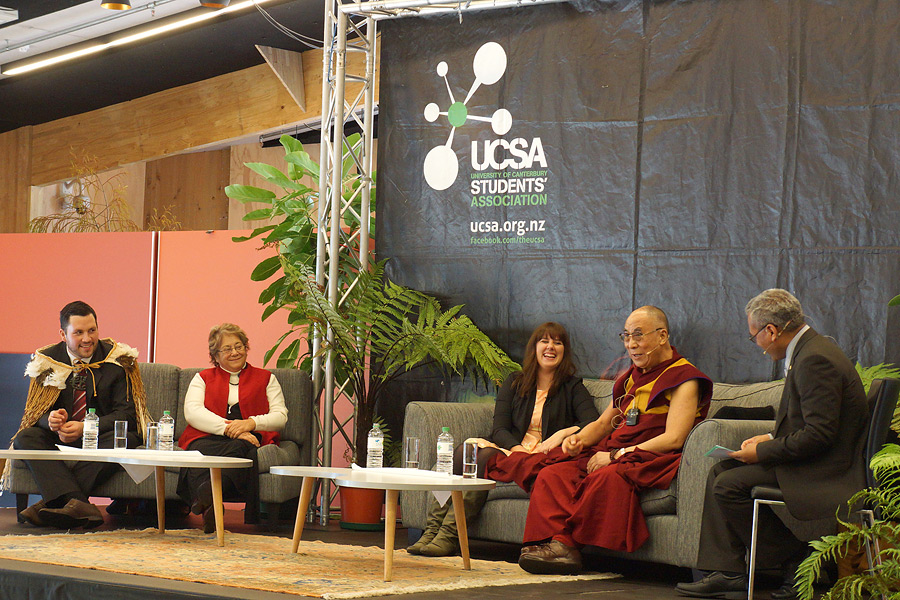
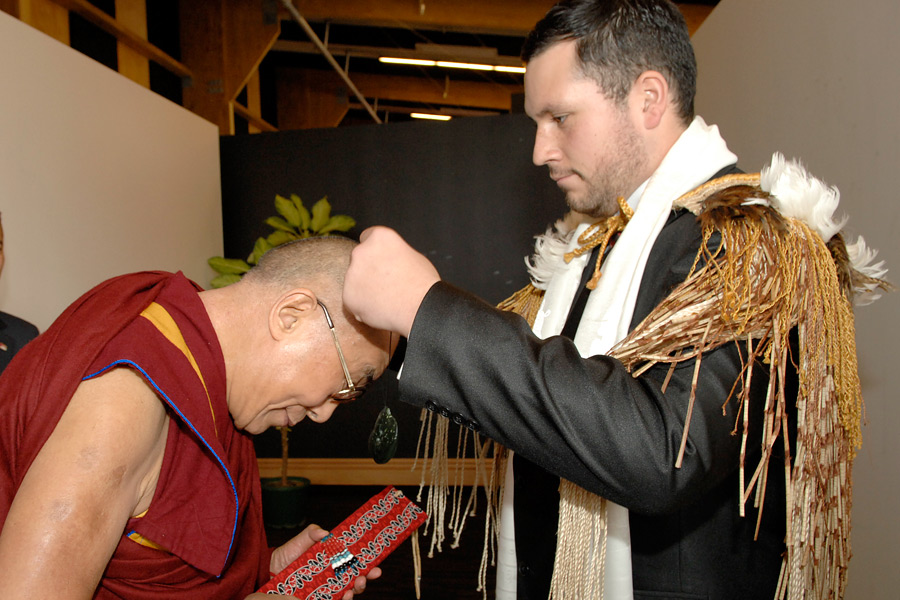
At an event organized by the University of Canterbury Student Association, His Holiness was given a strident and rousing welcome by a team of Maori sportsmen. He responded:
“I appreciate your traditional welcome. When I first came to New Zealand I was surprised by what seems to be an aggressive greeting, which feels like you are testing your guest! But I note that you are keeping up your traditional language and customs.
“Whenever I meet people I like to greet them as brothers and sisters. In the past, we were isolated from each other, but improved communications have made it evident that we are all the same as human beings. We may have different language and culture, but physically, mentally and emotionally we are all the same. We all want a happy life, and we have a right to achieve it. Great developments in science and technology, whose purpose is to ensure a happier humanity, have sometimes brought more stress and anxiety. Material facilities have given us physical comfort, but have not necessarily put our minds at ease.”
He mentioned that sensory experiences like listening to music and enjoying delicious food are pleasant, but the satisfaction they bring is short-lived. We need to find other ways to ensure lasting mental peace. He recalled a Christian monk he met in Barcelona, Spain, who had been in retreat in the mountains with almost no material comfort for five years. He asked him what he had been doing and when the monk told him he had been meditating on love, His Holiness noticed the glow of tranquillity in his eyes. On the other hand, he said, he has met billionaires who seem to have everything they want and remain miserable. This indicates that the ultimate source of joy and peace of mind is within the mind.
He dismissed a question about relations between Islam and the West being a clash of civilizations as “totally wrong.” He conceded that some individuals behave badly, but that this is not grounds for generalizing about an entire community. He suggested that many of the problems we encounter today have their beginnings in mistakes made in the twentieth century, but admitted that these questions are neither simple nor easy.
Asked who he looks to for guidance, His Holiness said that our real guide is our own mind, our sense of reason.
“I use my own intelligence, on the basis of a calm mind, and employ what I have learned from ancient Indian thought.”
A question about introducing ethics in schools prompted His Holiness to note that some people feel ethics should be based on religious teachings, but the difficulty in our present world is to ask which religion. He suggested that we need a secular ethics because the real point of ethics is creating respect and concern for others, something good and beneficial for society.
After lunch, His Holiness flew from Christchurch to the southern city of Dunedin. On arrival, he was asked by a television journalist why he had come. He answered:
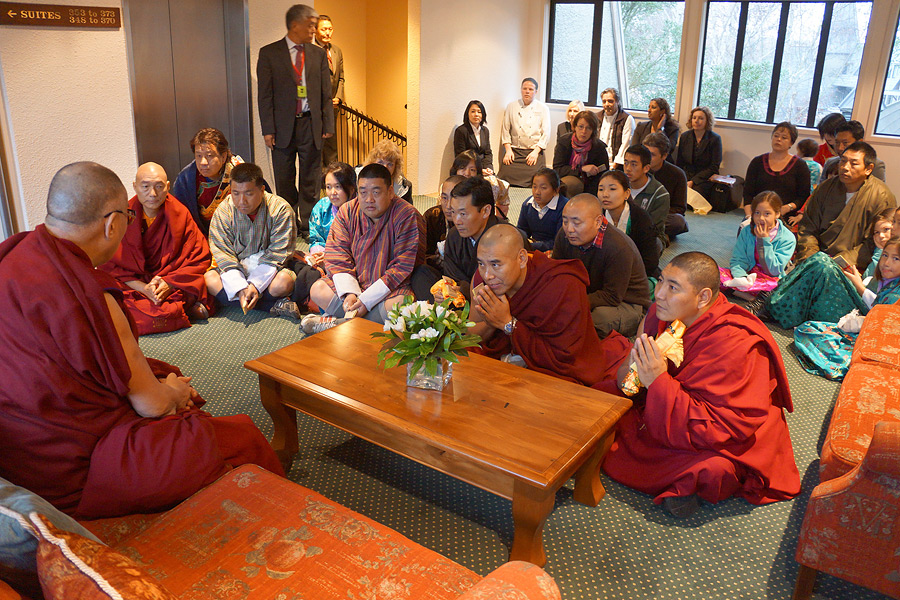
Warmly welcomed at Dhargyey Buddhist Centre, His Holiness spoke of being in exile for 54 years, that in the beginning of their life as refugees Tibetans were sad to have lost their country. Now, however, they feel proud of the knowledge and culture they have preserved. Ven Lhagon Rinpoche made a preliminary report about the centre concluding with prayers for His Holiness’s long life. In his report the director recalled the work that Geshe Ngawang Dhargyey, the founder, and his student Ven Thubten Rinpoche had done. He outlined the classes and meetings that take place in this and affiliated centres. He said that members support the issue of Tibet wherever they can and mentioned the interest that the local University of Otago, with its medical school, has shown in Tibetan medicine.