By Dr. Rinzin Dorjee, Research Fellow, Tibet Policy Institute, a think tank of the Central Tibetan Administration*
When the Chinese Communist Party’s (CCP) in the 1980s emphasized on proving truth from the facts, Tibetan leadership in exile successively sent delegations to visit Tibet to assess the conditions of Tibetans. In 1985, the fourth delegation from the Dharamshala took two large suitcases of portraits and precious pills of His Holiness the 14th Dalai Lama to distribute to Tibetans in Tibet. However, the Chinese authorities restrict Tibetans from the possession of an image of the Dalai Lama. When the delegations visited Tibet, every Tibetans they met pleaded for a photo of the Dalai Lama even when the Chinese local authorities took preemptive measures to prevent such a situation.
For Tibetans, not only love, they cannot imagine a day without the Dalai Lama. Tibetans recite daily prayers and sing to connect with the Dalai Lama even under the Orwellian nature of the CCP rule in Tibet. The 14th Dalai Lama while in exile is respected as a global spiritual leader. Fortune, a leading world magazine, has chosen the Dalai Lama, the 9th in rank for its list of world’s 50 greatest leaders in 2014.
The CCP propaganda of there being no love by Tibetans in Tibet for the Dalai Lama is unfounded speculation. I am sure the Party heads did work diligently and went around asking every Tibetans in so-called the Tibet Autonomous Region (TAR) about their views on the Dalai Lama. He got the answer he wanted. Did he expect any other response? Doesn’t he know any different answer would be a criminal offense? In Tibet, the people feign compliance and give whatever the answer the government wants. In 1960-1980, if you had asked any Tibetan do you believe in religion, the resounding answer would be “no”, but soon as restrictions on worship were lifted, religion return with force. It had never disappeared, and the people just pretended they didn’t believe in religion.
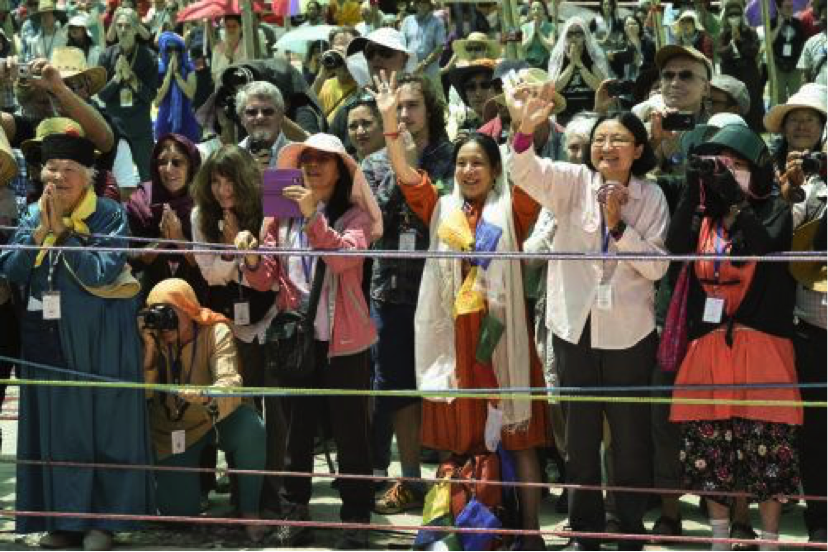
The relationship between the two, the Dalai Lama and the Tibetans, dates back to more than 500 years since the first Dalai Lama. The Great Fifth Dalai Lama, by taking over the political leadership of Tibet had cemented a stronger relationship with Tibetan people. The Chinese leaders may succeed in making Tibetans dependent on the Chinese government subsidies but they fail and continue to fail to win the hearts and minds of Tibetans during its 60 years of despotic rule. Why do the Chinese government need to confiscate passports of thousands of Tibetans inside Tibet to restrict travel to India to attend the Kalachakra teachings of the Dalai Lama in 2012, 2014, and 2017? Tibetans who could not attend the Kalachakra teachings in India due to travel restriction by the Chinese government, lit a butter lamp at their homes and prostrate facing towards India believing that they have received the teachings. In 2017, thousands of Chinese Buddhists from China attended the Kalachakra teachings in Bodh Gaya, despite the Chinese government demonizing the Dalai Lama as a separatist leader.
The special envoy of the Dalai Lama to negotiate with the representatives of the CCP, Lodi Gyari, who passed away last year, said categorically that if the Chinese government failed to find a solution to the Tibet issue and the 14th Dalai Lama passes away in a foreign land, for centuries, the Tibetan people will never forgive the Chinese leadership.
The Dalai Lama‘s latest comment on Reuters’s video interview stating the 15th Dalai Lama will be born in India is a huge blow to the Chinese government‘s covert strategy to choose his incarnation. The 14th Dalai Lama is a separatist’s leader in the eyes of the CCP. However, they want him to reincarnate according to their diktat.
The CCP’s strategy to detach the Dalai Lama from the hearts and minds of Tibetans is an attempt to reduce the significance of the Dalai Lama in Tibet and China. This implies a failure of CCP leaders’ naïve strategy to appoint the 15th Dalai Lama.
Two demands that every Tibetans who have self-immolated in Tibet are the restoration of Tibetan freedom and the return of the Dalai Lama to Tibet. These demands can be seen in videos and letters which have appeared later in social media. Their longing to see the Dalai Lama while they are setting themselves on fire is unbelievable. That is the love and faith Tibetans have towards their Dalai Lama.
According to an unverified source, many Chinese Communist Officials have the Dalai Lama’s photo on the home screen of their mobile phones. As authoritarian leaders, they demonize and label the Dalai Lama as a separatist. However, in their hearts, the communist leaders also embrace the Dalai Lama as a charismatic and a spiritual leader.
Robert Thurman, an American Buddhist and the author of, Why Dalai Lama Matters? writes that “In order to understand even better how ordinary Tibetans regard the social institution of the Dalai Lama, there are several prominent myths that are important to consider. These myths help us fathom the depth of feeling the Tibetan people have towards him. When properly appreciated and understood, these myths should help the Chinese leaders realize that it is impossible to eradicate the Dalai Lama from the Tibetan soul.”
Hu Yaobang, a former Chairman and General Secretary of the Central Committee of the CCP, and known for his liberal thinking suggested a 5- point proposal to the Gyalo Thondup, an elder brother of the Dalai Lama, on the return of the Dalai Lama. The third point in the proposal emphasized that if the Dalai Lama returns to China, he can visit Tibet on occasions whenever necessary. It is also stated that official power he holds before 1959 will be restored. The Dalai Lama responded that the key issue between Tibet and China is not about the return of the Dalai Lama, rather it is the fate of six million Tibetans who have been denied freedom and rights to rule themselves.
With these historical, traditional, and spiritual relationships that the Dalai Lama and Tibetans have built over many centuries, the Chinese government new strategy is doomed to be failed again.
Dr Rinzin Dorjee is a research fellow at the Tibet Policy Institute. The views expressed here do not necessarily reflect those of the Tibet Policy Institute.