

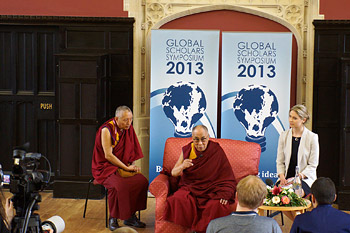
Cambridge, England, 19 April 2013 – His Holiness the Dalai Lama is a guest of the Global Scholars Symposium which allows current world leaders to interact with young academics who are striving to meet the great challenges of global society. He is staying in the Master’s Lodge of St John’s College, Cambridge and this morning walked through the College to the Divinity school to his first engagements of the day.

He acknowledged that a lot of development has taken place in Tibet, which is good, but pointed out that freedom is also important.
“The source of happiness is compassion although it doesn’t necessarily have any connection to religion. It can be based on our common experience, common sense and scientific findings. Promoting human happiness along these lines is my first commitment. My second relates to religious traditions, their common message of compassion and forgiveness, and encouraging respect among them. Thirdly, I am a Tibetan and someone in whom the Tibetan people place their trust, so if need be I have to be prepared to speak out freely on their behalf.”
With regard to the Chinese, he stated that 1.3 billion people have a right to know about reality, and censorship interferes with this. Once they recognise reality, they have the ability to judge what’s right from what’s wrong.
It was a short distance, after lunch, to Trinity Hall, where His Holiness met a group of Chinese students who are studying in Britain.
“Brothers and sisters – I always begin my talks in this way because it is one of my fundamental beliefs that we are social creatures, physically, mentally and emotionally the same.”
He remarked that many people are concerned about the prevalence of material values, which seems to have a link to the shocking increase in suicide among young people. In this context, transparency in your work brings about trust and friendship, which leads to a happy life. This depends on recognising that other human beings are just like us.
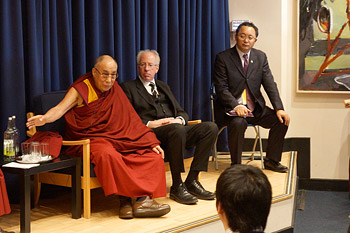
“We are seeking meaningful autonomy. When the Chinese government objects that we are seeking a Greater Tibet, my retort is that we do not use that term. We have to solve these differences through dialogue. We want the central government to give us the ethnic minority rights mentioned in the Chinese constitution.”
One student wanted to know how you can have a dialogue with someone pretending to be asleep. His Holiness said that dealing with the government is one thing, but he also believes in reaching out to the people. He said he tells Tibetans that Chinese are their neighbours and that they will have to live together side by side.
“Let’s wait and see how things change and whether the government will adopt a more realistic, holistic view. At the moment by maintaining censorship in China, the government are in effect fooling the people. Such deception is essentially self-defeating.”
At the beginning of the meeting, when the students were invited to ask questions only one or two hands went up; by the end, more than a dozen still had points to raise when time ran out.
Returning to St John’s College, His Holiness addressed a more general meeting of members of the University of Cambridge on the theme, ‘Educating the Heart.’
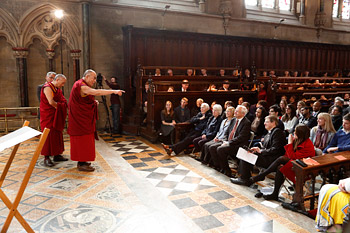
“People want to live a peaceful happy life, but don’t find it because they are not realistic in their approach. When we are too self-centred, we tend to see other people in terms of ‘them’ and ‘us’ which is divisive and unhelpful. Nowadays, scientists say that a healthy body requires a healthy mind, so just as we adopt physical hygiene to protect our health, we also need a sense of emotional hygiene too.”
He pointed out that ancient Indian literature contains an immense store of knowledge about the workings of the mind. Science is beginning to gather evidence that people meditating on compassion do experience measurable changes in their brains and their health improves. Today, in order to make compassion available to everyone we need to develop a system of secular ethics. We need a map of the emotions, because dealing with our emotions, especially the destructive emotions, is the key to a healthier mind.
“When you have greater compassion and inner strength, you have more confidence, which gives rise to trust, transparency and friendliness.”
Back at the Master’s Lodge, before he turned in for the day, the St John’s College choir sang delightfully for His Holiness. The young choristers’ faces, so serious while they sang, lit up when he came forward to shake each of their hands and thank them.