
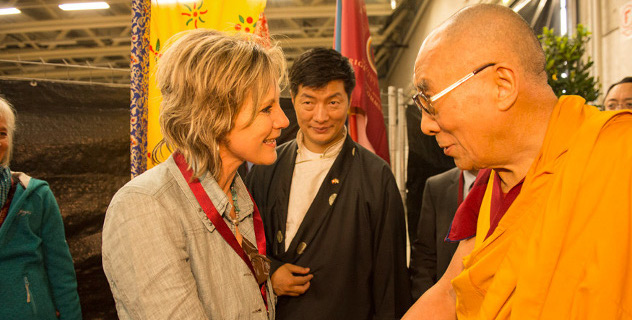
DHARAMSHALA: Over 16,000 people attended His Holiness the Dalai Lama’s teachings and public talks during the two-day Forum Fribourg in Switzerland over the weekend, Swiss news portal, The Local, reported.
Speaking on secular ethics on Sunday, His Holiness said: “Dear brothers and sisters, I’m extremely happy to have this opportunity to talk to you. Please think of yourselves just as human beings, not as Swiss, Italian, Russian, German, French, Spanish or Tibetan. Every one of us wants to live a happy life and we all have a right to fulfil that goal. However, we face many problems because we insist on focussing on the secondary differences between us.”
He said he usually discusses secular ethics under three main points, of which the first is our common experience. We are all born from a mother’s womb and most of us grow up under her care. This is a biological source for our sense of affection. Our very survival depends on others’ care. Those of us who received the greatest affection when we were young tend to be happier later in life. Families bound together by affection tend to be happier.
The second point is that we all have the potential to develop a sense of concern for others. No matter how strong or how educated we are, we cannot survive without others, so how can we neglect their interests? Warm-heartedness and genuine concern for others earns friendship, on the basis of which we can act truthfully and transparently, which in turn is a source of confidence. Thirdly are scientific findings. Modern scientists are mostly concerned with matter and what they can measure. But today, increasing numbers of scientists are showing interest in the mind and emotions, concluding that a healthy mind favours sound physical health.
His Holiness asked: “How can we promote secular ethics? Through education – for which we need a map of the mind. Please think about what I have said.”
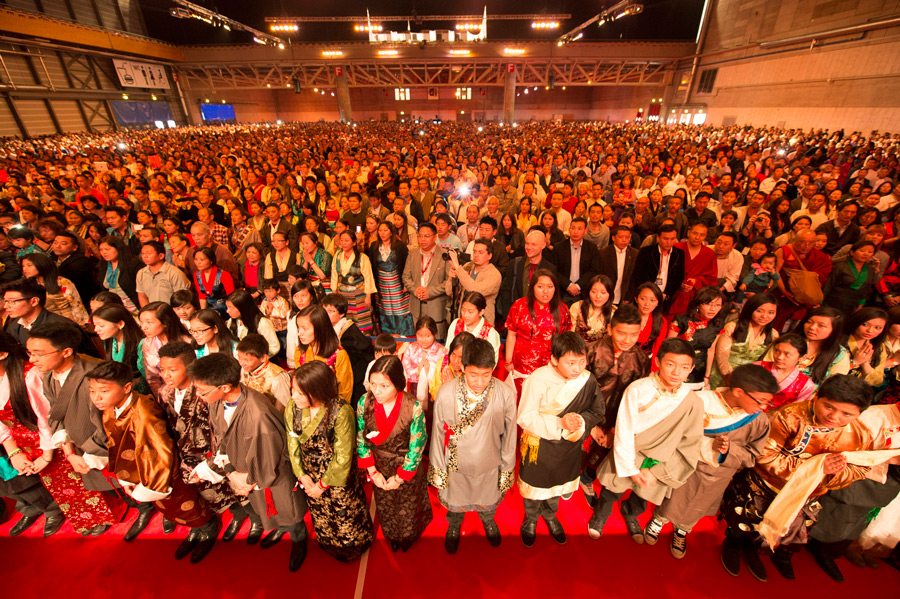
Later in the afternoon, His Holiness spoke to a gathering of Tibetans resident in Switzerland and the hall with a capacity of 8000 was filled once more. Accompanied by the Sikyong, Dr Lobsang Sangay, he was welcomed to the stage by a young Tibetan musical troupe. Everyone stood for the Tibetan national anthem and the Representative briefly presented a report. This was followed by children sweetly singing a patriotic song, after which His Holiness began his address: “Tibetans, monks and nuns, young and old, settled here in Switzerland, I have come here for a short time to teach and meet with you.”
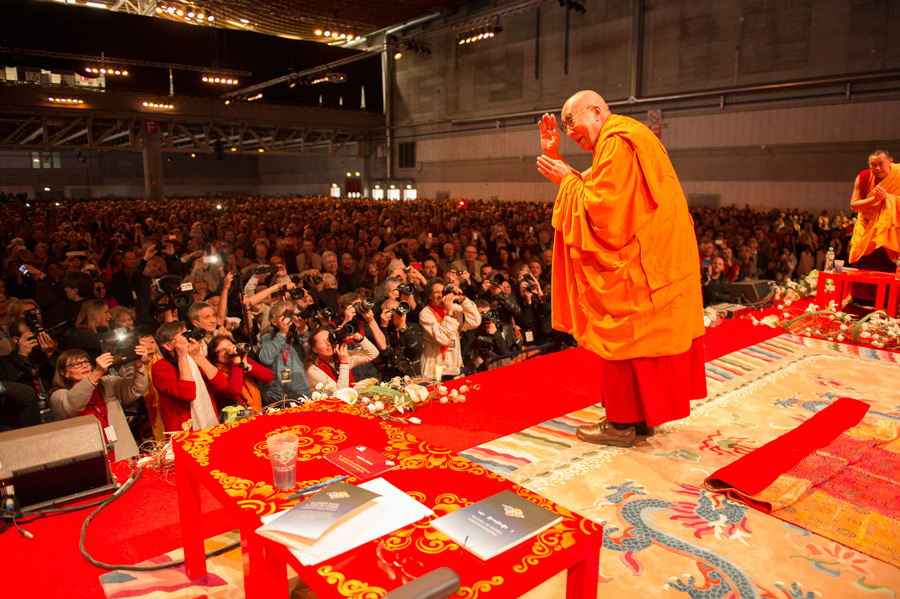
He said that Tibetans have kept alive the spirit that thrived when Tibetan kings ruled all Tibet in the 7th, 8th and 9th centuries. They have kept the Nalanda tradition of Buddhism alive as well as the Tibetan language, which is the best medium for giving it expression. He talked about the origins of the Tibetan nation and its culture, noting that archaeological estimates for the dates of the first Tibetans vary from 4000 years ago to 10,000 years ago. He recalled a Chinese archaeologist he met at Harvard telling him that contrary to Chinese government accounts, his findings suggested that Tibetans evolved on the Tibetan plateau itself, not elsewhere in China.
He reminded his listeners that Buddhism is not just about prayers and rituals, but using your mind to effect an inner transformation. He urged them to become twenty-first century Buddhists, using their own intelligence to understand what Buddhism is about.
He explained how his retirement came about; how he semi-retired in 2001 when a leader was first elected and how in 2011, he decided the time had come to hand over all political responsibility to the elected leadership. He said:
“China has accused us of trying to restore the system as it used to be – but we are following democracy and they are not.”
He traced the evolution of the Middle Way approach, recalling that Tibet’s last appeal to the UNO in1965, after three UN resolutions, was still ineffective. Concluding that dialogue with China was the only option, the Middle Way approach began to evolve gradually from 1974 and the Chinese indicated some willingness to respond on several occasions since then. He emphasised that the Middle Way approach is based on non-violence. However, he also stressed that it had been made clear as early as 1954 that Tibetans did not consider themselves to be under China.
He assured the assembled Tibetans that the Sikyong would speak further about these important matters. Recollecting the honest, if innocent, impression the initial 1000 Tibetans had made when they first arrived in Switzerland so many years ago, His Holiness urged those living here today to continue to be careful to maintain their dignity and good reputation.
His Holiness gave a one-and a half days of teachings on Atisha’s Lamp for the Path to Enlightenment (jangchup lamdron) and confer a White Tara Empowerment (drolkar jenang)
His Holiness graces ICT’s Light of Truth Award function
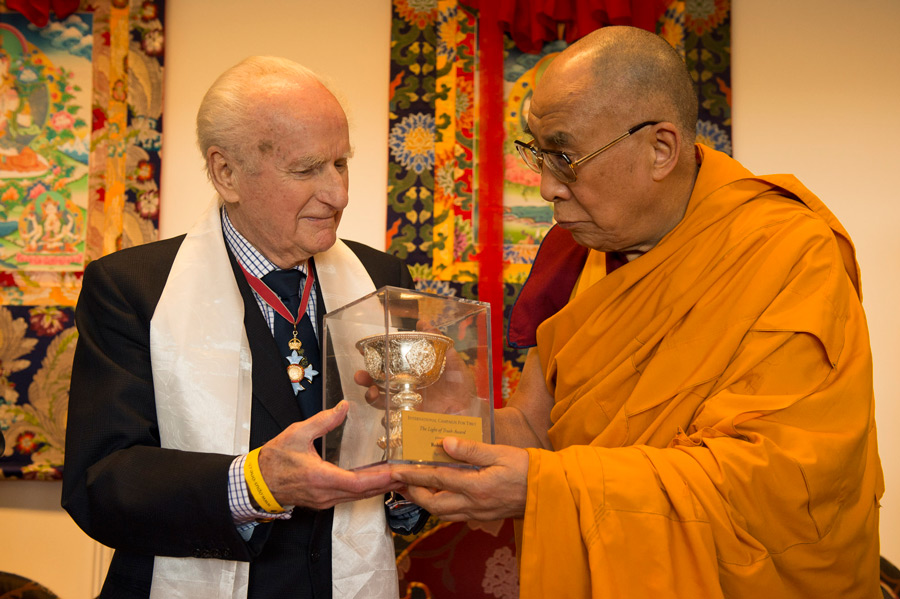
On Saturday, His Holiness the Dalai Lama presented five individuals, and members of their families with the International Campaign for Tibet’s Light of Truth award. They were Robert Ford from Britain, who was a radio-operator for the Tibetan government in Chamdo, and was imprisoned by the occupying Chinese forces; Prof Schwarz-Schilling of Germany for his support for Tibet in his political and academic work; Ms Sigrid Joss-Arnd of Switzerland for her work with the Red Cross on behalf of Tibetans; Mr Theo van Boven of the Netherlands for his work on human rights and Mr Wilder Tayler from Uruguay, Secretary-General of the International Commission of Jurists, whose findings about Tibet were especially useful. His Holiness greeted each of them and presented them with a Tibetan butter lamp symbolic of the Light of Truth. He said:
“All of you have been long-standing friends and supporters of Tibet, for which we are immeasurably grateful. As you know, the spirit of the Tibetan people is undiminished and the power of truth remains strong.”
His Holiness addresses Second Tibetan Buddhist Conference in Europe
His Holiness on Friday addressed about 80 representatives at the Second Tibetan Buddhist Conference in Europe held at the Fribourg Forum in Fribourg, Switzerland.
“Each one of the 7 billion people on earth wants to lead a happy life. Until now many of them have become accustomed to thinking that money is a natural source of happiness. However, this is not the case. Nowadays, therefore, bodies like the Mind & Life Institute are making efforts to educate people to pay more attention to developing inner peace and a calm mind.”
His Holiness explained that our various religious traditions besides Buddhism should be capable of fostering the ethics that are the root of such inner values. If we look at what the Buddha taught in terms of the Listener, Solitary Realizer and Bodhisattva vehicles and the Vaibhashika, Sautrantika, Chittamatra, and Madhyamaka schools of thought, we might ask why he gave such a range of instructions. And the answer is that he saw that different people have different needs and aptitudes.
His Holiness read recently that one billion out of the 7 billion population of the earth count themselves as non-believers in any religious tradition. Yet he suspects that of the remaining 6 billion, many more fall among the non-believers because they only pay lip-service to their spiritual practice when they are at the church or temple and appear to neglect it in the rest of their lives.
Therefore, there is a need for a serious effort to increase awareness of the importance of ethics, not as a religious practice related to heaven or liberation, but as something that affects us directly now. We need to help people understand that they will be happier if their actions are more consistently positive, which will lead to greater transparency, more friends and greater self-confidence.
This is not an invitation to proselytise. His Holiness was very clear about that:
“Even though I have spoken about Buddhism all over the world, I never suggest that anyone should become a Buddhist. Rather I recommend that people preserve their connection to their native religion. I also warn against building extravagant centres and temples in what are traditionally non-Buddhist countries for fear of causing an affront.”
What is important, he went on, is that people find ways to become more realistic and more compassionate. The path to this is education. Buddhists should examine how they can contribute to the betterment of society where they live by developing such education. His Holiness mentioned that in recent years he has reassessed how we can classify the teachings found in the Kangyur and Tengyur collection: Buddhist science, Buddhist philosophy and Buddhist religion. Classes based on these categorisations, during which visitors to Buddhist centres could learn about the functioning of the mind and emotions, would be very useful. This could entail establishing a sense of mental and emotional hygiene to correspond to the physical hygiene we normally observe to preserve our health.
Stressing that to be a Buddhist in the twenty-first century requires knowledge and understanding, not only faith, His Holiness urged people to study. This he said is an aspect of the legacy of the Nalanda tradition, which is the source of all schools of Tibetan Buddhism. He recalled a woman in the USA telling him that it was all very well for him to assert that Tibetan Buddhism is derived from Nalanda, but not all Sakyapas or Kagyupas agree. He said that he kept quiet at the time, but that it is quite clear that the Sakya tradition derives from the adept Virupa, and the Kagyu tradition from the adept Naropa, both of whom had formerly been scholars at Nalanda.
“It’s important to avoid divisive sectarian tendencies like this because Tibetan Buddhism is one of the richest Buddhist traditions and the Tibetan language is the best medium for conveying what it says.”
Meet the Press
After lunch, His Holiness gave several interviews to German, French and Swiss journalists. Inevitably he was asked again about the self-immolations that have taken place in Tibet and why he does not issue a statement urging them to stop. He replied:
“I have retired from political engagement and this is a political issue. However, we should note that these people could have sought to harm others, but chose to end their own lives instead. When this first occurred I expressed my sadness, but even then I expressed doubt as to the effectiveness of this kind of action. I certainly have not encouraged it.”
His Holiness challenged a suggestion that non-violence is not of practical value, pointing out that India achieved Independence through non-violent struggle and having done so was able to maintain friendly relations with Britain, the former colonial power. He pointed out that non-violence is a crucial factor in attracting the support of Chinese intellectuals and writers to the Middle Way Approach.
He was also asked what he might say to Xi Jinping if he were to meet him and his response was: “You are the leader of 1.3 billion people. As Deng Xiaoping said, we should seek truth from facts. Please do that. Analyse the reality of the situation then act accordingly. This is also what Hu Yaobang did.“