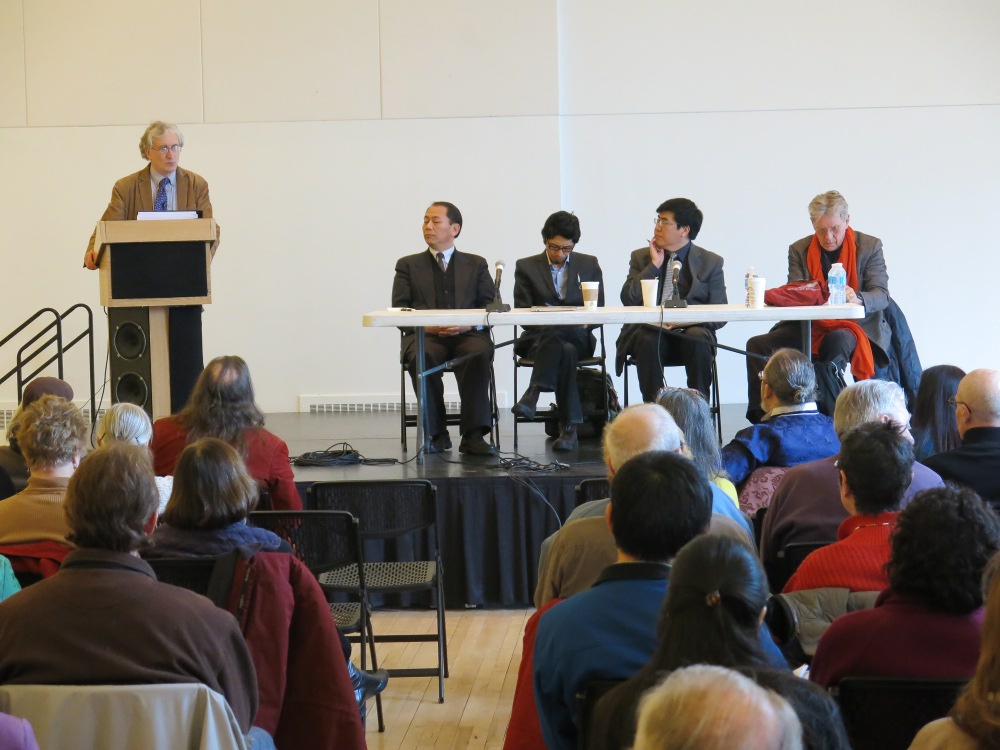
NEW YORK: The Tibetan Center and the Human Rights Project of the Bard College, New York, co-sponsored a panel discussion titled “The Future of Tibet” at Bard College, New York, on Saturday. The discussion aimed to bring into perspectives of the a group of noted panelists about the possible future for Tibet and Tibetan people in view of the unprecedented self-immolation protest by Tibetans against the Chinese government’s continued occupation and repression of Tibet.
The panelists include Mr Lobsang Nyandak, His Holiness the Dalai Lama’s Representative in New York, Mr Tenzin Dorjee, executive director of Students for a Free Tibet, Prof Robert Thurman, professor of Indo-Tibetan Buddhist Studies at Columbia University, co-founder and president of the Tibet House New York, and Prof Ming Xia, professor of political science at the Graduate Center and the College of Staten Island, the City University of New York. It was moderated by Prof. Robert J Barnett, Director of Modern Tibet Studies Program at Columbia University. Over 100 people attended the event, which was simultaneosly watched by thousands online.
Representative Mr Lobsang Nyandak in its opening remarks made it very clear that the future of Tibet and its people depends on the determination of Tibetan people. The critical situation inside Tibet is not only a matter of grave concern for not only Tibet and China, but also for the whole humanity. Therefore, the Tibetan people needed the support from the international community and the Chinese people to keep their identity alive.
Mr Nyandak expressed confidence that Tibetans in exile, under His Holiness the Dalai Lama’s leadership, have laid a strong foundation to sustain their freedom struggle by investing in democracy, education and preservation of its culture for the last more than 50 years.
Explaining the details of the middle-way policy, he said the Tibetan leadership will remain steadfast towards the resolving the problem of Tibet through dialogue with the Chinese government.
Prof Robert Thurman opined that the Chinese government can adopt “One Country Two System” model with Tibet like the Russian Federation. It is high time for Chinese to come out of hypocrisy and engage in meaninful dialogue with His Holiness the Dalai Lama.
Prof Xia Ming stressed that the political reforms in China is an important factor, including engagement with overseas Chinese.
Mr Tenzin Dorjee said that it is possible to restore Tibet’s independence on the basis of our past experience of 1913 when Tibet could restore its Independence by its popular declaration of Independence.
During an interesting question and answer session, a Chinese participant said the international media must report on the information provided by the Tibetan side until they are allowed to visit Tibet to know the ground reality there.