
Tibetan NGOs inform UN about appalling human rights situation in Tibet Friday, 12 June 2009, 3:19 p.m.
 |
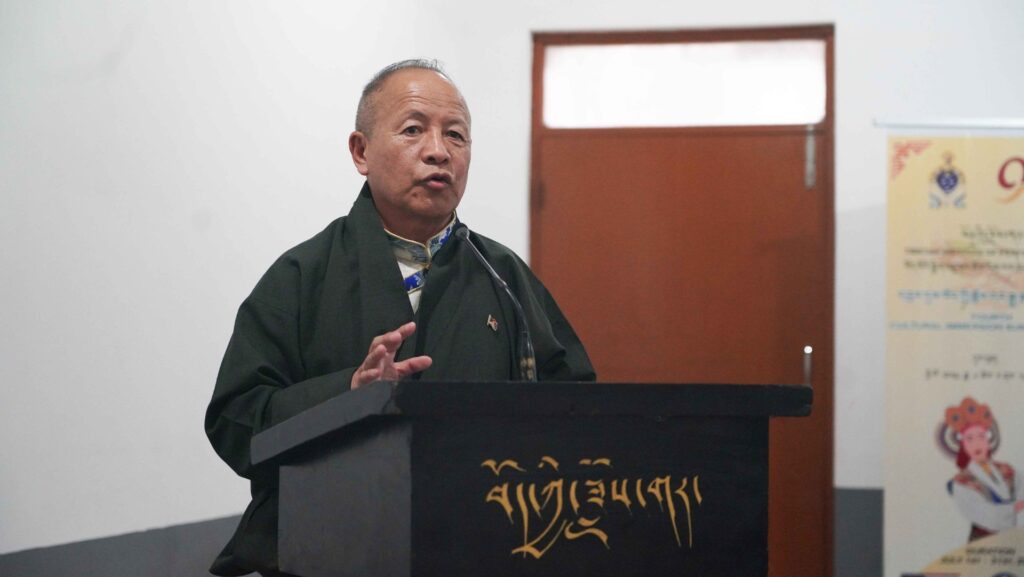
| Tenzin Samphel Kayta, addressing to the 11th session of UN human rights council on behalf of Society for Threatened Peoples, in Geneva on 8 June 2009 |
Dharamshala:
Two Tibetan non governmental organisations have expressed their concern
over the deprivation of rights to the Tibetan children to study their
history and cultural heritage, and China’s policy of repression and
indoctrinating Tibetans living inside Tibet to denounce His Holiness
the Dalai Lama.The Tibetan delegates raised the issues of human
rights violations in Tibet during the second week of 11th session of UN
Human Rights Council in Geneva on Monday, 8 June.Mr. Tenzin
Samphel Kayta, on behalf of Society for Threatened Peoples drew
attention of the UN member states on the recent report on Tibet
published by a group of prominent Chinese lawyers and legal scholars.
The report recommended the Chinese government to “pay close attention
to the living situation of young Tibetans, and with the greatest good
faith resolve current education problems in Tibetan areas, particularly
the problems of rural education and education for farmers and nomads,
and to facilitate Tibetan children to complete nine-year compulsory
education. “The report called for the need to develop and
encourage training mechanisms for highly skilled personnel in Tibetan
areas, and to optimize specialized knowledge structures among college
students.It called for the “need to speed up and improve
grass-roots professional technical education in Tibetan areas, and
using the method of joint work and study as used in schools in the
eastern provinces to allow Tibetan students to set out and increase the
degree of training in schools’ high-tech content and training in
practical production in Tibetan areas. It emphasised the need to train
skilled workers and eliminate all barriers for encouraging varied
Tibetan employment and entrepreneurship.”“Particular attention
should be paid in school education on extending and developing
appropriate content on Tibetan history and culture, and increasing the
civic awareness content of the training. Education and training must be
regarded as the most important long-term resolution to the question of
Tibetan areas,” the report added.Mr Kayta further said “these
recommendations by the Chinese lawyers reveals that all is not well as
far as the current education policy of the Chinese authorities, a
policy which continues to deprive Tibetan children education of the
history and cultural heritage of their people. Instead they grow up
under communist campaigns like the “patriotic education” which demands
that they denounce their spiritual leader and show allegiance to the
Communist Party of China.He gave a reference to an incident
which occurred on 29 April 2009, where a several hundred Tibetan
students of the Lhabrang Tibetan Middle School staged a protest
opposing China’s defamation campaign against the Dalai Lama. A source
with contacts in the area said that the main reason for the students’
protest is that the local authorities are implementing a campaign of
patriotic education and ‘anti-separatism’ in schools, which is strongly
focused on denouncing the Dalai Lama.He emphasised that the
Committee on the Elimination of Racial Discrimination (CERD) in 2001
expressed concern “about continuous reports of discrimination with
regard to the right to education in minority regions, with particular
emphasis on Tibet,” and recommended that China “urgently ensure that
children in all minority areas have the right to develop knowledge
about their own language and culture as well as the Chinese, and that
they are guaranteed equal opportunities, particularly with regard to
access to higher education.”The Chinese authorities
acknowledged in their latest report to CERD that “there is still a gap
in the development of education between ethnic areas and economically
developed areas. They also accepted that educational facilities in some
rural schools are backward and the teaching staff there needs to be
further reinforced.” Dekyi Dolkar, on behalf of of Helsinki
Foundation for Human Rights said “for the past decades, the Chinese
authorities have placed severe limitations on the freedom of speech in
Tibetan areas. These restrictions have applied to all expressions
of the Tibetan national identity, including the practice of Tibetan
Buddhism, calling for the Dalai Lama’s return to Tibet, or opposing to
Chinese government policies. There also exists a climate of
campaigns against ‘reactionary’ cultural activity and Tibetans who
openly participate in speech not approved by the government and
confront re-education through labour, detention without trial, and
lengthy prison sentences.She raised, among many cases, of a
young Tibetan writer and teacher named Dolma Kyab who was given a
ten-year prison sentence on charges that appear to be of ‘endangering
state security’ after he openly wrote about Tibetan geography, history
and religion in an unpublished book titled ‘The Restless Himalayas’. Another
Tibetan named Norzin Wangmo, a female cadre who was sentenced to five
years in prison for passing information over the phone and internet
about the situation in Tibet to the outside world.She expressed
concern over the attacks and closing down of websites owned bloggers
such as Woeser, who writes on current situation in Tibet. Woeser’s
blog, ‘Invisible Tibet’, has been one of the most widely read and
important sources of information on the ongoing crackdown on the
Tibetan Plateau.–Based on report filed by Tenzin Samphel KaytaRelated report:UN hears cases of human rights abuses in Tibet