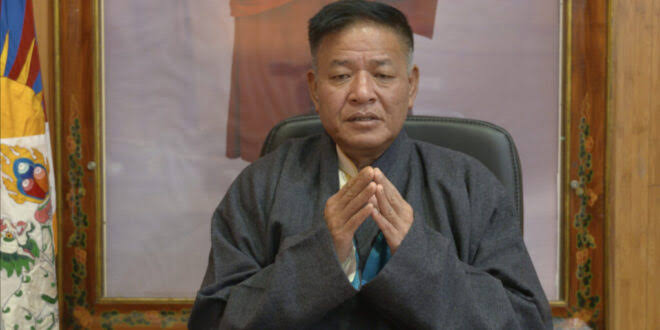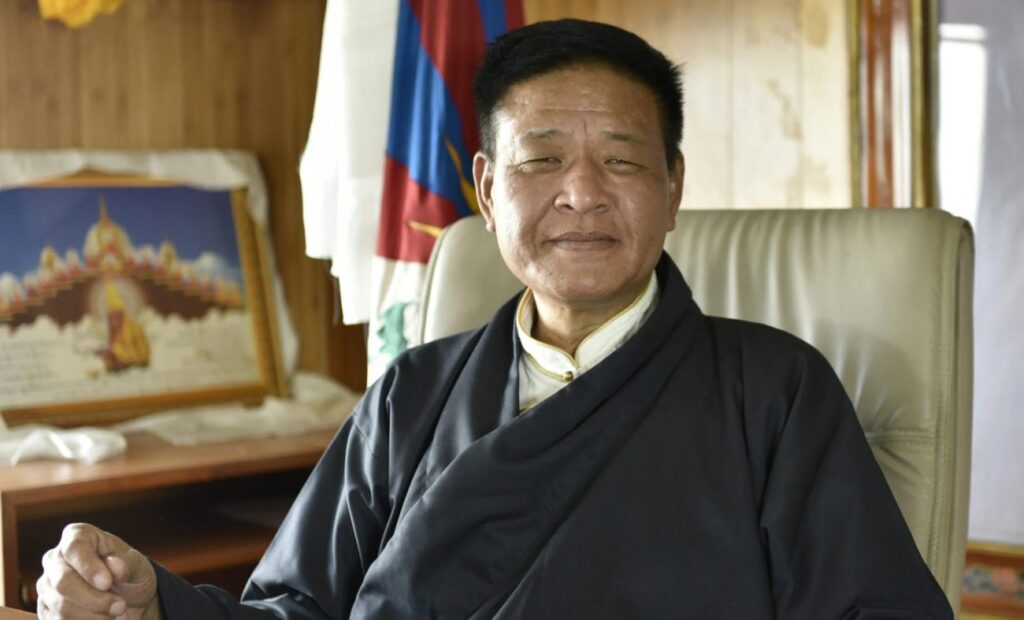

BANGALORE: Sikyong Dr Lobsang Sangay on Saturday underscored that a lasting solution to the issue of Tibet is crucial to the political and environmental interests of India and other Asian regions.
Speaking on ‘Tragedy in Tibet: Role of International Community and India’ at a press conference in Bangalore, the Sikyong said: “The situation in Tibet is extremely grim as 92 Tibetans have self-immolated since 2009, including 79 in 2012 and 29 in this November alone.”
He appealed to the Indian people to join the online solidarity with Tibet campaign to encourage the Chinese authorities to address its repressive policies, which are pushing Tibetans to burn themselves to death.
Sikyong Dr Lobsang Sangay said China’s damming of major rivers originating from the Tibetan plateau would pose serious environmental repercussions for billions of people living downstream regions, including India and south-east Asia.
Responding to a question on international community’s response to the escalating tragedy in Tibet, the Sikyong said the UN High Commissioner for Human Rights Navi Pillay, US and many other governments and parliaments, have made strong appeals to the Chinese leadership to address its repressive policies and find a lasting solution to the problem of Tibet through dialogue.
Sikyong also delivered a talk on the issue of Tibet at National Law School of Indian University. He spoke on the historical relations between Tibet and China as sovereign nations, shedding light on the 821 China-Tibet Peace Treaty. “…Tibet and China shall abide by the frontiers of which they are now in occupation. All to the east is the country of Great China; and all to the west is, without question, the country of Great Tibet,” he quoted from the treaty.
Sikyong said the communist Chinese government invaded Tibet in 1949, and coerced the Tibetan government to sign the “17-point agreement”. The Chinese government later violated the agreement by systematic destruction of every vestige of Tibet’s cultural and religious identity, and forced His Holiness the Dalai Lama with thousands of Tibetans to flee into exile in 1959, he added.
Sikyong recalled the Karnataka chief minister late S Nijalingappa’s support to rehabilitate the first batch of Tibetan refugees in settlements in the state.
He gave a detail account of far reaching democratic reforms carried out by His Holiness the Dalai Lama in exile, particularly the devolution of his political authority to the democratically-elected leadership of the Central Tibetan Administration.
He underlined that Tibetans will remain strongly committed to democracy and non-violence in their freedom struggle, and these will remain their uncompromised principles.
Sikyong Dr Lobsang Sangay will attend the 23rd anniversary of the conferment of the Nobel Peace Prize on His Holiness the Dalai Lama and 64th International Human Rights Day at the Tibetan Settlement in Mundgod on 10 December. Sikyong is visiting Mundgod in view of the large congregation of Tibetans attending teachings by His Holiness the Dalai Lama at the Gaden and Drepung Monasteries.