
By Jamphel Shonu
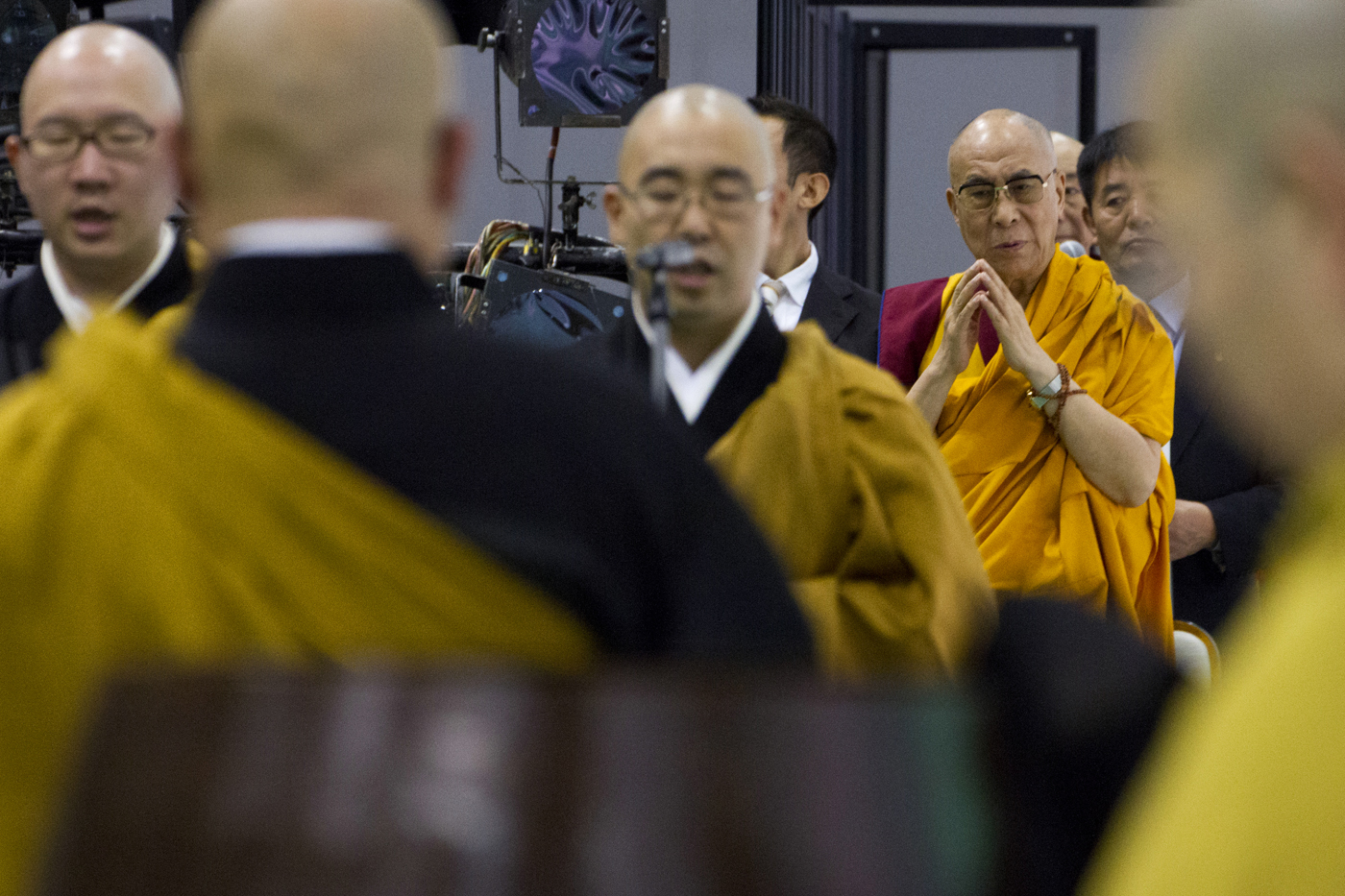
YOKOHAMA: His Holiness the Dalai Lama started his programmes in Japan on Sunday by giving a teaching on Geshe Langri Thangpa’s Eight Verses of Training the Mind in Yokohama.
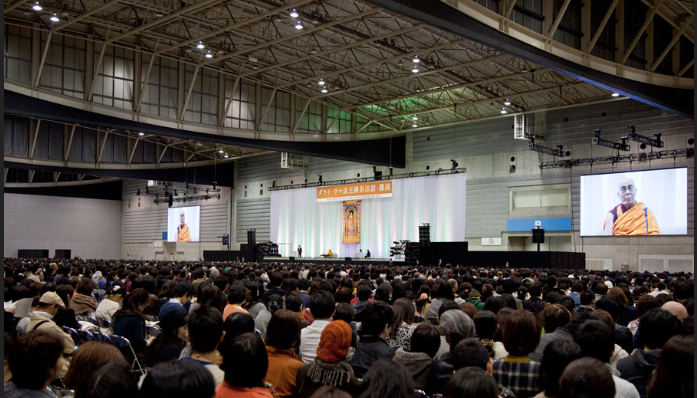
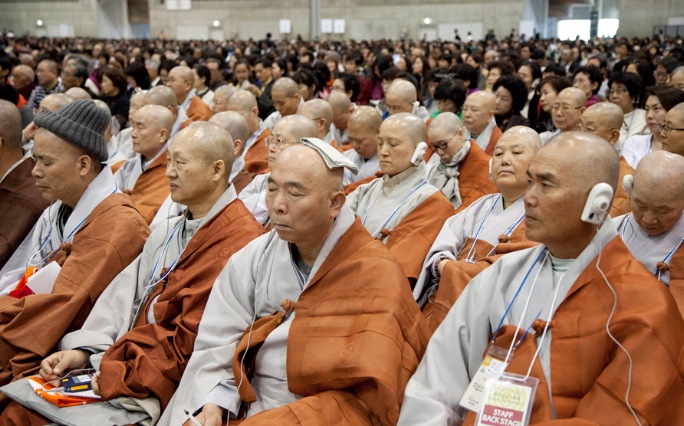
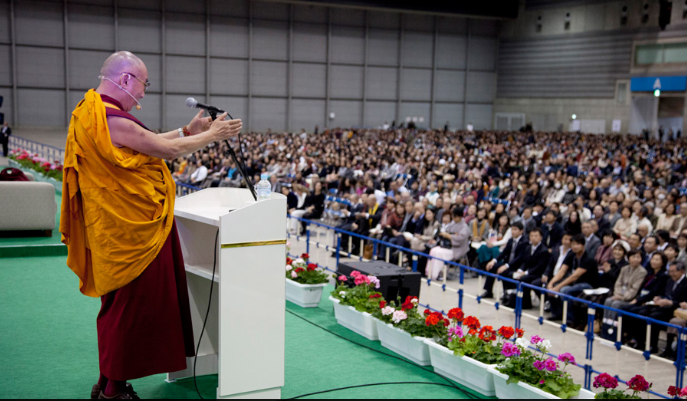
More than 6,500 people comprising mainly of Japanese and Koreans, as well as some Americans and Europeans attended the teaching.
His Holiness said, “Basically, we are all same human beings, biologically, mentally and emotionally. With oneness of humanity in mind, we should all try to develop compassion and kind heartedness towards each other.
His Holiness also said, emotional imbalance is the source of unhappiness in our lives. We should use our intelligence to make the right decisions and create a happier environment for ourselves as well as for the people around us.
Before the teaching, His Holiness met a group of 31 Taiwanese from the Association of Tibetan Buddhist centres in Taiwan.
During the lunch hour, His Holiness briefly attended a luncheon held for diplomats and other VIPs at the Carlton Room of the Intercontinental Hotel, Yokohama.
Meanwhile at the exhibition hall, groups from India, China, Korea and Japan recited Heart Sutra (TIB: Sherab Nyingpo) in five different languages (Sanskrit, Chinese, Korean, Japanese and Tibetan).
In the afternoon, His Holiness gave a public teaching on Nurturing the Heart: Developing Better Relationships for a Healthy and Happy Life at the same venue.
The introductory speech of the talk was given by Ms Shinto Masako, a leading journalist from Japan.
Addressing the packed hall, His Holiness said “as a human being, we all have the same potential to create a calm and peaceful mind. To achieve that, we have to interact with each other on a humane level. We all want a more peaceful and comfortable life and we all have the right to achieve that. So there should be no differences or barriers between us”.
“Most of the problems that we face today are of our own creation. None of the 7 billion human beings in this world wants trouble. But we have to reduce our greed for money, materials and power to create inner happiness. We need money, power and technology in our life but these are not the ultimate source of inner peace,” His Holiness said.
“Too much greed for money creates too much competition and too much competition creates distrust and suspicion among each other. So even if a person is very rich, it results in loneliness. Therefore, material value will not bring genuine happiness and peace”.
“21st century has brought us marvelous inventions like nuclear physics. But these inventions have created more fear and suspicion in the world. For example, Hiroshima and Nagasaki in Japan have suffered hugely from the two atom bombs dropped there”.
On my last visit to Japan, I visited Hiroshima and met some victims of the atom bomb. The tragedy happened during the second world war but even after so many decades, people there remain in constant fear. So unfortunately, even marvelous inventions have become a source of additional problem and fear. But it is unfair to blame technology for the entire problem. It is the human greed for power that has created all these problems, His Holiness said.
But in the later part of the 20th century, peace movement has gained a lot of strength. Everybody in the world is openly expressing the need for peace and an immediate stop to violence. Especially in Japan, the peace and anti-nuclear movement became very powerful because Japan has suffered a lot from it, His Holiness added.
Nowadays, even scientists are saying that peace of mind (healthy mind) is very important for our physical well-being. Constant fear and hatred is eating away our immune system. Therefore, an optimistic attitude towards life is very important, His Holiness asserted.
His Holiness also said that too much emotion including attachment is not good because the very nature of attachment is biased.
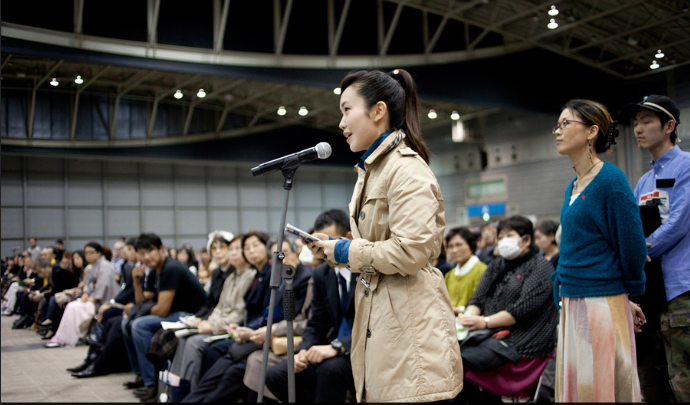
A question and answer session with the audience was held after the talk.
Briefing TibetNet after the talk, Mr Lhakpa Tshoko, Representative of His Holiness for Japan and east Asia said, His Holiness gave a teaching and talk today on creating a harmonious society through developing the heart.
He said, the public response to the talk was very overwhelming. We had to cut short the Q&A session due to shortage of time. But the main theme of most of the questions was about how to develop a compassionate heart and how to bring about real change in our daily lives, he said.