
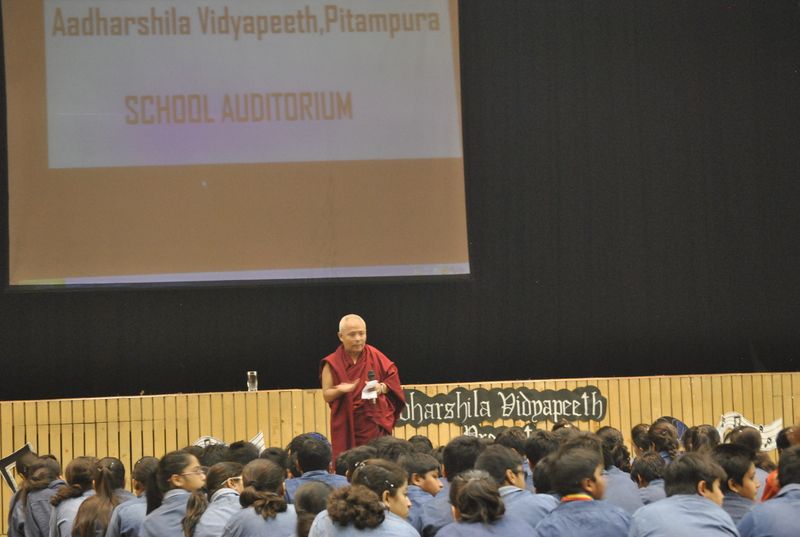
DELHI: ‘A Day for Tibet’, an awareness programme on Tibet was organised at a Aadharshila Vidyapeeth School in Delhi yesterday. It was jointly hosted by New Delhi-based India Tibet Coordination Office and the school administration of Aadharshila Vidyapeeth to enlighten the students on the issue of Tibet.
The agenda of the talk was on “Present situation of Tibet and India Tibet relations”. Around 80 students from class 8 and 9 standards participated to understand the long time relationship between India and Tibet.
Acharya Yeshi Phuntsok, Member of Tibetan Parliament in Exile, was invited as a guest speaker to address the day. In his remarks he said: “Before 1949 Tibet act as an independent nation with strong neighbouring countries like India, China, Russia and Mongolia. People’s Republic of China started invading Tibet in 1949 by capturing eastern part of Tibet and by 1959 whole of Tibet was forcibly occupied by China.”
He spoke about the centuries old strong religious and cultural ties between Tibet and India before the Chinese invasion of Tibet, adding that Tibet’s Buddhist religion and script flourished from India during 7th century.
He further said, the relationship between leaders started in 1956 when His Holiness the Dalai Lama first arrived in India to attend the 2500 anniversary of Buddha Jayanti. His Holiness met with various Indian leaders of that time such as the then Indian Prime Minister, Pt. Jawaharlal Nehru, Dr. Rajendra Prasad, first president of India, Mr Nijalingappa, Chief Minister of Karnataka, Sardar Vallabhai Patel among others, he added.
He also spoke on the present situation inside Tibet in view of the spate of of self-immolations by Tibetans, adding, in the last week alone we had heard news of 7 self-immolations. Tibetans in Tibet are discontented with the policy of China, which is pushing them to take drastic actions. All the self-immolators have called for the return of His Holiness the Dalai Lama to Tibet and for Tibetans, he added.
He underlined that Tibet is also considered as the earth’s Third Pole, but China’s dumping of nuclear waste and damming of rivers on the Tibetan plateau would seriously affect the lives of billions of people living in downstream Asian countries, including India.
He said the purpose of education is not to work for self-interest, but it serves to instill values in children to become responsible citizens to work for the welfare of the humanity.
India Tibet Coordination Office distributed books on the issue of Tibet to the participants.