
His Holiness the Dalai Lama Meets Himalayan Community and Foreigners who visited pre-1959 TibetWednesday, 6 May 2009, 9:29 a.m.
New York: On
May 5, 2009, the last day of His Holiness the Dalai Lama’s stay in New
York City, he had four events here that included meeting groups of
people who had different but interesting connection with Tibet and the
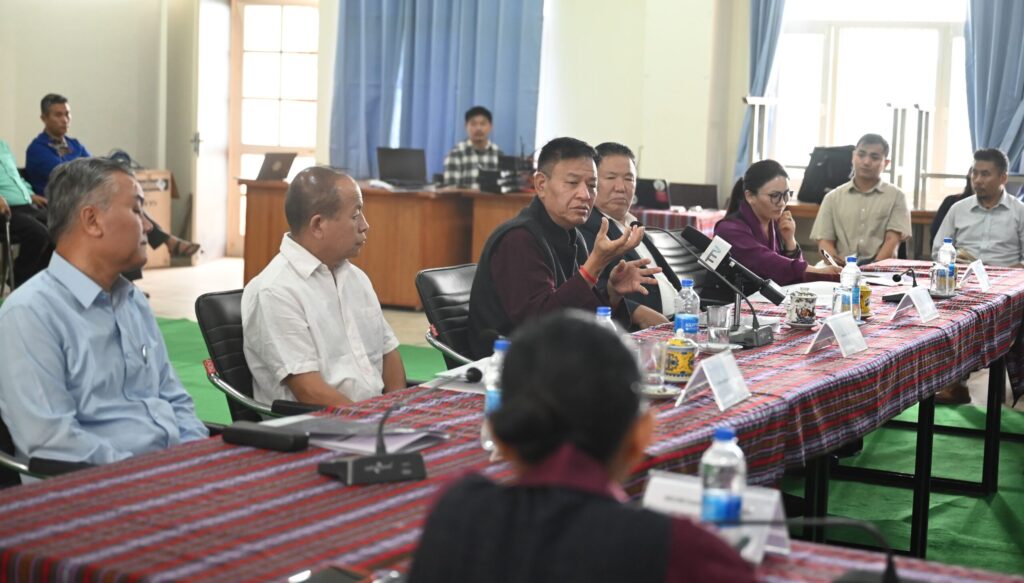
Tibetan people.In the morning, His Holiness addressed over 100
leaders communities from the Himalayan region, including from
Ghyalsumdo, Manang, Mugum, Mustang, Nubri, Sherpas, Tamang, Thakali,
Tsum, Walung, Yolmo (all in Nepal), Bhutan, and Tibet, as well as
Kalmyk Mongolians.Speaking on behalf of the representatives of
these communities, Mr. Sonam Sherpa, gave a brief report of a meeting,
which was held in February, between them and the Office of Tibet to
“discuss how to fulfill our common aspirations of preserving and
promoting our Buddhist culture in the United States.”Mr. Sherpa
said, “Your Holiness has many times expressed concerns about the
consequences if the present generation should fail to shoulder their
responsibility in preserving our rich religious traditions and as you
have advised us time and again to work together to preserve our
cultural identity which is deeply entwined with our Buddhist culture.”
He added that the meeting resolved to take steps, including the joint
observation of the Buddha Purnima, promotion of the study of the
Tibetan language among community members, organizing festivals
highlighting our common Buddhist culture and traditions, and organizing
lectures on Buddhism to our youth.He then introduced the
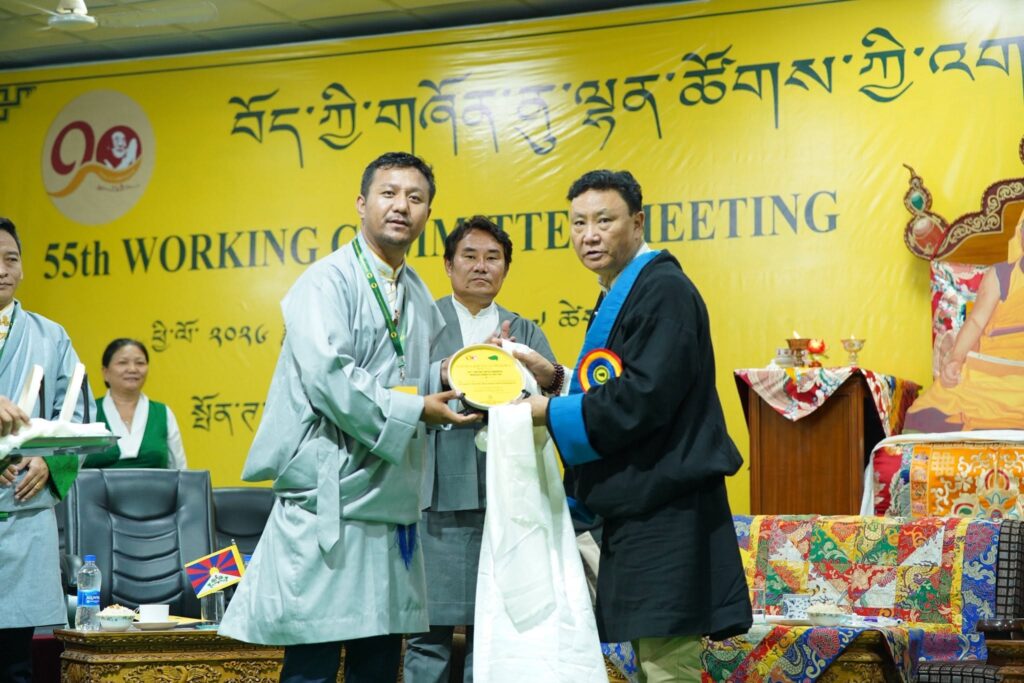
representatives of the different communities after which a plaque was
presented to His Holiness the Dalai Lama on which was inscribed the
following citation.ToThe Buddha of our times;The ray of light that dispels the darkness from our world;The beam of hope for peace and a better humanity;The warmth that soothes millions of hearts and minds;He who hails from the land of the snows,In every passing day of our time, grows,In his magnanimity and his fameWe, members of the Buddhist Communities, bow to youTo express our heartfelt gratitude for your noble deedsFor bearing the torch of Buddhism and bringing light unto this world.Presented to His Holiness the 14th Dalai Lama on May 5, 2009 by:Names of all communities follow.In
his address, His Holiness raised three points. The first was the fact
that human beings have to face natural problems and that the best way
to face them is not by wealth but through spirituality. His Holiness
said that Buddhism is not only an ancient religion, but also a rich
one, and from our perspective more humane and realistic. He referred
to the interest in Buddhist thoughts from among the scientific
community to emphasise the relevance of the religion in today’s world.Secondly,
His Holiness talked about the renewed interest in Tibetan Buddhism
among the Himalayan people. He said this is part of our identity as
well as our common spiritual heritage. His Holiness talked about the
Tibetan monastic institutions.Thirdly, His Holiness said in
order to really understand our common spiritual heritage, it was
important that people know the Tibetan language. He then talked about
the critical situation in Tibet, the source of the Tibetan language and
culture. He said while the Tibetan people have been able to preserve
the language and culture in the past 50 years under Chinese rule, if
the present trend continues then the worst case scenario is that it may
be impossible for the unique Tibetan culture to survive. His Holiness
said that in the eyes of the Chinese authorities the Tibetan Buddhist
culture was a source of separation of Tibet and referred to the
statement 15 years ago by the then Part Secretary in the Tibet
Autonomous Region, Chen Kuiyuan, who said that the ultimate source of
threat for Tibet’s separation is the Buddhist heritage. His Holiness
said the Chinese authorities have been taking action to undermine
Tibetan Buddhism accordingly.His Holiness said that Tibetan
Buddhism, which is the Nalanda tradition, is a treasure to the six
billion human beings in this world. He said given the situation of the
Tibetan people, the people of the Himalayan region and others who
follow the same religious tradition have the responsibility to take
care of the preservation of our spiritual heritage. He said that the
Tibetan refugees numbered just 150,000 whereas the Himalayan Buddhist
population was around two million and said that there was a heavier
responsibility on their shoulder to preserve the Tibetan Buddhist
culture.His Holiness said the proper way to preserve this
spiritual heritage is not merely by constructing temples or big statues
(which are good, but in the case of statues they cannot speak), but by
developing living Buddhism for human beings. In this His Holiness
asked the people to organize discussions on different aspects of
Buddhism and to invite experts, not in the form of lamas giving formal
teachings, but in the form of lectures.Following this meeting,
His Holiness met a group of Americans and Canadians (and or their
family members) who had visited Tibet prior to 1959. His Holiness
termed them as witnesses of the kind of Tibet before 1950 and said he
himself is a witness, too. He talked about the Chinese authorities’
claim that the Tibetan Government had sought the permission of the
Koumintang Government for his enthronement. He said that in this
connection, Ngapo Ngawang Jigme (who was a Minister in the Tibetan
Government and later served the People’s Republic of China government)
had sought permission to research into this claim and spoke about this
publicly in the mid-1980s in Lhasa. His Holiness said that Ngapo had
said he went to Nanjing to look into this and what he found was a
letter in Tibetan that was written by an individual. This letter was
not on the official Tibetan Government paper nor was it written in the
official style.Talking about another Chinese claim that the
Chinese mission had overseen his enthronement, His Holiness said as a
witness he can say that on such events, the British Mission
representative was always at the head of the line followed by the
representative of the Chinese Mission and then by the Nepalese Mission.His Holiness said this meeting was very moving similar to the one he had in Oxford with some other people who had been to Tibet.His
Holiness then answered a question from one of the attendees on the
current state of contact with the leadership in Beijing. His Holiness
said that last year, his envoys had presented the Chinese side with a memorandum on genuine autonomy for the Tibetan people and
even before the envoys returned to Dharamsala the Chinese side had
rejected it. His Holiness referred to the demonstrations by Tibetans
in Tibet last year. He said he had recently met a Tibetan from Amdo
(who had come with his Chinese businessman friend). This person told
him that the demonstrations were the outpouring of generations of
grievances that the Tibetans had. His Holiness said he had hoped that
the Chinese Government would see the reality and adopt an appropriate
policy towards Tibetans, along the lines of Deng Xiaoping’s policy of
seeking truth from facts. He said the Chinese have made things
difficult.His Holiness then made a brief appearance at a luncheon hosted by Tibet House. –Report filed by Bhuchung K Tsering of ICT
|
|