Wang Lixiong: On the impact on New Media
In a roundtable
discussion at the University of California, Berkeley, on March 18th,
participants presented their observations and shared their experiences
relating to the rise of the Internet and its interplay with China’s
media, society and politics. What is the state of new media in China?
How do members of Chinese society employ these technologies to
participate in politics and what it is the real impact? How does the
Chinese government actually regulate and control the Internet? What
role does the rise of Chinese cyber-nationalism play in this
complicated process? Ultimately, will this pervasive, many-to-many, and
emergent communication platform play a critical role in transforming
the Chinese political system by fostering the nascent civil society? —
or has it actually enabled China’s authoritarian regime to forestall
political reform by turning it into a safety valve or even an Orwellian
monster? The panel engaged in discussion and elicited meaningful
dialogue on these key questions.The following comment made by Wang Lixiong is reproduced from the China Digital Times on 20 April
 |
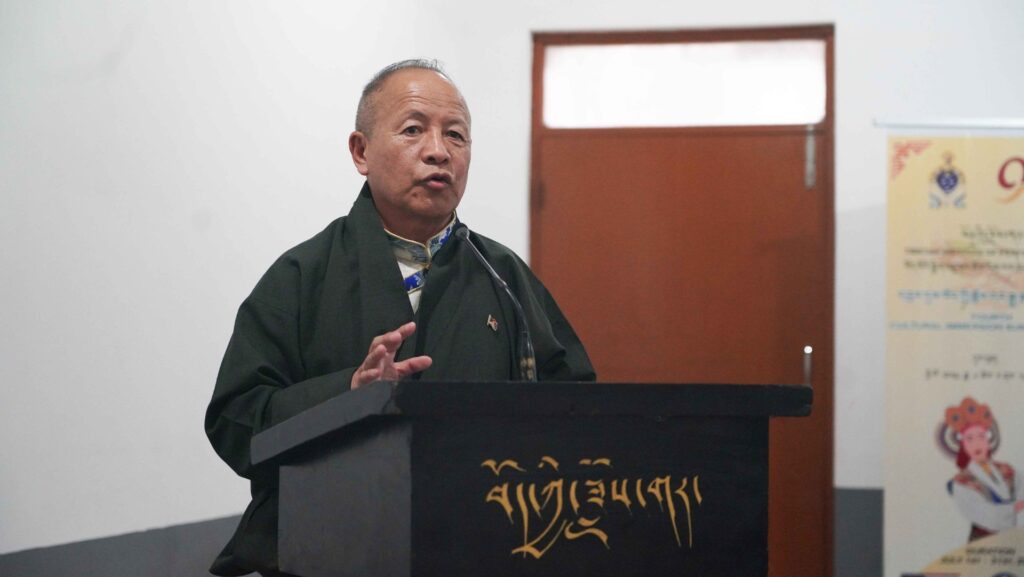
| Wang Lixiong/File Photo |
The
previous speakers have talked about the advantages of the Internet. Let
me speak to one of them: She is Woeser, a Tibetan blogger. Previously,
she had authored three blogs, but they were all shut down by
departments. These blogs were for a domestic audience. The fourth one
was a blog provider from an overseas web provider, but it was shut down
shortly after. But still, it survived for overseas audiences. The page
views for the blogs have reached over one million. Her work was
especially important during the March 2008 Tibet riots. As you know, no
foreign correspondents were allowed to be there at that time, and
Tibetans within China could not and dared not to speak out against the
heavy-handed measures and pressures they faced. I watched my
wife Woeser work in Beijing for about 20 hours a day compiling info on
Tibet from hundreds of sources on the Internet. Then she put this
information on her blog. Now, this blog had been seen by important
overseas media. At that time, her blog was considered the only source
of information from Tibetans within China. In a little more than one
month, page views exceeded three million. After over a month, her blog
was hacked by the Chinese red hackers alliance (hongke). Her blog was
restored repeatedly, but again was hacked and sabotaged in various
manners afterward. Then we used Google’s blogging system to restore the
blog. Maybe the hackers were not capable enough to hack into this
system, but a lot of angry youth showed up on the blog. She had to
censor a lot of comments from the angry youth. In previous years, her
blog had gathered a lot of remarkably talented people from all ethnic
groups in China. But after the angry youth showed up, all the serious
debaters and thinkers left, with only the angry youth staying on.So
from here, I want to contemplate the other side of the Internet, and
think about why the Internet has become a place where emotions are high
and verbal abuse is rampant, and why on the Internet consensus is only
reached for hot topics.I’d like to share some of my personal
thoughts: People keep talking about the era of Web 2.0. One important
distinction from 1.0 is that 2.0 includes participation from everybody.
This leads to an excessive amount of information. In this era, we have
a lot of bricks, but they cannot be used together to build a mansion.
Although the Internet can facilitate conversation, it cannot overcome
the limitations of the capability of people to receive information. I
would liken this situation to the revolutionary years when Mao received
the masses. Everybody would have a little Red Book in his or her hand.
Now everyone has a video camera in his or her hand. But he just has no
time to think through it and it leads to oversimplification of facts,
which then leads to radicalized opinions on the Internet.If we
can’t find an effective mechanism to distill this huge amount of
information, maybe we’ll have to return to the Web 1.0 era, where we
set up massive centers of information. And we can see that happening
because in the face of such a huge amount of information, people only
rely on several websites. This has provided opportunities for the
authoritarian power to reoccupy the cyberspace in China. On one hand,
they can deter several major sources and news portals, and on the other
hand they can use the 50 Cents Party to dissuade public opinion. In the
face of this danger, we cannot turn back to the Web 1.0 era, but we
should upgrade ourselves for the Web 2.0 era. Everyone participates on
the Internet, but maybe we can find a way to synthesize this
information. So this has raised a question … How should we go about
synthesis? How can everybody participate? The only way I think this can
happen is the democratic way.Using democratization, individual
participants can have their own prejudices and biases. Overall there
will be statistical accuracy. Only based on these democratic mechanisms
will citizens recognize the legitimacy of synthesizing this information
and only in this way can cohesiveness be maintained. This whole process
can then be sustainable without need for external forces.So my
conclusion on this issue is that democracy in the Chinese Internet will
look like everybody coming together to make a decision for themselves.
On the Internet, there is only participation, but no consensus in the
end. We should find a way to have people reach a consensus in the end.*Wang
Lixiong is an independent writer based in Beijing, China. He was born
in 1953 in Changchun, Manchuria, and trained as an auto mechanic during
the Cultural Revolution. In 1991 he published the political fiction
novel Yellow Peril, inspired by a 1984 raft trip he took down the
Yellow River, during which he passed through ethnically Tibetan regions
of China and became interested in the Tibet question. His other books
include Sky Burial: The Fate of Tibet, Distribution of Power? An
Electoral System by Stages, Memories of Xinjiang and The Struggle for
Tibet. He is married to the Tibetan blogger and poet Woeser.