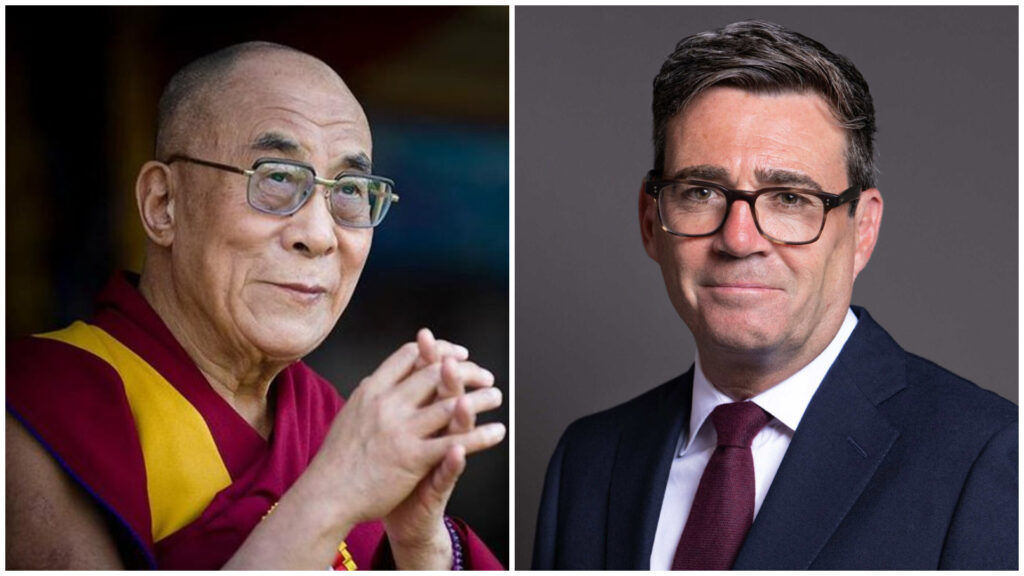
English Translation of Wang Lixiong’s Interview With His Holiness the Dalai Lama on Twitter[Sunday, 23 May 2010, 10:56 a.m.]
 |
| Illustration by Chinadigitaltimes.net |
(English
translation (from the Tibetan) of Wang Lixiong’s interview with His
Holiness the Dalai Lama on 21 May 2010. Wang Lixiong’s Twitter postings
were based on this interview.)Wang informed His Holiness that
he had invited people to submit their questions on Google Moderator and
also to vote on their preferred questions. He said altogether there
were 1253 people who posed 289 questions with 12473 votes revealing
preferences and their results are the questions that he be posed to His
Holiness.Question: Your Holiness Dalai Lama, how are
you? I want to ask you about the religious leadership of Tibet in the
future. What is your view on the possibility of “two successors”, as
happened in the case of the 11th Panchen Lama?His Holiness: In
1969 I had officially stated that the Tibetan people will decide
whether the institution of the Dalai Lama needs to continue or not.
Similarly, in 1992, I had issued an official statement in which I had
stated that when the time comes for the Tibetans in Tibet and in exile
to be reunited, I would not assume any position. The people who are
currently assuming responsibilities in Tibet would have to shoulder
that responsibility. Then, since 2001, if we look at the exile
leadership, a system has been established to elect (in a five-year
term) the leadership of the Central Tibetan Administration and this is
being practised now. Therefore, I do not place much importance
on the issue of the Dalai Lama. I will do whatever I can while I am
alive. I do not have any other consideration or responsibility. It
looks like the Chinese Communist Party seems to be more concerned about
the institution of the Dalai Lama than I. Thus, the situation could
become like that of the two Panchen Lamas. It will be an additional
problem without any benefit. Question: What is your view of the 11th Panchen Lama that the Chinese government has appointed?His Holiness:
From what I have heard he has sharp intellect and is greatly interested
in religious matters. But many people have much suspicion about him.
Therefore, it depends on him. It should be good if he turns out to be
someone who embodies both the knowledge of the scripture and the
realization based on it, and upholds the teaching and practice of the
Buddha’s doctrine. Question: I would like to ask Your
Holiness about the meetings between the Tibetan government in exile and
the Chinese Communists. Why are these meetings always fruitless? What
exactly are the questions that have been so intractable over the
decades?His Holiness: The Chinese Government has
been officially saying that there is no Tibetan issue to be discussed
and that it is only the personal issue of the Dalai Lama. I do not have
anything to ask for myself. It is the issue of the basic rights of the
six million Tibetans, their religion, culture, and environment. These
are issues that I am concerned about and need to be discussed. If and
when the time comes when the Central Government acknowledges that there
is a Tibetan problem, as they seem to be doing so in the case of
Xinjiang, and make an effort to resolve it there is something to
discuss. From my side, I will cooperate as I share the same objectives
as the Chinese Government, namely the development of the country,
stability, friendship. However, in terms of method, the Chinese
Government seems to be adopting an approach of force to establish
stability while we feel that stability should come from mental
satisfaction and trust. Question: Hello, your Holiness.
Regardless of what political path China takes in the future, the gap
between ordinary Tibetans and ordinary Han Chinese is getting bigger
all the time. Many Tibetan people are simplistic in saying the problem
is only Han rule of Tibet. In fact we Han people are also victims of
the same dictatorial rule. How do you view this problem?His Holiness:
The Chinese-Tibetan relationship did not begin in 1949-50 but is over
one thousand years old. During this period sometimes we had very
cordial relationship while at other times not too cordial relationship.
Currently we are in a period where we do not have cordial relationship.
The cause for this is governmental policies that have caused the
differences and not the people. Therefore, the people-to-people
relationship is becoming important.In free countries where
there are Tibetans and Chinese, we have been making efforts to
establish friendship associations between the two communities and these
have been having impact. One main problem is that Deng Xiaoping’s
Seeking Truth from Facts is not being implemented. Hu Yaobang had made
efforts to understand the real situation. Recently, Wen Jiabao has
talked about Hu Yaobang’s work attitude of not relying merely on
official report but understanding the situation through contact with
the people. There are many drawbacks in China because there is no
investigating into the reality of the issue in a transparent manner. If
there is transparency, it will help in reducing corruption. Question: Another issue. Do you have any way of maintaining good relations between Hans and Tibetans?His Holiness:
I travel to many countries and have always been adopting the attitude
that we are all same human beings. This has enabled me to have good
relationship. The Tibetans and Chinese are not only same as human
beings, but also have historical relationship. If we are clear and
establish equal relationship, all problems will be resolved.I
have been meeting regularly with people who come from mainland China.
They are sincere and I am able to establish close relationship. It
becomes problematic when there are doubts and suspicions. This is not
just with Chinese and Tibetans but throughout the world. This needs to
be resolved.Whenever I meet people, I tell them that we are the
same human beings. The difference in religion, culture and languages
are secondary. The most important thing is we are all same human
beings. In 1954-55, when I was in Beijing, at that time I had discussions on Marxism. I liked the idea of internationalism. Question:
“I would like to ask your Holiness about your “Memorandum on Achieving
True Autonomy for All Tibetans,” in which you do not write about how to
protect the rights of Han people who live in Tibet. Would you, after
autonomy, recognize a right of Han people who currently reside in
Tibetan areas to continue living there?” His Holiness:
Even in the past, before 1950, there were Chinese in Tibet. For
example, in my birth area there were many Chinese, including Muslims.
Therefore, in the future, too, the Chinese people will certainly be
there. What is pertinent to keep in mind is that in the case of the
Inner Mongolian Autonomous Prefecture the Mongol population has become
a small minority. If it becomes like that then the national autonomy’s
characteristics are not present. Secondly, in the case of
Tibet, in certain towns, where there is a sizable Chinese population
with fewer Tibetans, the natural outcome is a change and degeneration
of the Tibetan language and Tibetan tradition. We need to consider
this. Otherwise, there needs to be a situation where the Chinese
friends can exist safely and in happiness. After all, we are same as
human beings.Question: I would like to ask the Great Teacher
why your description of Tibet in the past—as a harmonious Buddhist
society—differs so radically from the Chinese government’s description
of an evil slave society. Many drawings and other visual materials
document the cruelty and iniquity of a slave society. Can you explain
why this discrepancy is so big?His Holiness: It is
true that the Tibet of the past, prior to 1950, was backward and in
general, feudal. No Tibetan says the former old society was like
heaven. Today, no Tibetan, in Tibet and outside, thinks or even dreams
of reviving the former old society.On the other hand, the Chinese Government’s charge that the past old Tibetan society was like hell is an exaggeration. In
the past there were films made about Tibetan history (by the Chinese).
Some people told me that when these films were being shot, onlookers
were laughing because these were not conforming to facts. They said a
very strange film was being shot. During the Cultural
Revolution it was being said that the Revolution was a great success.
Subsequently, when they could not cover the reality the position
changed. Similarly, the Tiananmen issue is known all over the
world but the Chinese Government seems to maintain that it virtually
did not happen by saying it was just a few (people). What is important
is that you all should undertake scientifically sound objective
investigations. I always even tell the Tibetans that they
should not base (their decision) merely because I have said it, but
that they should investigate. From a Buddhist practitioner’s
perspective, we need to investigate even the Buddha’s teachings. Question:
If the Chinese Government were to allow you to return to Tibet, and
were to grant self-rule to Tibet, what kind of political system would
you like to see in Tibet?His Holiness: That needs to
be decided by majority preference by Tibetans in Tibet, particularly
intellectuals, through seeking truth from facts. In exile, in the past
50 years our Administration is run along democratic lines. Question:
I would like to ask the Dalai Lama a sharp question. The fiercest
criticism that Chinese government officials level against you is that
you demand there be no troops in Tibet. This, they say, is evidence
that you are asking for independence in disguise. Are you maintaining
your demand of no troops in Tibet?His Holiness: I
have always been making it clear that under the autonomy Foreign
Relations and Defence will be undertaken by the Central Government. In
the past, I had expressed my dream of making Tibet a Zone of Peace in
the future through friendship and trust with neighboring India and
Nepal and others. This is not just limited to Tibet but I have always
been saying that the entire world needs to be demilitarized. There is
no need to be concerned over this point. Question: In view
of how things stand at present, the chances of a peaceful resolution of
the problem of Tibet during the Dalai Lama’s lifetime seems almost
zero. May I ask how His Holiness views the current prospects for Tibet?His Holiness: I
divide the period since the establishment of the People’s Republic of
China into four eras: Mao Zedong era, Deng Xiaoping era, Jiang Zemin
era, and Hu Jintao era. These have seen much changes based on the
reality of the situation. Therefore, I feel there will be a change to
the nationality policy, and it needs to happen. I do not believe that
it is not impossible for a mutually beneficial solution on the Tibetan
issue to come about. Secondly, I do not think this will take that many
years. Some Party members who have worked in Tibet in the past
and who are now retired, as also many Chinese scholars, have been
saying that the present nationality policy is not appropriate and have
suggested that it needs to be reviewed. Therefore, I believe that there
will be a change and a decision in the not too distant future.–Report filed by Bhuchung K Tsering of ICT