

DHARAMSHALA: Enduring a freezing winter morning in woolen coats and feathered jackets, hundreds of Tibetans and local Indians gathered at the Tsuglagkhang courtyard today to celebrate the 26th anniversary of the conferment of Nobel Peace Prize on His Holiness the Dalai Lama.
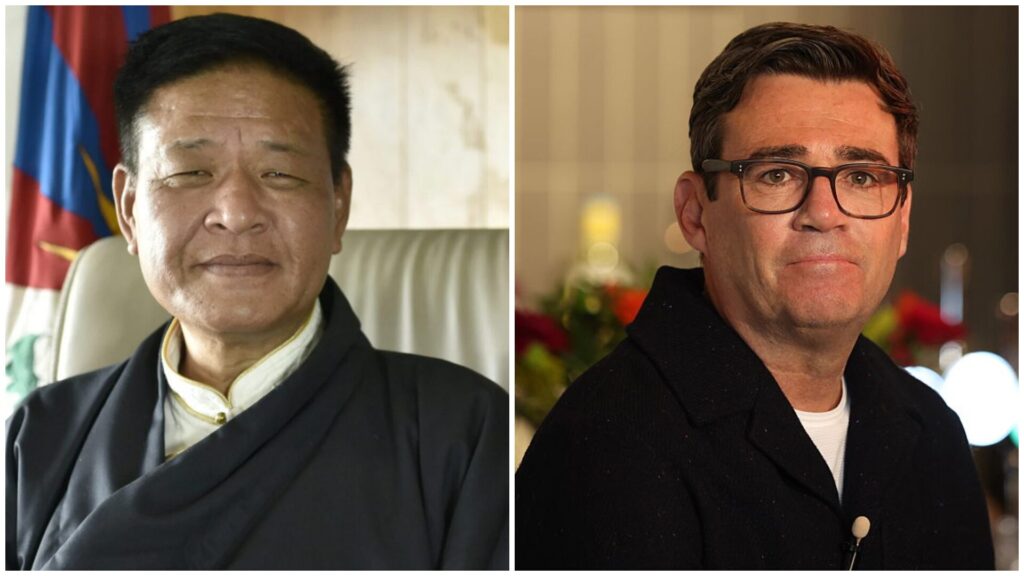
As the official ceremony began, the chief guest Shmt Sarveen Chaudhary, former minister of Himachal Pradesh and current MLA from Shahpur district, was welcomed on the stage with much fanfare. Other dignitaries at the ceremony include Sikyong Dr. Lobsang Sangay, Speaker Penpa Tsering of the Tibetan Parliament, Chief Justice Commissioner Mr Kargyu Dhondup, and senior officials of the Tibetan administration.
Describing His Holiness the Dalai Lama as the Messenger of Peace, the chief guest Shmt Sarveen Chaudhary expressed her deepest reverence for His Holiness and lauded the messages of peace and harmony that His Holiness espouses.

She remarked that the conferment of Nobel Peace Prize on His Holiness the Dalai Lama in 1989 was truly a victory for peace and the Tibetan people in their peaceful approach of resolving the Tibet issue.
She said: “Since coming into exile in 1959, His Holiness the Dalai Lama kept alive the struggle for Tibet from India. He exerted constant efforts to maintain peace and harmony even in the face of extreme adversity caused by Chinese brutalities in Tibet. It is due to this peaceful spirit of reconciliation that Tibet enjoys the fervent support of India and the whole world.”
“Even the prize money that His Holiness got from winning the Nobel was distributed towards various charitable causes including the eradication of leprosy, promotion of peace, etc. This in itself is a great lesson for humanity that we all need to emulate,” she added.
Emphasising the bond shared by Tibet and India, Shmt Chaudhary explained that the two countries share religious, cultural and linguistic connections, and described Tibet as a sacred place for Indians as it is the abode of Mount Kailash and Lake Mansarovar where Indians go for pilgrimages every year.
She also highlighted and encouraged the sustenance of that centuries old bond even in exile between the Tibetan community and the local Indian population by retaining the friendly exchanges of culture performances and mutual respect for each other’s traditions and languages.
Speaking about the impact of environmental degradation on the Tibetan plateau, Shmt Chaudhary said that Tibet is the major source of freshwater in Asia and urged the need to safeguard the fragile environment of the Tibetan plateau for a safe and secured future.
Expressing gratitude and respect, Sikyong Dr. Lobsang Sangay, in his speech said, “His Holiness the Dalai Lama advocates nonviolence and dialogue to resolve the issue of Tibet, interfaith harmony, human values and environment. For these extraordinary contributions, the Nobel Peace Prize was awarded to His Holiness the Dalai Lama in 1989.”
Sikyong recalled that this year – 2015 – was being celebrated by Tibetan people and the Central Tibetan Administration as the year His Holiness the Dalai Lama attained eighty-years of age. He said that the contribution which His Holiness the Dalai Lama made to the political cause of Tibet and the revival of Tibetan culture outside Tibet will forever be etched in the memories of the Tibetan people and in history.
Speaking about the Middle Way Approach, Sikyong said, “Envisioned by His Holiness the Dalai Lama, the Middle Way Approach is the official policy of the Central Tibetan Administration. It is aimed at the long-term benefit of both the Chinese and Tibetan people, and has galvanised support from governments, opinion makers, intellectuals including many Chinese writers and scholars.”
“Among the governments, the White House issued statements strongly supporting the Middle Way Approach. President Barack Obama, at a joint press conference with Chinese President Xi Jinping earlier this year, publicly urged the Chinese President to engage in dialogue with His Holiness the Dalai Lama or his representatives. President Obama emphasised the importance and the need for dialogue to resolve the Tibet issue,” Sikyong added, thanking the US President for expressing encouragement and support to the Tibet issue.
Sikyong also highlighted the message conveyed by the US Congressional delegation led by Leader Nancy Pelosi to the Chinese government about the strong, bipartisan support His Holiness the Dalai Lama enjoys in the Congress of the United States and among the American people.
As 10 December is also World Human Rights Day, Sikyong drew attention towards the dire situation of human rights in Tibet. He said: “The Chinese government claims a ‘golden age for Tibet’ but Tibetans inside Tibet have nothing to celebrate as the human rights situation is continuously deteriorating.” He said: “Neither economic benefit nor basic freedom is granted to the Tibetan people as they continue to suffer political repression, economic marginalization, social discrimination, cultural assimilation and environmental destruction under China’s authoritarian rule.” He also called for the protection of Tibet’s fragile environment and the release of Tibetan political prisoners including the Panchen Lama and Jadrel Rinpoche.
Speaker Penpa Tsering of the Tibetan Parliament, in his speech, referred to His Holiness as the champion of world peace. He said that His Holiness the Dalai Lama has shouldered hundred-fold hardships, traveling repeatedly to many places in countries both in the East and West to bring peace and happiness to the world.
Reiterating Middle Way Approach as the realistic solution to resolve Tibet issue, he said, “The most effective support for the Tibetan people’s struggle for their just cause comes due to the position or policy of Middle Way Approach which is currently the fundamental stand of the Central Tibetan Administration.” He also urged the Chinese government to reform their failed, hardline policies in Tibet and implement the approach of ‘seeking truth from facts’ which the Chinese government harps about all the time.
Shri. Ram Swaroop from the Indo-Tibetan Friendship Association, in his speech, applauded the contributions of His Holiness the Dalai Lama to bring peace in the world and for affirming brotherhood among diverse peoples.
The speeches were followed by cultural performances by local Indian and Tibetan dance troupes. The ceremony also included the launch of a new thematic report “The Panchen Lama Lineage: How Reincarnation is being Reinvented as a Political Tool” by the Department of Information and International Relations.