DHARAMSHALA: Three staff from Tibet Museum and Environment and Development Desk, Central Tibetan Administration went on a week-long trip to Spiti Valley in Himachal Pradesh, to raise environmental and Tibet awareness among the local residents.
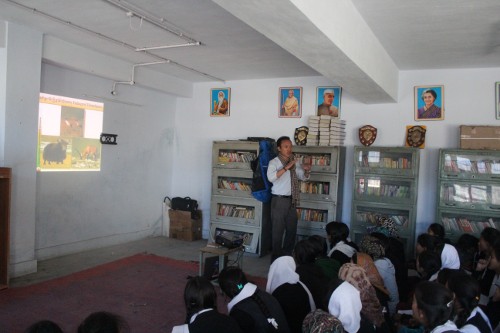
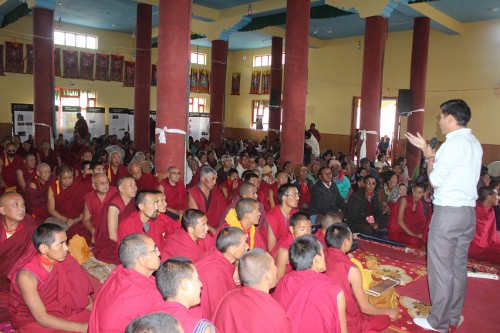
Jigmey Norbu and Zamlha Tempa Gyaltsen from the Environment desk visited a range of schools and monasteries in the valley. They talked about (I) General Environment problem and solutions, (II) Impact of Climate change on wild life and, (III) Impact of climate change on the landscape of Himalayan ranges and Tibetan Plateau.
The environment presentation began with a large public talk at Rangrik Manjushri Temple followed by more detailed talks at various schools such as (1) Munseling School in Rangrik (2) Jawahar Narvodaya Vidyalaya School in Kaza,(3) Govt.Sr Secondary School in Sangnam, (4) Govt.Sr Secondary School in Kaza (5) Serkong public school and Govt.Sr Secondary School in Tabo. A total of more than 1200 public and senior students attended the presentations, they showed great interest and appreciation for travelling all the way to remote Spiti valley to give a timely and highly relevant environment talk.
The Tibet Museum held an exhibition on the wave of self-immolation protests that has swept Tibet since 2009. Tsering Dolma from Tibet Museum also interacted with the local public, answering their queries about Tibet and the self-immolation protests.
Like other Himalayan regions, the Spiti valley has been experiencing a strong impact of climate change in recent decades with loss of snow cover and drying up of rivers, also huge influx of tourists in summer has left damaging environment footprints in the region. The two researchers talked about importance of forest cover and strongly asked both students and general public to plant more trees to counter the adverse impacts of climate change and at the same time to develop a greener Spiti valley.